- Plants
- ›Vascular Plants
- ›flowering plants
- ›Dicots
- ›Legumes, Milkworts, and Allies
- ›Legumes
- ›Faboideae
- ›Loteae
- ›Hippocrepis
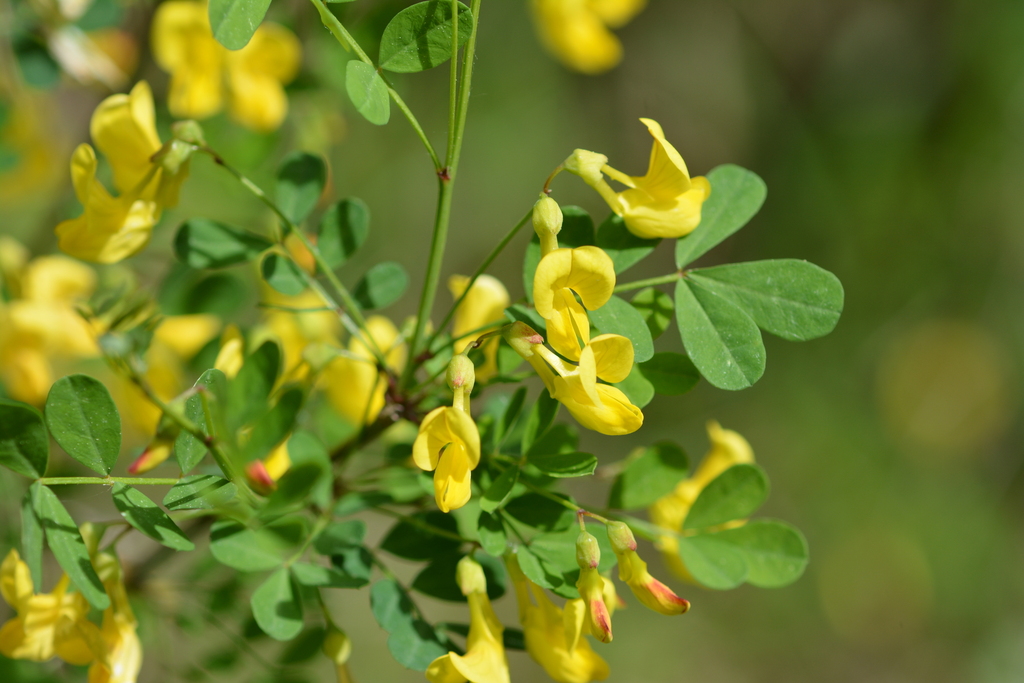
Scorpion Senna
Hippocrepis emerus
Hippocrepis emerus, the scorpion senna, is a species of perennial plant belonging to the genus Hippocrepis in the family Fabaceae.
From the article Hippocrepis emerus on Wikipedia (CC BY-SA), quoted section by section
Description
Hippocrepis emerus reaches on average 50–150 centimetres (20–59 in) of height, with a maximum of 200 centimetres (79 in). The plant has a lignified stem with green branches bearing five to nine leaflets. These leaves are glossy, obovate, and imparipinnate, with their maximum width being above the middle and often larger extremities. The pale yellow flowers are arranged in groups of 1 to 5, and measure 14–20 millimetres (0.55–0.79 in) long. The petals are "nailed", meaning they have a long handle ("nail") and a "plate". The nails of the petals are two to three times longer than the calyx. These plants are hermaphroditic and entomophilous, and their flowering period extends from April through July. Their legumes (seed pods) are oblong-cylindrical and 5–11 centimetres (2.0–4.3 in) long, with three to twelve segments.
Range & habitat
This plant occurs in northeastern Spain and in central Mediterranean countries up to northern Europe and to Asia Minor and Tunisia.
Wikipedia: “Distribution”
Where it lives
Recorded sightings
—
geo-referenced records in GBIF, from museums, herbaria and field observers.
Drag the globe to turn it. Dots are where records exist, not a range map; darker means more records.
In the stacks
Searching the stacks…
Every page naming Hippocrepis emerus in the Biodiversity Heritage Library →
This page is assembled live from iNaturalist, GBIF, Wikipedia, the Source Library and the Internet Archive. It is not yet part of the hand-edited codex. iNaturalist taxon 208964.