On eBird ↗
Small Buttonquail
Live sightings near you, the range map, bar charts of when it is seen, and Macaulay Library photos and recordings.
Common Buttonquail
Turnix sylvaticus
The common buttonquail, Kurrichane buttonquail, small buttonquail, or Andalusian hemipode (Turnix sylvaticus) is a buttonquail, one of a small family of birds which resemble, but are unrelated to, the true quails. This species is resident from southern Spain and Africa through India and tropical Asia to Indonesia.
From the article Common buttonquail on Wikipedia (CC BY-SA), quoted section by section
Description
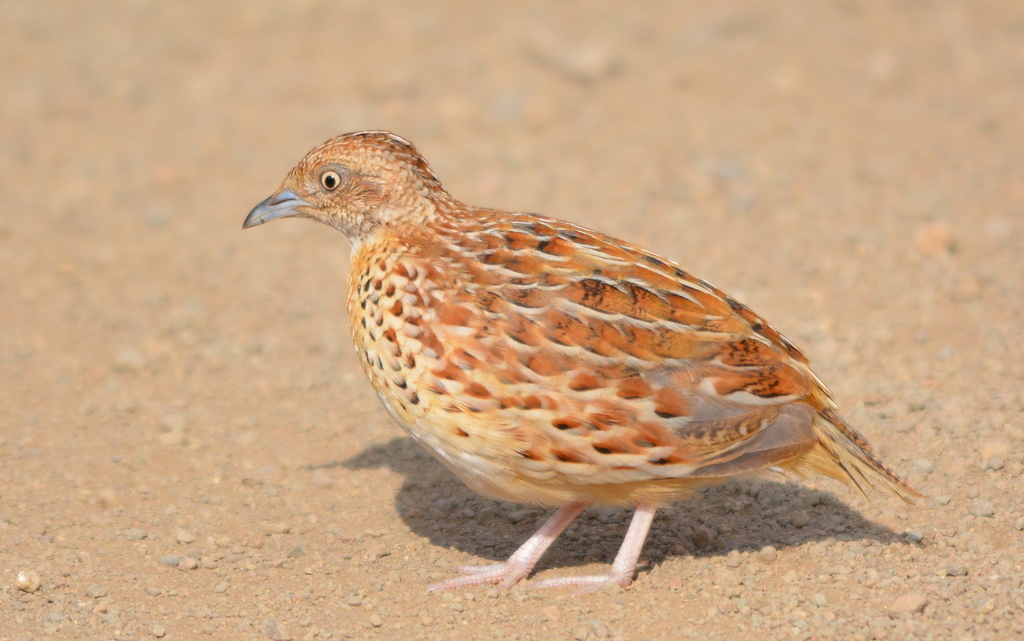
The common buttonquail resembles the common quail. It has streaked sandy brown upperparts, buff underparts with black flank markings, and a plain face. In flight, a whitish wingbar contrasts with the grey wing. Sexes are similar, but immature birds are more spotted below. This tiny buttonquail is notoriously difficult to see. It is a small, 15 cm (5.9 in) long drab running bird, which avoids flying.
Range & habitat
This species is resident from southern Spain and Africa through India and tropical Asia to Indonesia. It inhabits warm grasslands or scrub jungle and feeds on insects and seeds. This species avoids thick forest and hilly country, and lives by preference in cornfields and stretches of grassy plain though it may also be found in any type of low herbage and open scrub jungle.
Wikipedia: “Distribution and habitat”
What it does
It skulks and is flushed with difficulty, rising often close by one's feet. When flushed it flies low over the ground and soon settles again, after which it is very difficult to put up a second time. The female calls with a deep hoom-hoom-hoom and the male replies kek-kek-kek.
Breeding. The female initiates courtship and builds the ground nest. The male incubates the normally four speckled greyish eggs, and tends the young, which can run as soon as they are hatched. The nesting season is June to September. The nest is a slight pad of grass placed in a natural hollow in the ground where it is usually tucked away amongst the stems of a tuft of grass. Very occasionally the grass is bent over it in a sort of canopy.
Wikipedia: “Behaviour”
Listen
Looking for field recordings…
Where it lives
Recorded sightings
—
geo-referenced records in GBIF, from museums, herbaria and field observers.
Drag the globe to turn it. Dots are where records exist, not a range map; darker means more records.
In the stacks
Searching the stacks…
Every page naming Turnix sylvaticus in the Biodiversity Heritage Library →
This page is assembled live from iNaturalist, GBIF, Wikipedia, the Source Library and the Internet Archive. It is not yet part of the hand-edited codex. iNaturalist taxon 20887.