On eBird ↗
Chaco Chachalaca
Live sightings near you, the range map, bar charts of when it is seen, and Macaulay Library photos and recordings.
Chaco Chachalaca
Ortalis canicollis
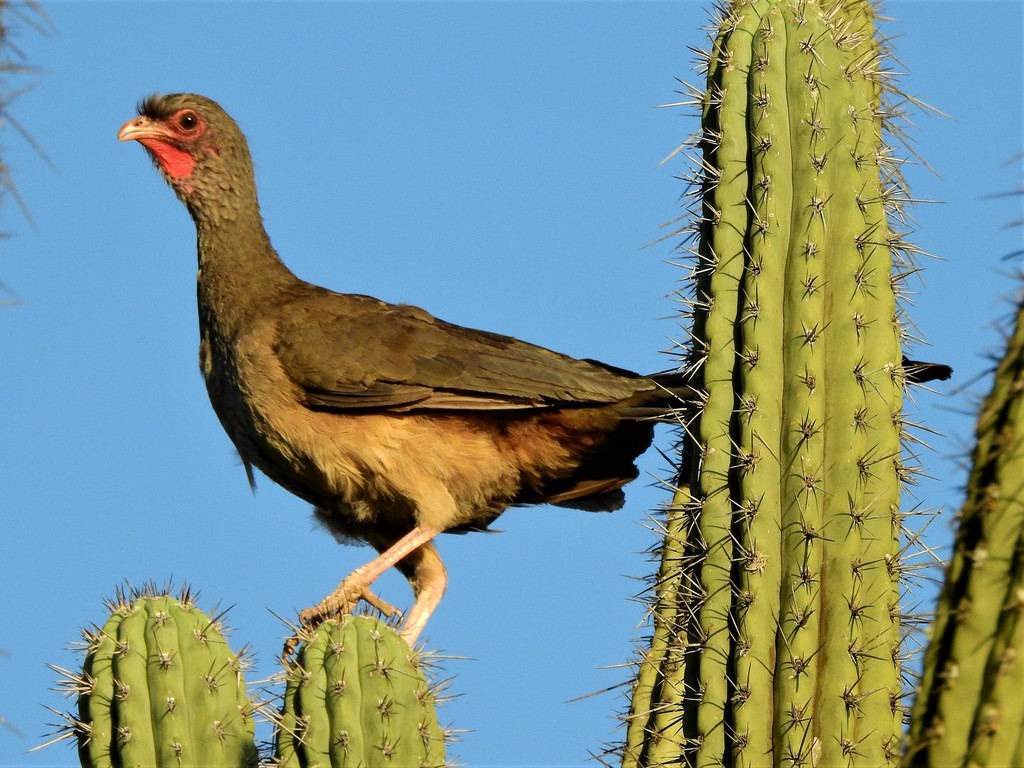
The Chaco chachalaca (Ortalis canicollis) is a species of bird in the Cracidae family. It is found in Argentina, Bolivia, Brazil, Paraguay, and Uruguay. Its natural habitats are subtropical or tropical dry forests and subtropical or tropical moist lowland forests.
From the article Chaco chachalaca on Wikipedia (CC BY-SA), quoted section by section
Description
The Chaco chachalaca is 50 to 56 cm (1.6 to 1.8 ft) long and weighs 479 to 678 g (1.1 to 1.5 lb). The nominate subspecies' head, back, and breast are gray and the belly tan to brown. It has bare pinkish red skin around the eye. O. c. pantanalensis is browner and the facial skin is more purplish than pinkish.
Range & habitat
The nominate subspecies of Chaco chachalaca is found in the Gran Chaco of eastern Bolivia, western Paraguay, and northern Argentina. O. c. pantanalensis is found in southwestern Mato Grosso and Mato Grosso do Sul of Brazil. There are also unconfirmed reports of it in neighboring Bolivia and Paraguay. The South American Classification Committee of the American Ornithological Society considers the species to be hypothetical in Uruguay. The Chaco chachalaca inhabits a variety of landscapes including lowland swamp forest and scrub, dry subtropical forest, semi-deciduous and gallery forest, and palm groves. It can be found in both mature and secondary forest. In Brazil and Paraguay it is found only at low elevations but can be found as high as about 1,000 m (3,300 ft) in Argentina.
Wikipedia: “Distribution and habitat”
What it does
In forest landscapes, the Chaco chachalaca usually forages in small groups though as many as 30 have been observed. It usually feeds in the crown of trees but in areas with little undergrowth will also feed on the ground. In Argentina groups of up to 150 have been observed feeding in agricultural land far from cover. Its diet is primarily fruits and leaves year round and it adds invertebrates, especially caterpillars, when they are seasonally abundant.
Wikipedia: “Feeding”
Listen
Looking for field recordings…
Where it lives
Recorded sightings
—
geo-referenced records in GBIF, from museums, herbaria and field observers.
Drag the globe to turn it. Dots are where records exist, not a range map; darker means more records.
In the stacks
Searching the stacks…
Every page naming Ortalis canicollis in the Biodiversity Heritage Library →
This page is assembled live from iNaturalist, GBIF, Wikipedia, the Source Library and the Internet Archive. It is not yet part of the hand-edited codex. iNaturalist taxon 2088.