On eBird ↗
Eared Quetzal
Live sightings near you, the range map, bar charts of when it is seen, and Macaulay Library photos and recordings.
Eared Quetzal
Euptilotis neoxenus
The eared quetzal (Euptilotis neoxenus), also known as the eared trogon, is a near passerine bird in the trogon family, Trogonidae. It breeds in streamside pine-oak forests and canyons in the Sierra Madre Occidental of Mexico south to western Michoacán. It is sometimes seen as a vagrant to southeasternmost Arizona in the United States and has bred there. This range includes part of the Madrean Sky Islands region of southeastern Arizona, southwestern New Mexico, and northern...
From the article Eared quetzal on Wikipedia (CC BY-SA), quoted section by section
Description
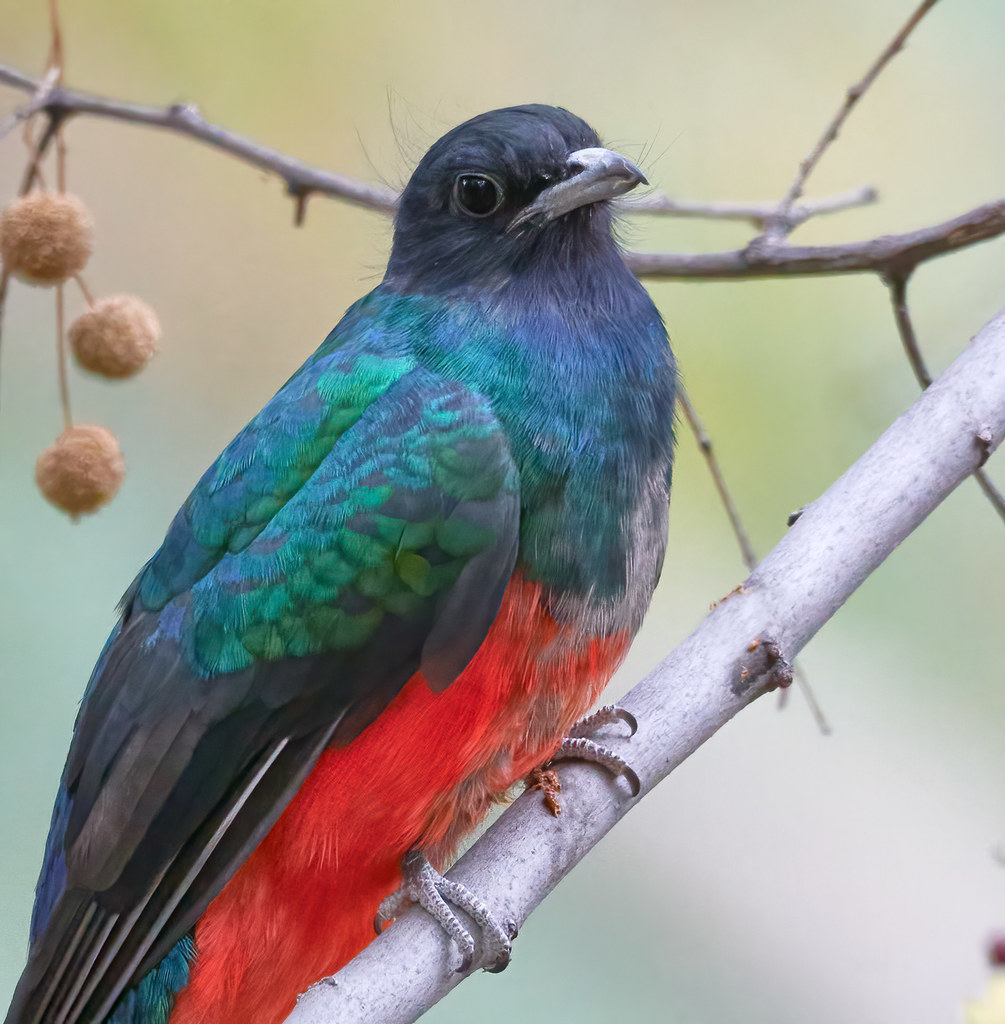
Its body length is 33–36 cm (13–14 in). Both sexes have iridescent green backs, iridescent dark blue central tail feathers, and outer tail feathers that are predominantly white terminally with a band of black at the base (sometimes partially barred black and white in females). The bill is dull gray with a slightly darker band at the tip. The adult male has a blackish head, iridescent green breast, and geranium red belly and undertail coverts. The adult female has a gray head, breast, and upper belly and less extensive (though equally bright) red on the lower belly. Both sexes bear the wispy hair-like auricular plumes that give the species its name, though these are rarely apparent in the field. Both head and bill appear rather small and narrow in comparison to those of typical trogons. The male's song (tremolo call) is a series of whistled notes increasing in volume. Calls include low-intensity squeals rising in pitch, a loud squeal ending with a sharp "chuck", and a strident cackle given mostly in flight.
Quetzals differ from typical New World trogons in having iridescent wing coverts, less extensive fusion between the two forward-facing toes of their heterodactyl foot, broad tails with distinctly convex (rather than straight or concave) sides, and eggs with pale blue shells. …
Range & habitat
It is a resident of the middle to upper levels of pine-oak woodlands and oak-conifer forests, frequently along streams.
Wikipedia: “Distribution and habitat”
What it does
Eared quetzals feed on insects, small vertebrates, and fruit, including the warty red fruit of madrone trees. Caterpillars, moths, katydids, cicadas, small lizards, and other prey are fed to the young. Like other trogons, eared quetzals often pluck prey and fruit while hovering. Members of this species have been observed to exhibit aversion to large areas of conspicuous color on and near human observers (negative chromotropic responses), including white, red, orange, and blue. This suggests that the species-confidence hypothesis, which states that birds tend to be attracted to colors that match those found in their species and repelled by colors not found in their species, does not apply to eared quetzals.
Wikipedia: “Food and feeding”
Listen
Looking for field recordings…
Where it lives
Recorded sightings
—
geo-referenced records in GBIF, from museums, herbaria and field observers.
Drag the globe to turn it. Dots are where records exist, not a range map; darker means more records.
In the stacks
Searching the stacks…
Every page naming Euptilotis neoxenus in the Biodiversity Heritage Library →
This page is assembled live from iNaturalist, GBIF, Wikipedia, the Source Library and the Internet Archive. It is not yet part of the hand-edited codex. iNaturalist taxon 20861.