On eBird ↗
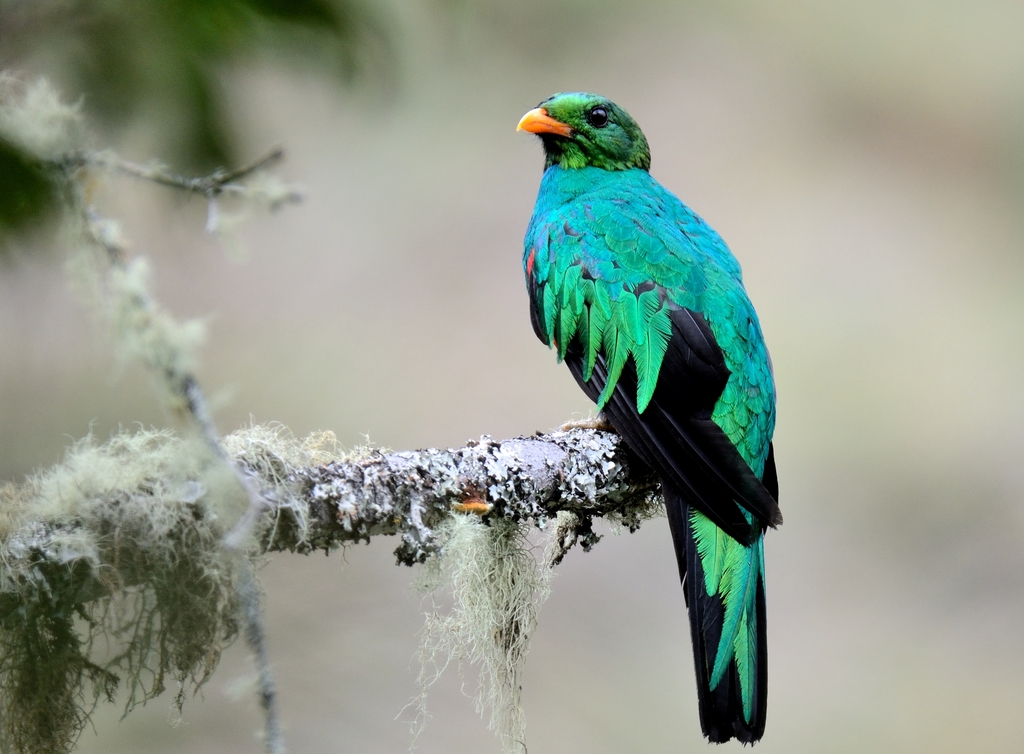
Golden-headed Quetzal
Live sightings near you, the range map, bar charts of when it is seen, and Macaulay Library photos and recordings.
Golden-headed Quetzal
Pharomachrus auriceps
The golden-headed quetzal or corequenque (Pharomachrus auriceps) is a strikingly coloured bird in the genus Pharomachrus. It is found in moist mid-elevation forests from eastern Panama to northern Bolivia.
The golden-headed quetzal is known for its iridescent green colour, which it shares with other quetzals, and its distinctive golden head. The female of the species is less brightly coloured, displaying more brown tones than the male. The golden-headed quetzal's diet consists mainly of fruit, and occasionally insects. It is generally a solitary and quiet bird unless it is breeding season, when the male and female become a monogamous pair and create a cavity nest in an old tree. During breeding season both sexes share brooding and feeding duties for 25–30 days until the chick is ready to fledge. The golden-headed quetzal is fairly common and considered a species of least concern.
From the article Golden-headed quetzal on Wikipedia (CC BY-SA), quoted section by section
Description
The golden-headed quetzal weighs between 154–182g. It has a wingspan of 30–36 cm and a length of 33–36 cm with tail plumes adding another 8–10 cm. Like other members of the genus Pharomachrus, the golden-headed quetzal is known for its iridescent golden-green wings and breast, which can appear blue depending on the light. The female's breast is a duller brownish colour; her head is also a duller golden-brown when compared to the male's gold-bronze head, from which the species name is derived. Their bills are short and broad; they appear yellow in males and a brownish greyish in females. The quetzal's uppertail coverts are darker green and extend beyond the tip of the tail, more so in the male than in the female. Both the male and the female have a black undertail, though the female sometimes displays greyish-black tips. The feathers on the lower breast of both sexes are a brilliant red colour. Both sexes, like other trogons, also have heterodactyl feet, with the first and second toes facing backwards and the third and fourth toes facing forward. Their legs and feet are an olive green or a brownish colour. The young golden-headed quetzal is a brownish black colour with a few iridescent green feathers on the neck and breast, and lacking the tail coverts of the adult. The golden-headed male quetzal differs from other quetzals in its lack of a crest of head feathers. P. a. …
Range & habitat
Golden-headed quetzals inhabit areas of Central and South America. P. a. auriceps is found in eastern Panama (Cerro Pirre mountain) as well as in the Andes spanning from southern Colombia to eastern Peru and northern Bolivia. P. a. hargitti is only found in the Andes of Venezuela. Their natural habitat is most commonly humid and wet moderate-elevation montane and foothill forests although they have also been seen less frequently on the forest edge and in clearings as well as in temperate cloud forests and elfin forests. They reside at elevations ranging from 1200m to 3100m.
Wikipedia: “Habitat and distribution”
What it does
The golden-headed quetzal's diet consists mainly of fruit, though it has also been known to eat insects. Remsen et al. (1993) found that the stomach contents of P. auriceps were "fruit only" 87.5% of the time and "arthropods and fruit" 12.5% of the time. The quetzal's fruit-heavy diet makes it a very important species for the dispersal of the fruits' seeds. It is also thought that, like other quetzals, the golden-headed quetzal feeds on small vertebrates such as frogs and lizards. However, this has been brought into question by Lohnes and Greeney (2008) who found the diet of P. auriceps was much less varied since they never observed it feeding on any animal matter other than insects while observing the species for 22 days. Their observations also confirmed that the formerly accepted idea that quetzals did not feed their hatchlings fruit until ten days after hatching was untrue.
Wikipedia: “Diet”
Listen
Looking for field recordings…
Where it lives
Recorded sightings
—
geo-referenced records in GBIF, from museums, herbaria and field observers.
Drag the globe to turn it. Dots are where records exist, not a range map; darker means more records.
In the stacks
Searching the stacks…
Every page naming Pharomachrus auriceps in the Biodiversity Heritage Library →
This page is assembled live from iNaturalist, GBIF, Wikipedia, the Source Library and the Internet Archive. It is not yet part of the hand-edited codex. iNaturalist taxon 20853.