On eBird ↗
White-tipped Quetzal
Live sightings near you, the range map, bar charts of when it is seen, and Macaulay Library photos and recordings.
White-tipped Quetzal
Pharomachrus fulgidus
The white-tipped quetzal (Pharomachrus fulgidus) is a species of bird in the family Trogonidae found in Venezuela, Colombia, and Guyana. Two subspecies have been described. Pharomachrus fulgidus fulgidus is found in the mountains of northern Venezuela and Pharomachrus fulgidus festatus ranges through the Santa Marta mountains of northeast Colombia. Quetzals are iridescent and colourful birds found in forests, woodlands and humid highlands. The white-tipped quetzal has been a limited subject of research. Pharomachrus nests have been studied to analyse the effects of rainfall on breeding, however conclusions are based on single observations. On the IUCN Red list of threatened species, the white-tipped quetzal is listed as a species of least concern.
From the article White-tipped quetzal on Wikipedia (CC BY-SA), quoted section by section
Description
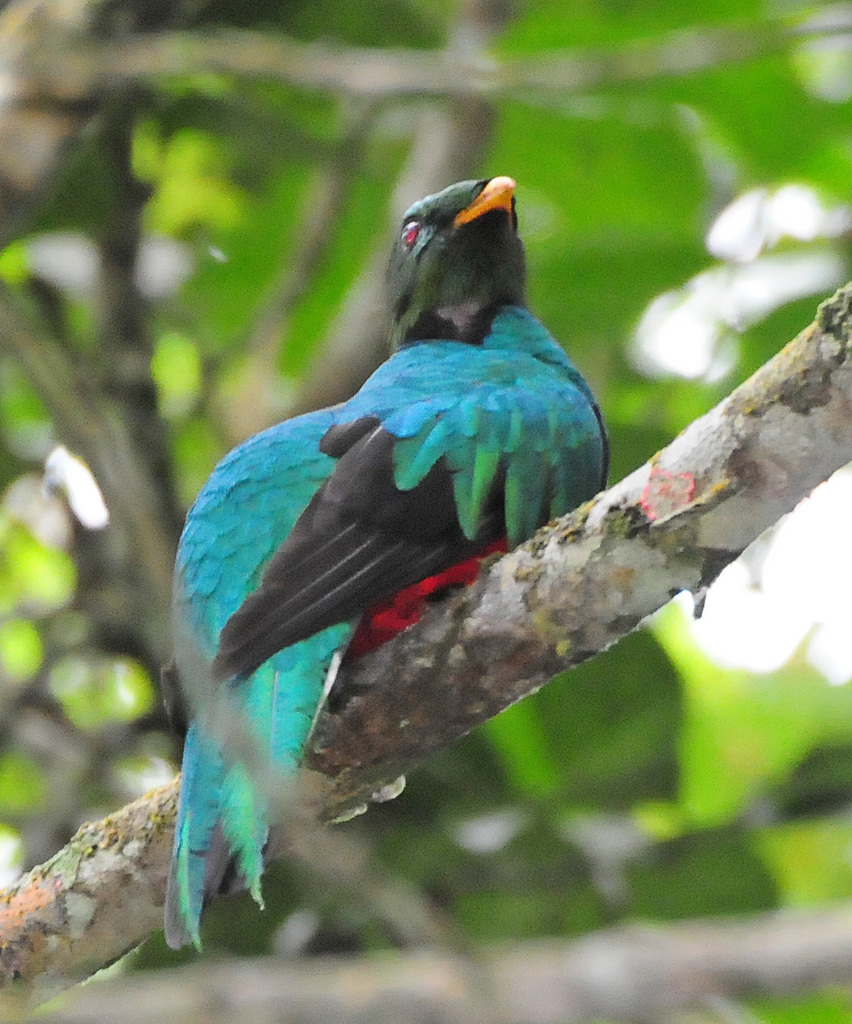
The adult male white-tipped quetzal is identified by a golden, green-bronze crown and nape with bright green breast, back, rump and upper tail-coverts. The male bill is butter yellow and feet are brownish-black. The under tail-coverts and belly are a striking red, wings and upper tail are black with the under tail appearing white, thus the 'white-tipped' descriptive name. These broad, white backed outer rectrices occupy about a third of their length. The male has elongated feathers on the forehead, creating a short crest. The white tips of outermost rectrix are 50 mm long, next 55mm, and next 32 mm long. Adult females are less iridescent, with no frontal crest and the throat, belly and breast appearing brown-grey bordered by a green band. The female bill and feet are yellowish-brown to grey and their three outermost rectrices are also narrowly tipped with white. In immature birds, both male and female chicks have remiges, scapulars and wing coverts intermixed with buff, outer rectrices infused with white and feathers more narrow and pointed than adults. Immature females have a brown breast. Trogons are the only birds with a heterodactyl toe arrangement.
Wikipedia: “Morphology”
Range & habitat
The white-tipped quetzal can be found in Colombia, Venezuela and Guyana and the species is endemic to the northern South America. In Colombia and Venezuela they appear in upper tropical and subtropical zones. The white-tipped quetzal occurs in a wide variety of habitats from subtropical to temperate forests, cloud forests, secondary growth, forest edges, moist ravines and coffee plantations. Like the golden-headed and crested quetzals, they are cloud forest birds. They are rarer in Guyana, however they have been seen inhabiting the most dense areas in the barrancas (deep ravines) of forests. Due to the lack of observations on the white-tipped quetzal, it is unknown why they favour these environments, however it is likely due to the temperate, humid conditions, the availability of berries and the ability to find small crevices in these areas to nest in.
Wikipedia: “Habitat”
What it does
Breeding predominantly occurs towards the end of the dry season, between January and April. It is thought that the quetzal's reproductive cycle is directly correlated with fruit availability. Reproductive activities including courtship, nesting and chick rearing occur when fruits are most abundant in the forest conditions. This aids the species during energy-demanding phases of their life which may increase the probability of successful reproduction. White-tipped quetzal nests are usually located in isolated, non-native trees, sometimes in previous holes of woodpeckers and often in dead tree trunks 4–10m above the ground. Nests have been observed in an old cavity, excavated by a Woodpecker, in a dead snag, approximately 5 m above the ground at an elevation of 1600 m. They can also nest in termite nests, laying 2–4 white or pastel-coloured eggs and there were subtle differences in egg color and size. First breeding is usually at one to two years of age. The altricial young hatch naked, quickly molting into their immature plumage without a significant downy stage. This fast, naked-to-feathered progression may be an ancestral characteristic or a result of nesting in cavities where the temperature is constant and down is not needed for temperature regulation. …
Wikipedia: “Ecology”
Listen
Looking for field recordings…
Where it lives
Recorded sightings
—
geo-referenced records in GBIF, from museums, herbaria and field observers.
Drag the globe to turn it. Dots are where records exist, not a range map; darker means more records.
In the stacks
Searching the stacks…
Every page naming Pharomachrus fulgidus in the Biodiversity Heritage Library →
This page is assembled live from iNaturalist, GBIF, Wikipedia, the Source Library and the Internet Archive. It is not yet part of the hand-edited codex. iNaturalist taxon 20849.