On eBird ↗
Rufous-vented Chachalaca
Live sightings near you, the range map, bar charts of when it is seen, and Macaulay Library photos and recordings.
Rufous-vented Chachalaca
Ortalis ruficauda
The rufous-vented chachalaca (Ortalis ruficauda) is a member of an ancient group of birds of the family Cracidae, which are related to the Australasian mound builders. It inhabits northeast Colombia and northern Venezuela where it is called guacharaca, and the island of Tobago in Trinidad and Tobago where it is known as the cocrico and is one of the country's two national birds (being featured on the country's coat of arms). It is also found on Bequia and Union Island in the Grenadines where it may have been introduced.
From the article Rufous-vented chachalaca on Wikipedia (CC BY-SA), quoted section by section
Description
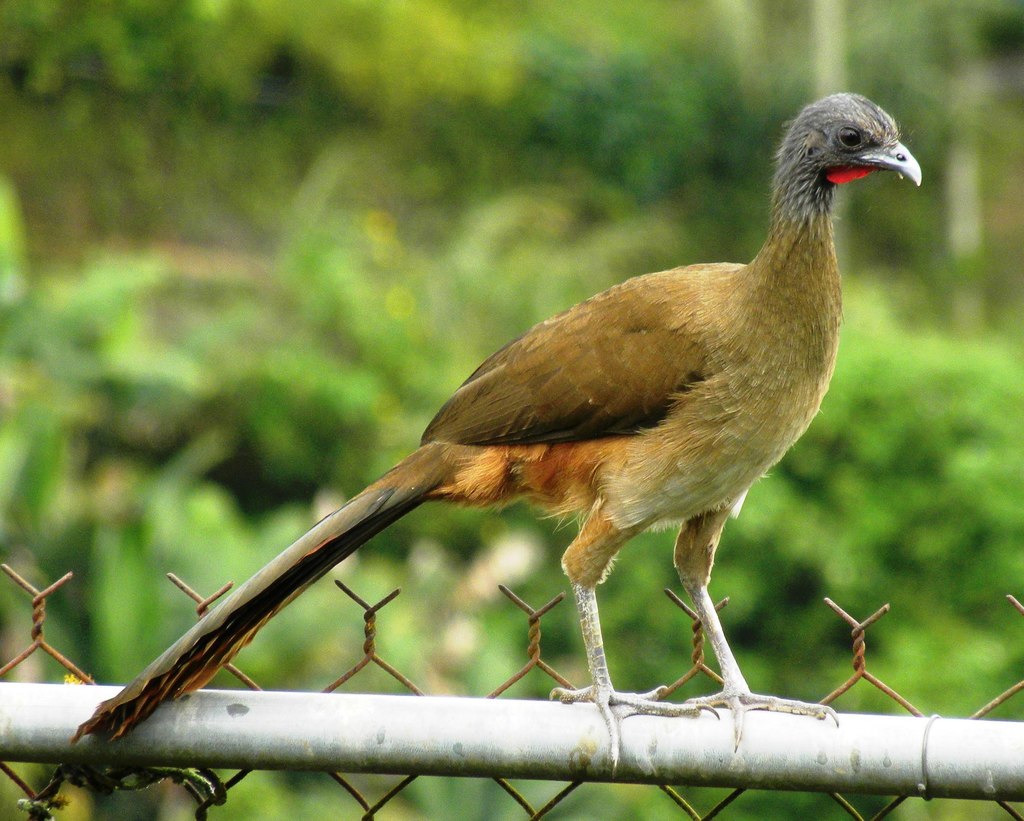
These are medium-sized birds, similar in general appearance to turkeys, with small heads, long strong legs and a long broad tail. They are typically 53–58 cm long; the female weighs 540g and the larger male 640g. They have fairly dull plumage, dark brown above and paler below. The head is grey, and the brown tail is tipped rufous or white depending on race.
Range & habitat
The rufous-vented chachalaca is a largely arboreal species found in forest and woodland, but it is also found in more open dry scrubby areas. This combined with relatively low hunting pressure, make it far less vulnerable than larger members of the family, notably curassows.
Wikipedia: “Habitat”
What it does
The species is a social bird, often seen in family groups. It walks along branches seeking the fruit (such as mangoes, berries and those from the Euterpe palm), leaves and seeds on which it feeds. It is an able flyer that can even take off and fly vertically, but does not usually fly long distances. The twig nest is built low in a tree, and three or four large white eggs are laid. The female incubates them alone.
Wikipedia: “Breeding and behaviour”
Listen
Looking for field recordings…
Where it lives
Recorded sightings
—
geo-referenced records in GBIF, from museums, herbaria and field observers.
Drag the globe to turn it. Dots are where records exist, not a range map; darker means more records.
In the stacks
Searching the stacks…
Every page naming Ortalis ruficauda in the Biodiversity Heritage Library →
This page is assembled live from iNaturalist, GBIF, Wikipedia, the Source Library and the Internet Archive. It is not yet part of the hand-edited codex. iNaturalist taxon 2084.