On eBird ↗
Malabar Trogon
Live sightings near you, the range map, bar charts of when it is seen, and Macaulay Library photos and recordings.
Malabar Trogon
Harpactes fasciatus
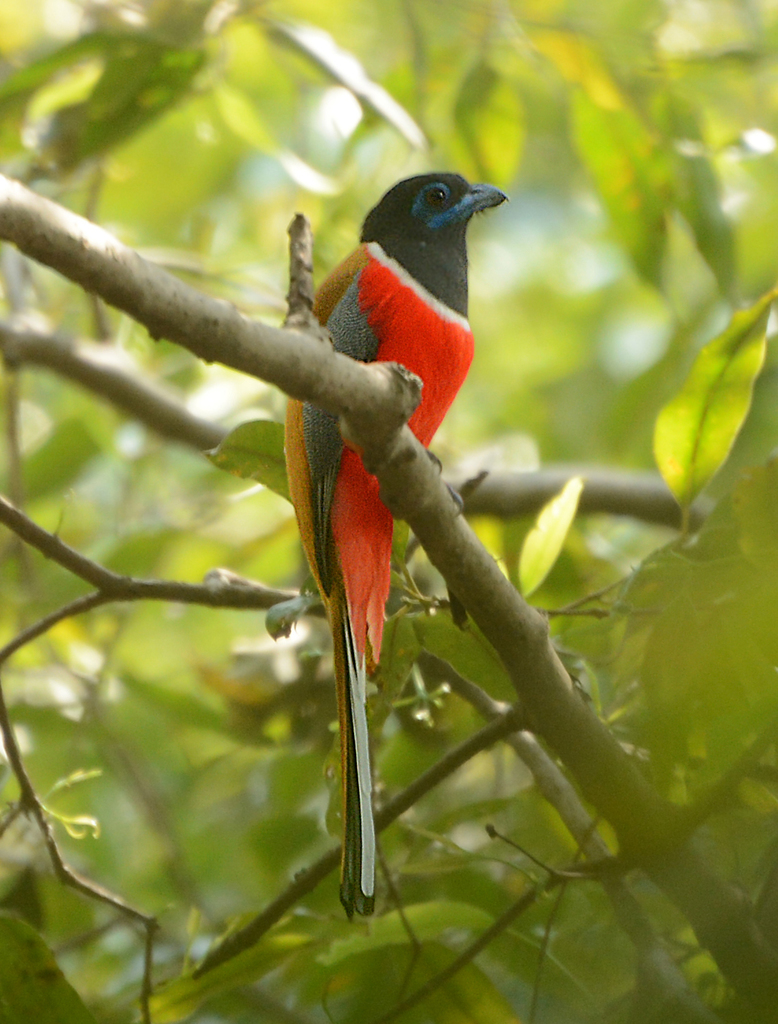
The Malabar trogon (Harpactes fasciatus) is a species of bird in the trogon family. It is found in the forests of India and Sri Lanka. In India, it is mainly found in the Western Ghats, hill forests of central India and in parts of the Eastern Ghats. They are insectivorous and although not migratory, may move seasonally in response to rain in hill forest regions. Like in other trogons, males and females vary in plumage. The birds utter low, guttural calls that can be heard only at close quarters, and perch still on a branch under the forest canopy, often facing away from the viewer, making them easy to miss despite their colourful plumage.
From the article Malabar trogon on Wikipedia (CC BY-SA), quoted section by section
Description
Like most other trogons, these birds are brightly coloured and sexually dimorphic. The male has a slaty-black head and breast, with a white border on the black bib separating it from the crimson on the underside. The back is olive-brown to chestnut. The wing coverts are black with fine white vermiculations. They have 12 tail feathers that are graduated. The central tail-feathers are chestnut with a black tip, with the second and third pairs from the middle having more black than chestnut. The outer three pairs have long white tips. The female lacks the contrasting black and crimson, and has only a slightly darker head and breast that shades into the olive-brown on the back, while the crimson of the underside of the male is replaced by ochre. In both sexes, the beak is bluish, as is the skin around the eye. The iris is dark brown and the feet are pale blue. The nostrils are covered by tufts of filoplumes. The feet are heterodactyl, a feature unique to the trogons, with the digits I and II facing back and digits III and IV pointing forward. In most birds, I, II, and III face forward, while IV faces back. In zygodactyly, II and III face forward, while I and IV face backwards. Several populations have been named. …
What it does
These birds usually perch still, especially when alarmed and will sometimes clinging laterally to branches. When calling they sometimes raise and lower their tail. The call is a series of guttural or purring notes. The song of the male is a series of percussive kyau calls. The breeding season in India is mainly February to May (before the Monsoons), while it is March to June in Sri Lanka.
When they sit still, they appear hunched. The Hindi name used by hunters is kafni churi and refers to the hunched neckless appearance as if dressed in a fakir's kafni (robe). The Marathi name is karna while it is called kakarne hakki in Kannada. In Kerala it is known as theekakka (literally "fire-crow"). In Sri Lanka, it is known as loha wannichcha in the Sinhala language. Malabar trogons feed exclusively on insects and fruits have not been noted in their diet, unlike in the New World trogons. Seeds have however been reported in the diet of Sri Lankan specimens. In the forests of Sri Lanka, they are often found in mixed-species foraging flocks where they may sometimes be subject to kleptoparasitism by drongos. A study in Kerala found that they foraged mainly at 5 to 10 m with females tending to forage lower within the canopy. When foraging on bark, they propped themselves using their tail like woodpeckers, especially on decaying tree stumps. …
Wikipedia: “Behaviour and ecology”
Listen
Looking for field recordings…
Where it lives
Recorded sightings
—
geo-referenced records in GBIF, from museums, herbaria and field observers.
Drag the globe to turn it. Dots are where records exist, not a range map; darker means more records.
In the stacks
Searching the stacks…
Every page naming Harpactes fasciatus in the Biodiversity Heritage Library →
This page is assembled live from iNaturalist, GBIF, Wikipedia, the Source Library and the Internet Archive. It is not yet part of the hand-edited codex. iNaturalist taxon 20800.