On eBird ↗
Green-backed Trogon
Live sightings near you, the range map, bar charts of when it is seen, and Macaulay Library photos and recordings.
Green-backed Trogon
Trogon viridis
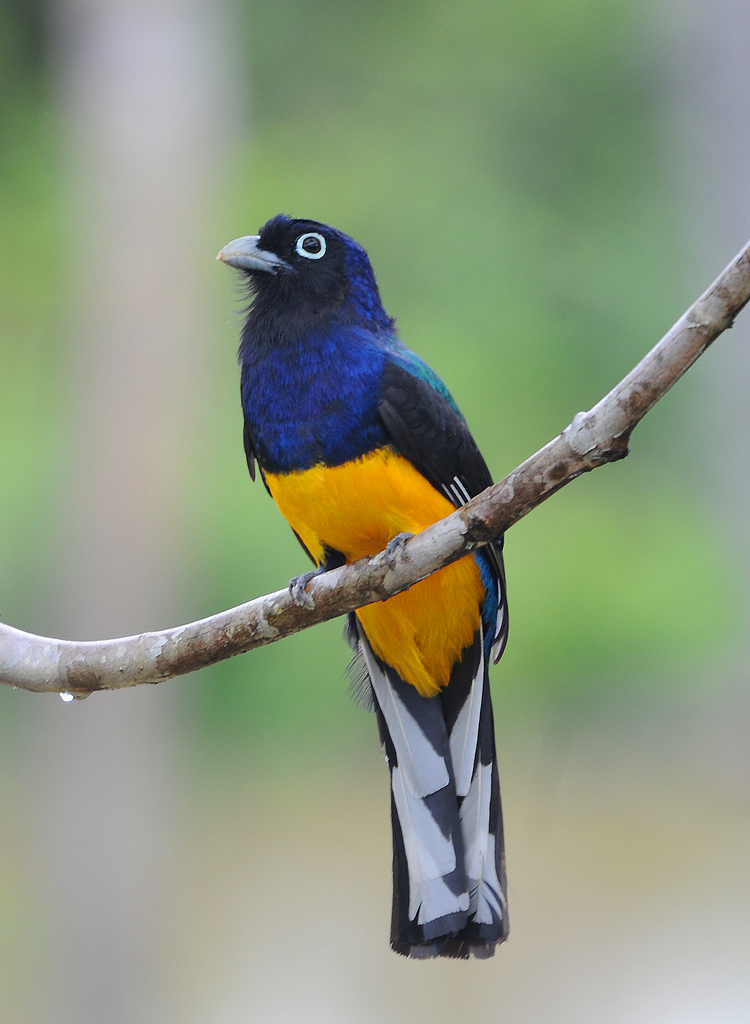
The green-backed trogon (Trogon viridis), also known as the Amazonian white-tailed trogon, is a bird in the trogon family Trogonidae. It is widely distributed across the Amazon rainforest with a disjunct population on the southeast coast of Brazil. As with all trogons, this species is sexually dimorphic. The male has a yellow belly without a white breastband, a blue head with a pale-blue orbital eye-ring, a blue bill, a green back and a green tail that is mostly white below. The female is duller with a dark grey head, a dark grey back and some black barring beneath the tail.
From the article Green-backed trogon on Wikipedia (CC BY-SA), quoted section by section
Description
This relatively large trogon is 28 to 30 centimetres (11 to 12 in) long. As most trogons, it is strongly sexually dimorphic. In the male the head and upper breast are dark blue (appears blackish in poor light), and the back is green. The lower underparts are orange yellow. The wings are black, vermiculated with white. The undertail is black and white: Each feather has a broad black base and a broad white tip and outer edge. The complete eye-ring is pale bluish. The female green-backed trogon resembles the male, but has a grey back, head and breast, and distinct black-and-white barring mainly to the outer webs of each tail feather. For comparison, the similar but smaller violaceous trogon has a yellow (male) or incomplete white eye-ring (female), and the male also has barring to the undertail. There is no overlap in the distribution of the green-backed and white-tailed trogons, but the two can be separated by the undertail pattern: Unlike the green-backed trogon, the male white-tailed trogon only has a very narrow black base to each feather (the undertail appears almost entirely white), and the female mainly has black-and-white barring to the inner webs of each feather (can be difficult to see). …
Range & habitat
It is found in tropical humid forests in South America, where its range includes the Amazon, the Guiana Shield, Trinidad, and the Atlantic Forest in eastern Brazil. It is a resident of humid tropical forests, and is typically the commonest trogon in its range.
Wikipedia: “Distribution and habitat”
What it does
They typically perch upright and motionless. Although their flight is fast, they are reluctant to fly any distance. Their broad bills and weak legs reflect their diet and arboreal habits. Green-backed trogons feed mainly on small fruit, supplemented by arthropods and lizards – slightly more so in the dry season when fruit are scarce, but even then they seem to be among the most frugivorous trogons in their range. They are consequently more rarely seen to attend mixed-species feeding flocks than other trogons. It nests in a termite nest or a hole in a rotten tree. The nest is usually if not always built by the female which excavates an upward-sloping tunnel ending in a breeding chamber. The nesting season is apparently mainly during the summer months (June–August). The clutch is typically two or three white eggs. These are incubated for 16–17 days, with a further two weeks to fledging.
Wikipedia: “Behavior and ecology”
Listen
Looking for field recordings…
Where it lives
Recorded sightings
—
geo-referenced records in GBIF, from museums, herbaria and field observers.
Drag the globe to turn it. Dots are where records exist, not a range map; darker means more records.
In the stacks
Searching the stacks…
Every page naming Trogon viridis in the Biodiversity Heritage Library →
This page is assembled live from iNaturalist, GBIF, Wikipedia, the Source Library and the Internet Archive. It is not yet part of the hand-edited codex. iNaturalist taxon 20773.