- Animals
- ›Arthropods
- ›Hexapods
- ›Insects
- ›Winged and Once-winged Insects
- ›Butterflies and Moths
- ›Butterflies
- ›Skippers
- ›Spread-wing Skippers
- ›Checkered-Skippers, White-Skippers, and Allies
- ›Pyrgus
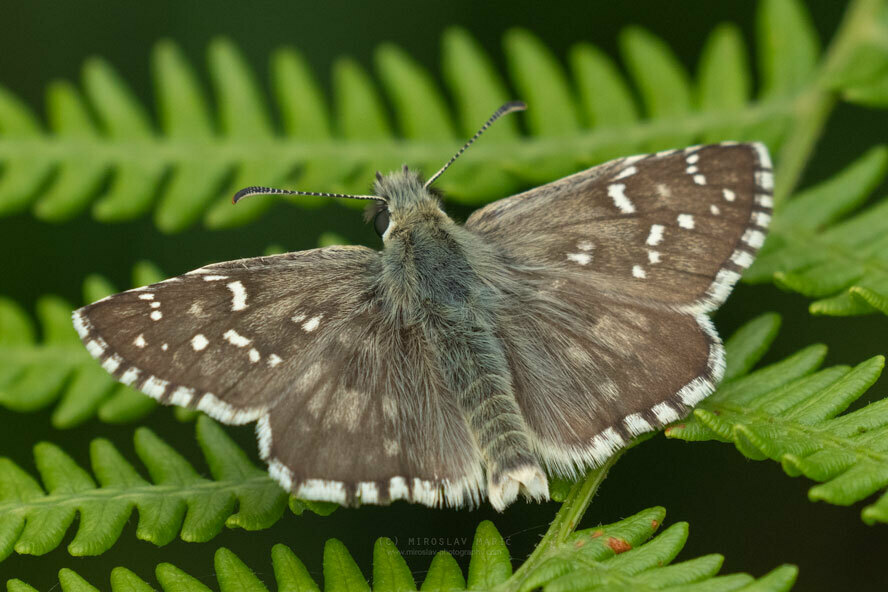
Large Grizzled Skipper
Pyrgus alveus
The large grizzled skipper (Pyrgus alveus) is a species of skipper butterfly (family Hesperiidae). It is distributed throughout most of continental Europe but is absent from Denmark and practically all European islands including Great Britain, Ireland, Azores, Balearic Islands, Channel Islands, Canary Islands, Crete, Cyprus, Iceland, etc.
From the article Large grizzled skipper on Wikipedia (CC BY-SA), quoted section by section
Description
This is a rather variable species with a wingspan of 22–32 mm (not always particularly "large") with several subspecies having been described. As with most Pyrgus species it has dark brown wings with pale chequered margins and is rather difficult to identify specifically in the field but good views reveal clear, well-spaced white spotting on the forewing and much fainter markings on the hindwings. The species complex of Pyrgus alveus agg. has not yet been adequately researched from a taxonomic point of view. In particular, the separation and evaluation of the taxa Pyrgus alveus, Pyrgus trebevicensis and Pyrgus accretus is considered to be extremely problematic. Therefore, in many cases, the reports can neither be clearly assigned nor is a taxonomic separation based on biological differences within the complex confirmed. Many authors consequently regard Pyrgus trebevicensis and Pyrgus accretus as synonyms, subspecies or ecological forms of Pyrgus alveus. Because of the hitherto unsolved problems with regard to taxonomy and identification, the complex Pyrgus alveus / Pyrgus trebevicensis is referred to below as Pyrgus alveus agg.
Pyrgus alveus agg. is similar to Pyrgus warrenensis and Pyrgus armoricanus. These two species already show macromorphological differences to Pyrgus alveus / Pyrgus trebevicensis, in particular the latter are on average larger. …
Range & habitat
The species complex Pyrgus alveus agg. is distributed from northwest Africa over the mountains of the Iberian Peninsula and southern Europe (Apennines and Balkan Peninsula) as well as across western, central (to the southern North German Plain) and Eastern Europe to Transbaikalia. In Northern Europe only the southern part of Fennoscandia is populated. In the southeast the area extends over Anatolia to the Caucasus. It is absent from Denmark and practically all European islands including Great Britain, Ireland, Azores, Balearic Islands, Channel Islands, Canary Islands, Crete, Cyprus, Iceland, etc.
Wikipedia: “Range”
What it does
The phenology of Pyrgus alveus agg. covers a period of four months in Bavaria. This applies to both the alpine and extra-alpine regions of Bavaria and corresponds to an only slightly shorter period of time, as is also known from the Swabian Alb in Baden-Württemberg. The flight period starts in mid-May and ends in mid-September. Despite the long period in which imagos can be observed, according to the current state of knowledge, Pyrgus alveus agg. only forms one generation per year in central Europe. The long development time of the caterpillars also speaks against a second annual generation. The flight times vary due to the wide range of elevations in the Alps. The altitude distribution extends from the colline level at almost 300 m in the Grabfeldgau and the Haßberge in northwest Bavaria to the alpine zone at 2100 m in the Allgäu high Alps. The focus of the records is between 350 m and 500 m, which is mainly due to the extra-alpine occurrences in the Franconian Alb. The occurrences in the Alps spread over a wide area of almost 700–2100 m, a less pronounced focus concerns the altitude between 1000 m and 1400 m. Oviposition of Pyrgus alveus agg. has been ovserved on Potentilla verna agg. and Helianthemum nummularium in Bavaria. Here caterpillars were only found on Potentilla verna agg. …
Wikipedia: “Ecology”
Listen
Looking for field recordings…
Where it lives
Recorded sightings
—
geo-referenced records in GBIF, from museums, herbaria and field observers.
Drag the globe to turn it. Dots are where records exist, not a range map; darker means more records.
In the stacks
Searching the stacks…
Every page naming Pyrgus alveus in the Biodiversity Heritage Library →
This page is assembled live from iNaturalist, GBIF, Wikipedia, the Source Library and the Internet Archive. It is not yet part of the hand-edited codex. iNaturalist taxon 207678.