On eBird ↗
Band-tailed Guan
Live sightings near you, the range map, bar charts of when it is seen, and Macaulay Library photos and recordings.
Band-tailed Guan
Penelope argyrotis
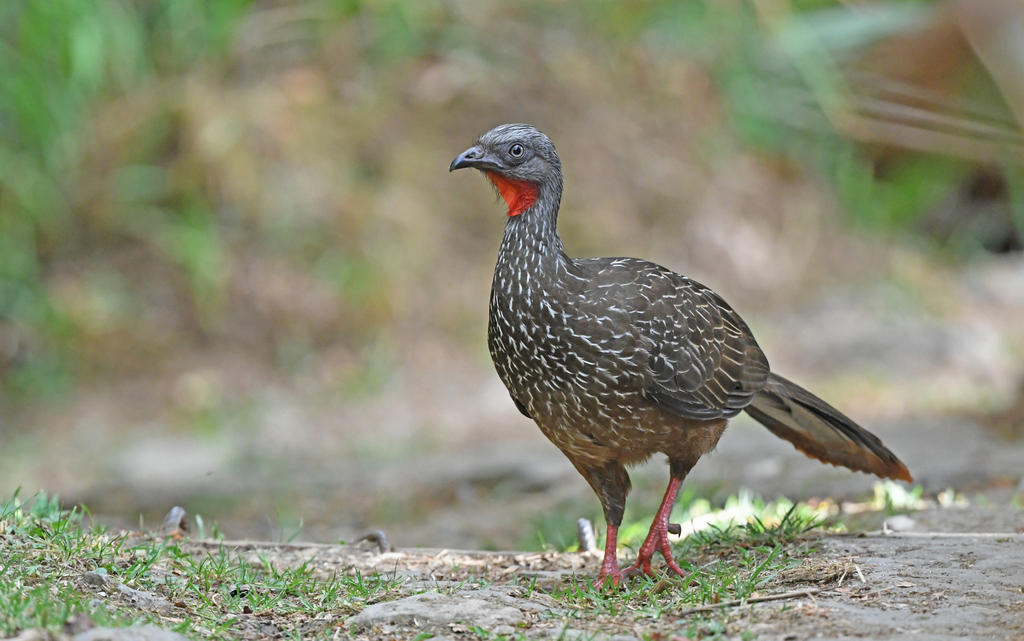
The band-tailed guan (Penelope argyrotis) is a species of bird in the Cracidae family, the chachalacas, guans, and curassows. It is found in Colombia and Venezuela. Its natural habitats are subtropical or tropical moist montane forests and heavily degraded former forest.
From the article Band-tailed guan on Wikipedia (CC BY-SA), quoted section by section
Description
The band-tailed guan is 50 to 61 cm (1.6 to 2.0 ft) long. Males weigh 686 to 981 g (1.5 to 2.2 lb) and females 625 to 900 g (1.4 to 2.0 lb). The nominate subspecies' upperparts are blackish-brown to dark rufous with conspicuous white streaks. Its breast is olive brown and belly is pale to medium brown. Its face is pale grey to white and it has a prominent red dewlap. It gets its name from the wide chestnut band across the end of the tail. P. a. albicauda differs from the nominate by having buffy tips on the tail feathers. P. a. colombiana has more white on the crown and less white on the face than the nominate.
Range & habitat
The nominate subspecies of band-tailed guan is found in the eastern Andes of Colombia and western Venezuela and also in the Venezuelan Coastal Range. P. a. albicauda is found in the Serranía del Perijá of northern Colombia and northwestern Venezuela. The nominate P. a. argyrotis is restricted to the Sierra Nevada de Santa Marta of northern Colombia. They mostly inhabit dense wet virgin forest, though they will sometimes be found in secondary forest, shade coffee plantations, and the upper reaches of drier forest. In the Sierra Nevada de Santa Marta they range in elevation from 550 to 2,000 m (1,800 to 6,560 ft) and in Venezuela usually from 800 to 2,400 m (2,600 to 7,900 ft), though locally much higher or lower.
Wikipedia: “Distribution and habitat”
What it does
The band-tailed guan usually forages in groups of up to six, but more may feed in a fruit-laden tree. It feeds on fruit, usually in the mid-story, but will eat fallen fruit on the ground.
Wikipedia: “Feeding”
Listen
Looking for field recordings…
Where it lives
Recorded sightings
—
geo-referenced records in GBIF, from museums, herbaria and field observers.
Drag the globe to turn it. Dots are where records exist, not a range map; darker means more records.
In the stacks
Searching the stacks…
Every page naming Penelope argyrotis in the Biodiversity Heritage Library →
This page is assembled live from iNaturalist, GBIF, Wikipedia, the Source Library and the Internet Archive. It is not yet part of the hand-edited codex. iNaturalist taxon 2072.