On eBird ↗
Crested Guan
Live sightings near you, the range map, bar charts of when it is seen, and Macaulay Library photos and recordings.
Crested Guan
Penelope purpurascens
The crested guan (Penelope purpurascens) is a member of an ancient group of birds of the Cracidae family, which are related to the Australasian mound builders. It is found in the Neotropics, in lowlands forests ranging from south Mexico and the Yucatán Peninsula to western Ecuador and southern Venezuela. The sexes are similar in appearance; the plumage is mainly dark brown with white spotting, an area of bare skin round the eye, bright red wattles, a...
From the article Crested guan on Wikipedia (CC BY-SA), quoted section by section
Description
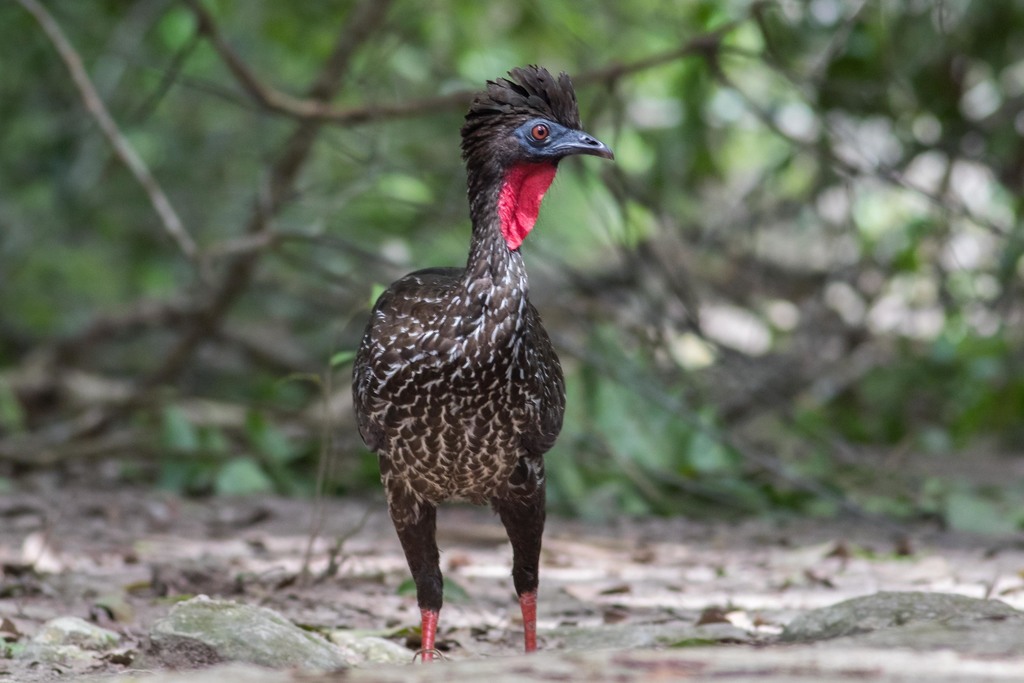
The crested guan is 76 to 91.5 cm (30 to 36 in) long and weighs about 1.6 to 2.4 kg (3.5 to 5.3 lb). Among standard measurements, its wing chord is 33 to 37 cm (13 to 15 in), its tail is 29 to 36 cm (11 to 14 in), and its tarsus is 6.5 to 8.6 cm (2.6 to 3.4 in). It is similar in general appearance to a turkey, with a small head, long strong legs, and a long broad tail. The sexes are similar. Adults of the nominate subspecies are mostly dusky olive brown and have a faint greenish or purplish iridescence. Their belly and crissum are chestnut and the breast and belly feathers have white edges. Their throat has some bristles and its loose skin dangles as a small red wattle. Juveniles resemble adults but overall mottled with blackish brown and with a rufous brown wash on the wing and tail feathers. Both sexes have a red iris, a blackish bill, slaty black bare skin on their face, and red legs and feet. Subspecies P. p. aequatorialis is similar to the nominate, but smaller and more rufescent. Subspecies P. p. brunnescens is more rufescent than the nominate but less so than aequatorialis.
Range & habitat
The nominate subspecies of the crested guan is the northernmost. It is found in Mexico from Sinaloa in the west and southern Tamaulipas in the east and south along the Pacific and Caribbean slopes through Belize and Guatemala into El Salvador and Honduras. Subspecies P. p. aequatorialis is found across much of Nicaragua and south through Costa Rica, Panama, western Colombia, and western Ecuador into far northwestern Peru. Subspecies P. p. brunnescens is found in the Serranía del Perijá where northeastern Colombia and northwestern Venezuela meet, east around Lake Maracaibo, and also in the Venezuelan Coastal Ranges intermittenly from Falcón to Delta Amacuro. The crested guan inhabits a variety of forested landscapes including tropical and subtropical evergreen and deciduous forest, cloudforest, gallery forest, and evergreen montane forest. Most are semi-humid to humid though it occurs locally in drier forest as well. In elevation it is found from sea level to 2,500 m (8,200 ft) in northern Central America, to 1,800 m (5,900 ft) in Costa Rica, to 1,500 m (4,900 ft) in Colombia and Ecuador, to 800 m (2,600 ft) in Peru, and to 1,100 m (3,600 ft) in Venezuela.
Wikipedia: “Distribution and habitat”
What it does
The crested guan is generally considered to feed on fruit, usually high in the canopy where it takes it directly from the tree, though it will feed at any level including on the ground. It is usually in pairs or loose flocks that quickly and agiley move from limb to limb by jumps and short flights. However, a study on Barro Colorado Island in Panama found that a high percentage of its diet there was young leaves, with insects also making a significant contribution.
Wikipedia: “Feeding”
Listen
Looking for field recordings…
Where it lives
Recorded sightings
—
geo-referenced records in GBIF, from museums, herbaria and field observers.
Drag the globe to turn it. Dots are where records exist, not a range map; darker means more records.
In the stacks
Searching the stacks…
Every page naming Penelope purpurascens in the Biodiversity Heritage Library →
This page is assembled live from iNaturalist, GBIF, Wikipedia, the Source Library and the Internet Archive. It is not yet part of the hand-edited codex. iNaturalist taxon 2062.