 NL·0726
Herbarium of the Nature Library
- Name
- Struthio camelus
- Family
- Struthionidae
- Native to
- Sub-Saharan Africa; formerly North Africa and the Middle East
- Habitat
- Savanna, Semi-desert, Grassland
On eBird ↗
Common Ostrich
Live sightings near you, the range map, bar charts of when it is seen, and Macaulay Library photos and recordings.
Common ostrich
Struthio camelus
Also calledNaʿāma (Arabic) · Shutur murgh (Urdu/Persian, 'camel bird') · Mbuni (Swahili) · Volstruis (Afrikaans) · Avestruz (Spanish)
The largest living bird, up to about 2.7 m tall, and the fastest runner on two legs. It lays the largest eggs of any living bird.
The common ostrich, or simply ostrich, is a species of flightless bird native to certain areas of Africa and is the largest living species of bird. The common ostrich is one of two extant species of ostriches, the only living members of the genus Struthio in the ratite group of birds. The other is the Somali ostrich, which has been recognised as a distinct species by BirdLife International since 2014, having been previously considered a distinctive subspecies of ostrich. Wikipedia
What it can do
- iRuns at about 70 km/h, with strides up to 5 m
- iiLays eggs about 15 cm long and 1.4 kg
- iiiHas the largest eyes of any land vertebrate, around 5 cm across
- ivHas only two toes, an adaptation for running
- vA forward kick can kill a lion
In the field
Field marks
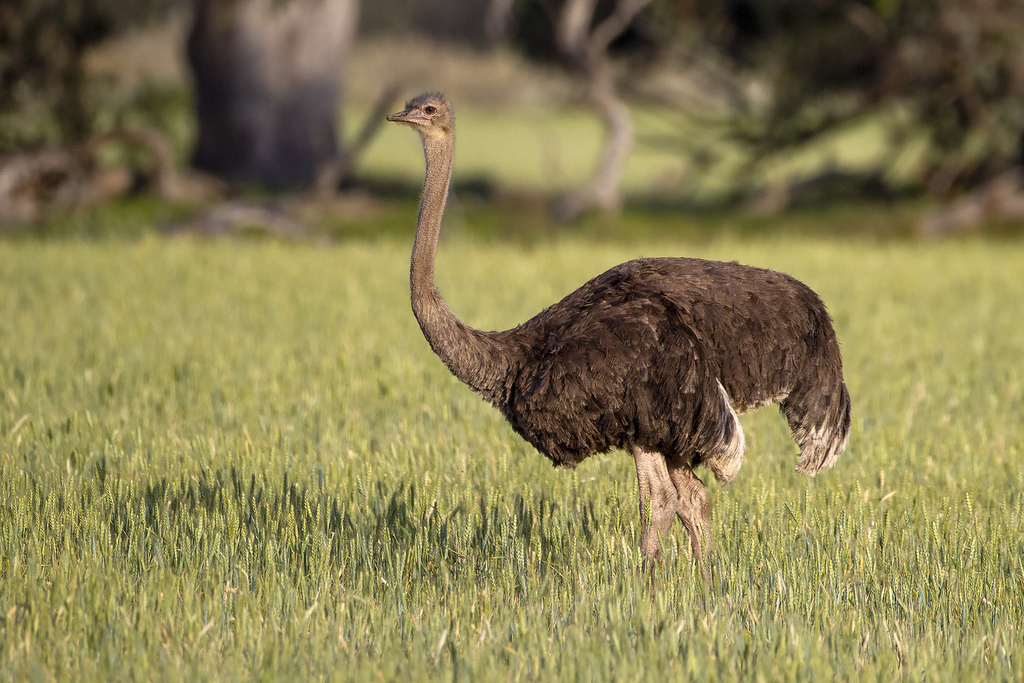
- aTallest bird, flightless, with long bare neck and legs
- bMales black with white wings and tail; females greyish-brown
- cMale's neck and legs pinkish, turning red on the shins when breeding
- dTwo toes on each foot
- Voice
- Breeding males give a deep, booming roar
- Not to be confused with
- Somali ostrich (a separate species in the Horn of Africa) has blue-grey neck and thigh skin. Ostriches kick hard; watch from a vehicle or at a distance.
- Where to see it
- Etosha (Namibia), Maasai Mara and Serengeti, and the Cape of Good Hope section of Table Mountain National Park
- When
- Resident
Listen
Looking for field recordings…
Life & habits
- Diet
- Plants, seeds and roots; also insects and small animals
- Habitat
- Open savanna, semi-desert and grassland
- Size
- Up to 2.7 m tall; 63–145 kg
- Lifespan
- 30–40 years in the wild
Several females lay in one shared nest; the dominant female and the male take turns incubating, he at night, she by day.
Where it lives
Recorded sightings
—
geo-referenced records in GBIF, from museums, herbaria and field observers.
Native range
Sub-Saharan Africa; formerly North Africa and the Middle East
Drag the globe to turn it. Dots are where records exist, not a range map; darker means more records.
In the old herbals & bestiaries
Woodcuts and engravings matched from the Source Library’s scanned books by name. Plates marked “relative” show a close kin rather than this exact species. Click a plate to read the page it came from, with translation.


In the stacks
Searching the stacks…
Every page naming Struthio camelus in the Biodiversity Heritage Library →
Marginalia
Ostrich eggshells were engraved by people at Diepkloof Rock Shelter in South Africa about 60,000 years ago, and used as water flasks and beads by San peoples. Ostrich plumes were a fashion craze in Edwardian Europe.
Curiosity
The story that ostriches bury their heads in sand is a myth, perhaps from seeing them turn eggs in ground nests.
Kinship





Fact-checked: 1 correction made to this sheet. Photographs: iNaturalist contributors under the licences shown. Records: GBIF.org. Historical plates: Source Library (CC BY-SA 4.0; originals public domain). Summary text: Nature Library editors and Wikipedia (CC BY-SA). Medicinal and edibility notes are historical and educational, not advice. iNaturalist taxon 20526.