- Animals
- ›Arthropods
- ›Hexapods
- ›Insects
- ›Winged and Once-winged Insects
- ›Butterflies and Moths
- ›Geometrid and Swallowtail Moths
- ›Geometer Moths
- ›Ennominae
- ›Ennomini
- ›Ourapteryx
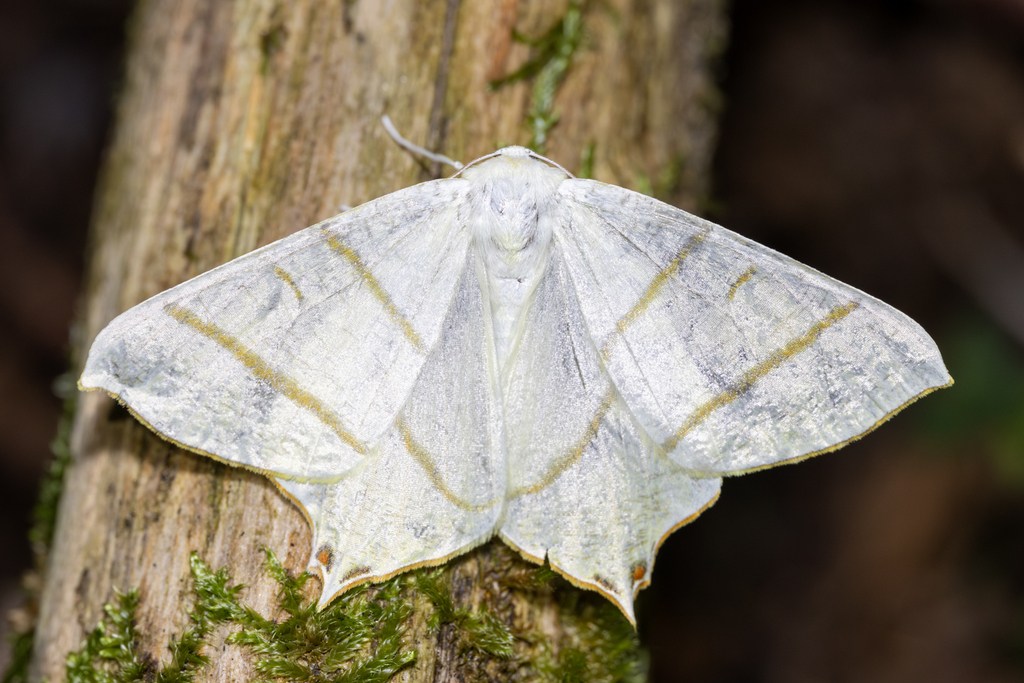
Swallow-tailed Moth
Ourapteryx sambucaria
The swallow-tailed moth (Ourapteryx sambucaria) is a moth of the family Geometridae. The species was first described by Carl Linnaeus in his 1758 10th edition of Systema Naturae. It is a common species across Europe and the Near East.
From the article Swallow-tailed moth on Wikipedia (CC BY-SA), quoted section by section
Description
This is a large (wingspan 50–62 mm), impressive moth, remarkably butterfly-like. All parts of the adult are bright white to pale yellow marked with faint buffish fascia. The species gets its common name from pointed projections on the termen of the hindwing with brownish spots at their base. It flies at night in June and July [1] and is attracted to light, sometimes in large numbers. Prout gives an account of the variations. The egg is orange, with about 16 longitudinal keels and between them transverse lineations. The larva is grey-brown, the colouring arranged in a succession of scarcely noticeable longitudinal lines.
The brown, twig-like larva feeds on a variety of trees and shrubs including elder, hawthorn, honeysuckle and ivy. The species overwinters as a larva.
^The flight season refers to the British Isles. This may vary in other parts of the range.
Listen
Looking for field recordings…
Where it lives
Recorded sightings
—
geo-referenced records in GBIF, from museums, herbaria and field observers.
Drag the globe to turn it. Dots are where records exist, not a range map; darker means more records.
In the stacks
Searching the stacks…
Every page naming Ourapteryx sambucaria in the Biodiversity Heritage Library →
This page is assembled live from iNaturalist, GBIF, Wikipedia, the Source Library and the Internet Archive. It is not yet part of the hand-edited codex. iNaturalist taxon 205220.