On eBird ↗
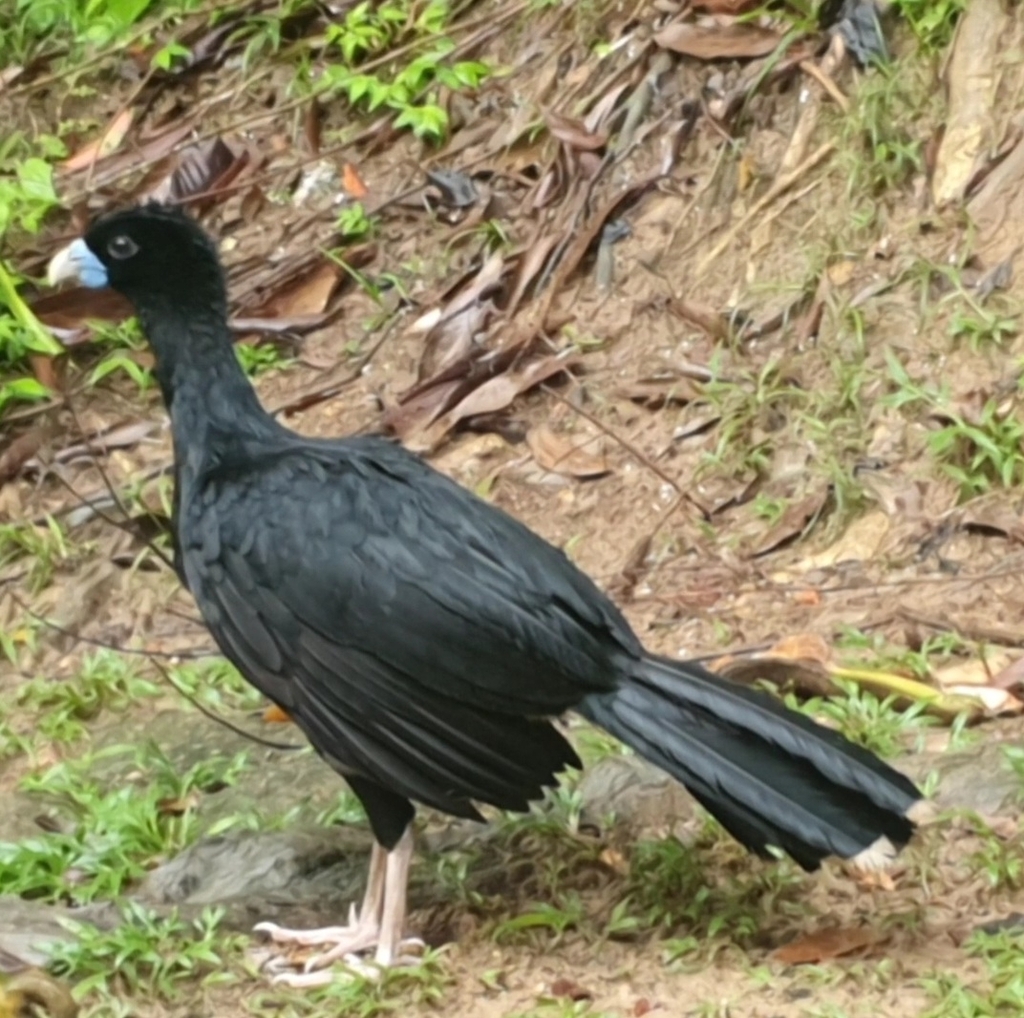
Blue-billed Curassow
Live sightings near you, the range map, bar charts of when it is seen, and Macaulay Library photos and recordings.
Blue-billed Curassow
Crax alberti
The blue-billed curassow (Crax alberti) or blue-knobbed curassow is a species of bird in the family Cracidae, which includes the chachalacas, guans, and curassows.
From the article Blue-billed curassow on Wikipedia (CC BY-SA), quoted section by section
Description
The blue-billed curassow is 82.5 to 92.5 cm (2.7 to 3.0 ft) long and weighs 3.2 to 3.6 kg (7.1 to 7.9 lb). It is the only curassow with a blue cere and wattle, the latter found only on the male. Males are mostly black with a white vent and tail tip. Females are also mostly black but their lower belly and vent are rufous. They have fine white barring on the wings and tail, and a rare "barred" morph also has barring on the breast and belly. Both sexes have an erectile crest, the male's black and the female's black and white.
Range & habitat
The blue-billed curassow is found only in northern Colombia. Its range used to stretch 106,700-square-kilometers; it now has a highly fragmented range, with small populations between La Guajira and Magdalena Departments south to Antioquia and Boyacá Departments with 2,090-square-kilometers. It inhabits undisturbed forest in the tropical and upper tropical zones, mostly from near sea level to 600 m (2,000 ft) but at least formerly as high as 1,200 m (3,900 ft). The Serranía de las Quinchas area in the Magdalena Valley is home to the last viable population of blue-billed curassows.
Wikipedia: “Distribution and habitat”
What it does
The blue-billed curassow mainly feeds on the ground. Its diet has not been extensively studied but it is known to include fruits, worms, and insects. It also takes in sand and small stones as digestive aids.
Wikipedia: “Feeding”
Listen
Looking for field recordings…
Where it lives
Recorded sightings
—
geo-referenced records in GBIF, from museums, herbaria and field observers.
Drag the globe to turn it. Dots are where records exist, not a range map; darker means more records.
In the stacks
Searching the stacks…
Every page naming Crax alberti in the Biodiversity Heritage Library →
This page is assembled live from iNaturalist, GBIF, Wikipedia, the Source Library and the Internet Archive. It is not yet part of the hand-edited codex. iNaturalist taxon 2050.