On eBird ↗
Dwarf Cassowary
Live sightings near you, the range map, bar charts of when it is seen, and Macaulay Library photos and recordings.
Dwarf Cassowary
Casuarius bennetti
The dwarf cassowary (Casuarius bennetti), also known as Bennett's cassowary, little cassowary, mountain cassowary or muruk, is the smallest of the three extant species of cassowaries. Like all cassowaries, it is a mostly black, large flightless bird. It inhabits the island of New Guinea and the Bismarck Archipelago.
From the article Dwarf cassowary on Wikipedia (CC BY-SA), quoted section by section
Description
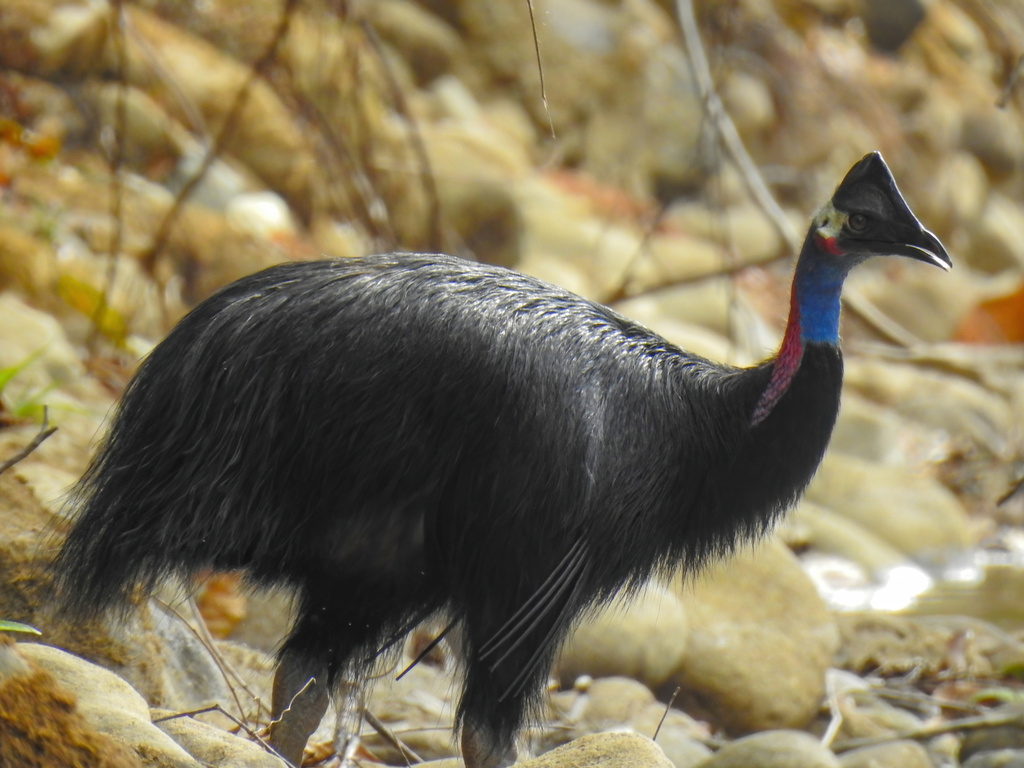
The dwarf cassowary is a large flightless bird but is smaller than other living cassowaries (the southern cassowary and northern cassowary). It stands 80 cm (2.6 ft) tall at the back, and 99–135 cm (3.25–4.43 ft) in total height. In length, it measures 100–150 cm (3.3–4.9 ft). They can weigh between 17.6 and 35 kg (39 and 77 lb). The dwarf cassowary has hard and stiff black plumage, a low triangular casque, pink cheek and red patches of skin on its blue neck. Compared to other cassowaries, the dwarf cassowary is shorter, with a tarsi length of 24.5 cm (9.6 in), with a slightly smaller bill, at 11 to 12.2 cm (4.3 to 4.8 in). The feet are large and powerful, equipped with dagger-like claws on the inner toe, up to 10 cm (3.9 in) long. Both sexes are similar, but females have longer casques, brighter bare skin colour and are larger in size. The casques of dwarf cassowaries tends to be jet black, and unlike both the southern and northern cassowary, the casque of the dwarf cassowary does not glow under UV light.
Range & habitat
The dwarf cassowary is endemic to the montane cloud forests and tropical rainforests of the island of New Guinea (divided between the countries of Indonesia and Papua New Guinea). Though the birds are primarily found on the island of New Guinea proper, they are also known from the Bismarck Archipelago (part of Papua New Guinea's Islands Region), including the islands of New Britain and New Ireland, as well as Yapen Island (part of Indonesia's Papua Province), at elevations of around 3,300 m (10,800 ft) above sea level. In areas where dwarf cassowaries do not encounter the northern cassowary (Casuarius unappendiculatus) nor the southern (Casuarius casuarius) species—i.e., avoiding interspecific competition—they will naturally become more confident and forage in lowland or open forest areas. The dwarf cassowary's total population is distributed over an area of approximately 258,000 km2 (100,000 sq mi).
Wikipedia: “Range and habitat”
What it does
The species feeds mainly on fallen fruits or fruits that they pluck from shrubs, invertebrates, small vertebrates, and fungi. Dwarf cassowaries use the crest on their head to sort through leaf litter and reveal many sources of food, such as fungi, insects, plant tissue, and small vertebrates, including lizards and frogs. It forages solitary or in small family groups; around good food sources, larger groups may form. It possibly undertakes seasonal migrations in part of its range, but is sometimes presumed sedentary.
Breeding. Breeding has been documented both during the wet and dry season. The nest is a shallow depression on the ground, with 2 to 5 eggs per clutch. These eggs measure 12.8–15.2 cm (5.0–6.0 in) in length and 8.1–9.5 cm (3.2–3.7 in) in width, weighing 625–640 g (1.378–1.411 lb). Incubation takes 49–52 days, and is done exclusively by the male, along with raising the chicks.
Wikipedia: “Ecology”
Listen
Looking for field recordings…
Where it lives
Recorded sightings
—
geo-referenced records in GBIF, from museums, herbaria and field observers.
Drag the globe to turn it. Dots are where records exist, not a range map; darker means more records.
In the stacks
Searching the stacks…
Every page naming Casuarius bennetti in the Biodiversity Heritage Library →
This page is assembled live from iNaturalist, GBIF, Wikipedia, the Source Library and the Internet Archive. It is not yet part of the hand-edited codex. iNaturalist taxon 20499.