- Animals
- ›Chordates
- ›Vertebrates
- ›Ray-finned Fishes
- ›Spiny-rayed fishes
- ›Blennies, Damselfishes and Allies
- ›Damselfishes
- ›Giant Damselfishes
- ›Plectroglyphidodon
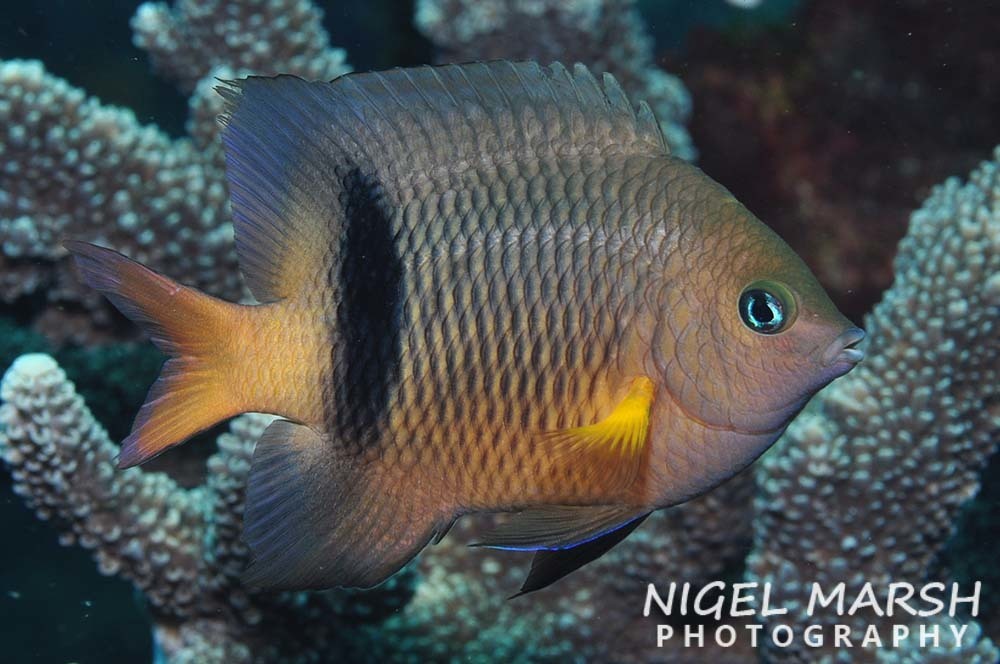
Blackbar Damselfish
Plectroglyphidodon dickii
Plectroglyphidodon dickii, common name blackbar devil, Dick's damsel or narrowbar damselfish, is a species of damselfish in the family Pomacentridae. This species was formerly classified as Dascyllus aruanus, but recently the populations of western Indian Ocean and Pacific Ocean have been split off.
From the article Plectroglyphidodon dickii on Wikipedia (CC BY-SA), quoted section by section
Description
Plectroglyphidodon dickii can reach a body length of about 9–11 cm (3.5–4.3 in). These damselfishes have a compact and stocky body, with 12 dorsal spines, 16-18 dorsal soft rays, 2 anal spines and 14-16 anal soft rays. The background coloring is mainly light brown with very visible scales and a small vertical black bar crossing the rear of the body, just ahead of the caudal area. The eyes show light blue rings and light purple markings. The dorsal, pectoral and pelvic fins are yellow orange or light brown, while the caudal fin is white, more rarely orange, with a transparent blue shaded fringe on the rear. The operculum sometimes shows a purplish tinge. Also the caudal peduncle can be white or orange.
Range & habitat
This species is present in the Indo-Pacific, from East Africa to the Line Islands and Tuamotu, north to Japan, south to Australia and east to French Polynesia.
Wikipedia: “Distribution”
In human culture
The genus epithet Plectroglyphidodon derives from the Greek words plektron (meaning = anything to strike with, spur), plus the suffixes glyphis (mening carved) and odous (meaning teeth).
Wikipedia: “Etymology”
Where it lives
Recorded sightings
—
geo-referenced records in GBIF, from museums, herbaria and field observers.
Drag the globe to turn it. Dots are where records exist, not a range map; darker means more records.
In the stacks
Searching the stacks…
Every page naming Plectroglyphidodon dickii in the Biodiversity Heritage Library →
This page is assembled live from iNaturalist, GBIF, Wikipedia, the Source Library and the Internet Archive. It is not yet part of the hand-edited codex. iNaturalist taxon 204597.