On eBird ↗
Blue-throated Bee-eater
Live sightings near you, the range map, bar charts of when it is seen, and Macaulay Library photos and recordings.
Blue-throated Bee-eater
Merops viridis
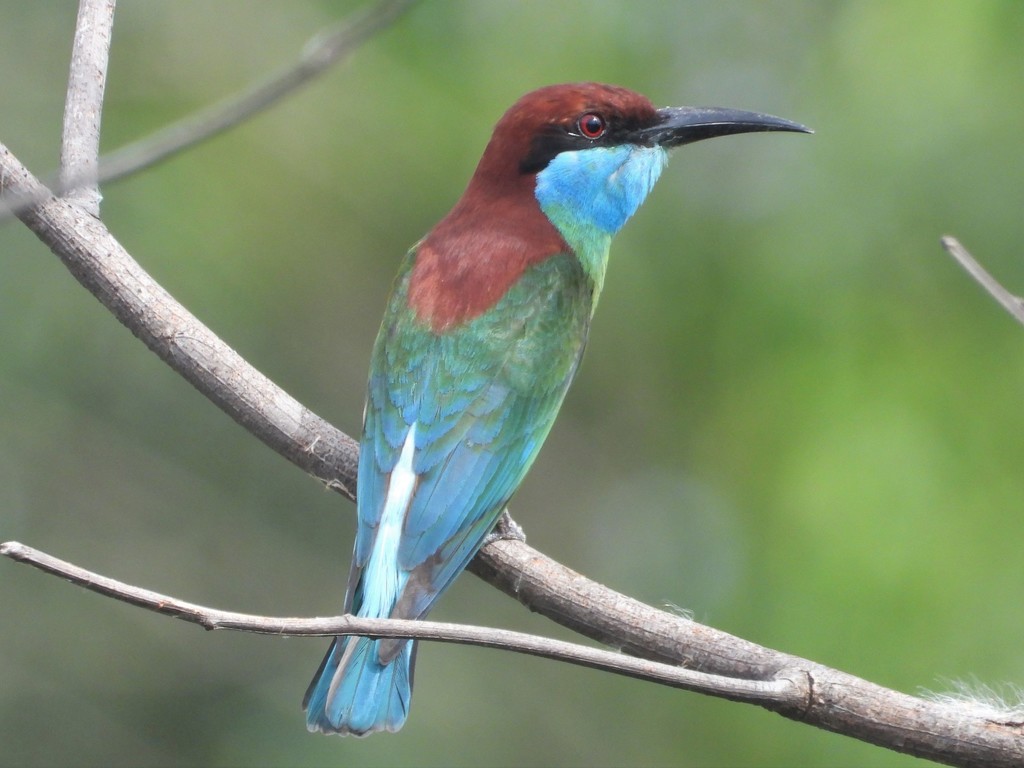
The blue-throated bee-eater (Merops viridis) is a species of bird in the bee-eater family. It is found in much of southeast Asia, in subtropical or tropical mangrove forests. Their diet consists mostly of bees, wasps, and dragonflies. Blue-throated bee-eater is a medium-large species of bee-eater with brightly coloured plumage consisting of a red-brown nape, dark green wings, light green breast, and their signature blue throat. The juvenile plumage has a dark green head and wings and light green breast, only developing their full plumage in adulthood. They have a rich variety of songs and calls, including long calls which allow them to communicate long distances in the forest.
The conservation status of the blue-throated bee-eaters is of "least concern" due to their large distribution and stability of its population as of 2024. However, deforestation may be its biggest threat, destroying its habitat and decreasing bird diversity generally.
From the article Blue-throated bee-eater on Wikipedia (CC BY-SA), quoted section by section
Description
Adult blue-throated bee-eaters are around 21 cm long, excluding the elongated central tail feathers, which are an additional 9 cm, and a weight of around 34–41 grams. Adults have spectacular plumage with a red-brown crown and nape, dark green wings, blue tail, light green breast and belly, and the signature blue throat. Juveniles are mostly green all over their body, developing their full plumage later; they have a dark green head and wings and light green breast, and also lack the elongated central tail feathers of adults. Both adults and juveniles have black eye stripes. The eyes range between red and brown, or a combination.
Range & habitat
They have a wide distribution ranging from southeastern China to the Greater Sundas Islands. The most concentrated distribution is found in Singapore, Malaysia, southern Cambodia, and southern Thailand. Other locations with greater dispersal include Borneo and Java. It is most widespread at low altitudes, between 0–670 m, but is known to occur up to 1,600 m. Their habitat includes a wide variety of flat plains, such as farmland, suburban gardens, riversides, dunes, and sandy clearings. In the winter, some blue-throated bee-eaters move to forest canopies and saltwater channels of mangrove forests. Unlike most bee-eaters which dig nest burrows in near-vertical sand cliffs, they often dig nest burrows nearly horizontally into flat ground. Colony sizes range from 50 to 200 pairs or living completely solitary in the open country.
Migration. Each spring, blue-throated bee-eaters (Merops viridis) along with blue-tailed bee-eaters (Merops philippinus) migrate from Sumatra, cross the Straits of Malacca, and end up on the west coast of Malaysia. The observed flight locomotion from Tanjung Tuan, west coast of Malaysia, was a combination of flapping and gliding flight. Occasionally, they would use the air currents from the sea-breeze to soar upwards. Once reaching land, they would rest on the lighthouse and tree branches for up to ten minutes before continuing eastward. …
Wikipedia: “Distribution and habitat”
What it does
Blue-throated bee-eaters make a combination of calls characterised as long calls, alarm calls, chirps, low chirps, purrs, sharp coos, trills, and feeding calls. Long calls have been observed to communicate long distances and can be recognised by their volume and intensity. A long call is performed either during flight or on a perch by stretching and pointing their bill upwards, known as a "long call" posture. Chirps are short and sharp with regular intervals, often used during digs.
Wikipedia: “Vocal behaviour”
At the table
They predominantly feed on flying insects such as bees and wasps, though a large percentage of their diet consists of dragonflies, with highest success rate of their catches in sunny conditions. Other insects caught include flies, beetles, and other bugs up to 42mm. Observations found no feeding activities during rain and right after showers. Their feeding patterns are well-matched with the seasonal weather patterns. The highest feeding rate is during breeding season, perfectly matching the sunniest period, right after the rainy season.
Wikipedia: “Food and feeding”
Listen
Looking for field recordings…
Where it lives
Recorded sightings
—
geo-referenced records in GBIF, from museums, herbaria and field observers.
Drag the globe to turn it. Dots are where records exist, not a range map; darker means more records.
In the stacks
Searching the stacks…
Every page naming Merops viridis in the Biodiversity Heritage Library →
This page is assembled live from iNaturalist, GBIF, Wikipedia, the Source Library and the Internet Archive. It is not yet part of the hand-edited codex. iNaturalist taxon 204541.