On eBird ↗
Spotted Antpitta
Live sightings near you, the range map, bar charts of when it is seen, and Macaulay Library photos and recordings.
Spotted Antpitta
Hylopezus macularius
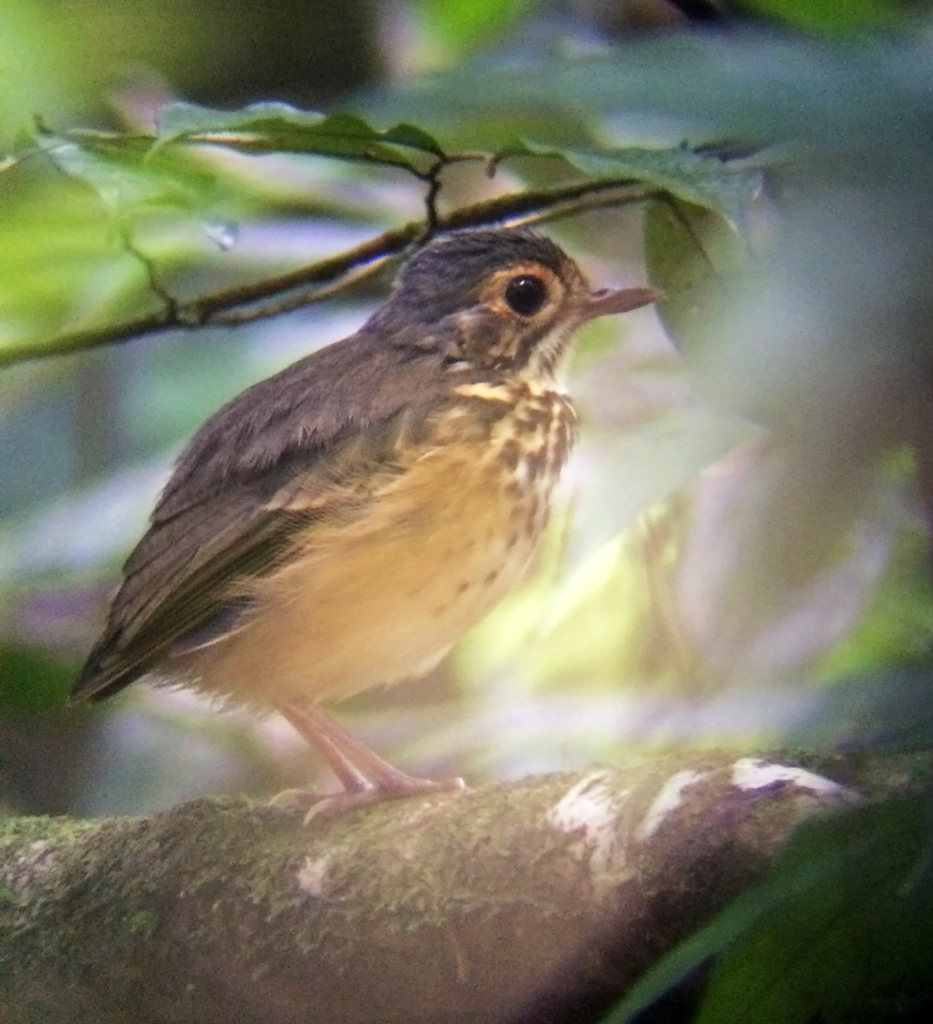
The spotted antpitta (Hylopezus macularius) is a species of bird in the Grallariidae family. It is found in Bolivia, Brazil, Colombia, Ecuador, French Guiana, Guyana, Peru, Suriname, and Venezuela. Its natural habitat is subtropical or tropical moist lowland forests.
From the article Spotted antpitta on Wikipedia (CC BY-SA), quoted section by section
Description
The spotted antpitta is about 14 cm (5.5 in) long and weighs 43 to 53 g (1.5 to 1.9 oz). The sexes have the same plumage. Adults of the nominate subspecies have orange-buff lores and a ring of the same color around the eye. Their ear coverts are olive-brown with a black streak below them. Their forehead, crown, and nape are dark gray. Their upperparts and tail are olive-brown. Their wings are mostly brownish with orange-buff bases and outer edges on the primaries and olive-brown edges on the secondaries. Their wing coverts are mostly brownish with wide orange-buff edges. They have a wide white "moustache" with a wide black stripe below it. Their chin and throat are white with a black line down from the bill. Their underparts are mostly pale ochraceous or buffy-white with many short black streaks on the breast. Their sides, flanks, and undertail coverts are orangey-buff. Subspecies H. m. dilutis has a more brownish back than the nominate and flanks that are olivaceous-washed dull ochraceous-yellow. Both subspecies have a dark brown iris, a black maxilla, a pink mandible with a black tip, and pinkish brown to pale gray brown legs and feet.
Range & habitat
The nominate subspecies of the spotted antpitta is found from eastern Bolívar state in northeastern Venezuela east through the Guianas and northeastern Brazil, all north of the Amazon and east of the Branco and Negro rivers. Subspecies H. m. dilutis is found from central Amazonas state in southern Venezuela, in extreme southeastern Colombia, in northeastern Peru, and in the Negro River basin in northwestern Brazil. (Note that the map also includes the ranges of Snethlage's and Alta Floresta antpittas.) The species inhabits the floor and undergrowth of mature forest, both terra firme and gallery forest. It is a bird of the lowlands, reaching only 300 m (1,000 ft) in Colombia and 500 m (1,600 ft) in Venezuela.
Wikipedia: “Distribution and habitat”
What it does
The spotted antpitta's diet has not been detailed but is known to include insects. It forages mostly on the ground where it probes and flicks leaf litter and soil to find prey. It is usually seen singly and sometimes in pairs.
Wikipedia: “Feeding”
Listen
Looking for field recordings…
Where it lives
Recorded sightings
—
geo-referenced records in GBIF, from museums, herbaria and field observers.
Drag the globe to turn it. Dots are where records exist, not a range map; darker means more records.
In the stacks
Searching the stacks…
Every page naming Hylopezus macularius in the Biodiversity Heritage Library →
This page is assembled live from iNaturalist, GBIF, Wikipedia, the Source Library and the Internet Archive. It is not yet part of the hand-edited codex. iNaturalist taxon 204522.