On eBird ↗
Common Hill Myna
Live sightings near you, the range map, bar charts of when it is seen, and Macaulay Library photos and recordings.
Common Hill Myna
Gracula religiosa
The common hill myna (Gracula religiosa), sometimes spelled "mynah" and formerly simply known as the hill myna or myna bird, is a species of starling found in the hills of South and Southeast Asia. The Sri Lanka hill myna, a former subspecies of G. religiosa, is now generally accepted as a separate species G. ptilogenys. The Nias hill myna (G. robusta) are also widely accepted as specifically distinct, and many authors favor treating the southern hill myna (G. indica) from the Nilgiris and elsewhere in the Western Ghats of India as a separate species.
The common hill myna is a popular talking bird. Its specific name religiosa may allude to the practice of teaching mynas to repeat sacred prayers. The common hill myna is one of the most commonly spotted birds in Asian aviculture.
From the article Common hill myna on Wikipedia (CC BY-SA), quoted section by section
Description
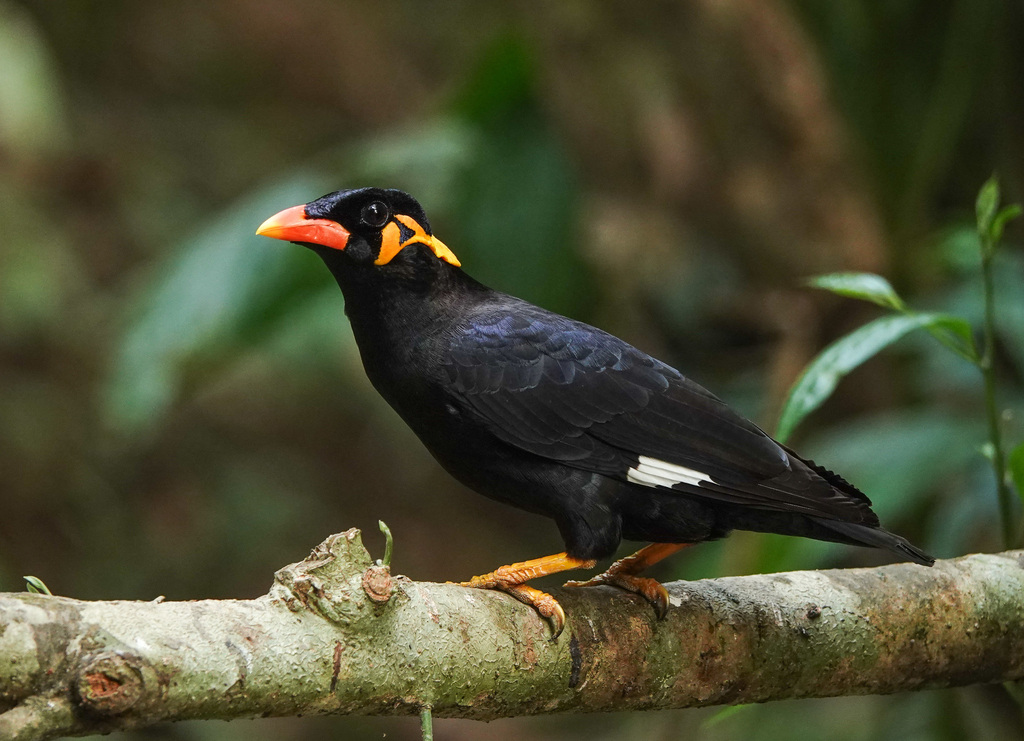
This is a stocky jet-black myna, with bright orange-yellow patches of naked skin and fleshy wattles on the side of its head and nape. At about 29 cm length, it is somewhat larger than the common myna (Acridotheres tristis). It is overall green-glossed black plumage, purple-tinged on the head and neck. Its large, white wing patches are obvious in flight, but mostly covered when the bird is sitting. The bill and strong legs are bright yellow, and there are yellow wattles on the nape and under the eye. These differ conspicuously in shape from the naked eye-patch of the common myna and bank myna (A. ginginianus), and more subtly vary between the different hill mynas from South Asia: in the common hill myna, they extend from the eye to the nape, where they join, while the Sri Lanka hill myna has a single wattle across the nape and extending a bit towards the eyes. In the southern hill myna, the wattles are separate and curve towards the top of the head. The Nias myna differs in details of the facial wattles, and size, particularly that of the bill. Sexes are similar; juveniles have a duller bill. The subspecies differ in size, in the pattern of wattles on the head and in the glossiness of the plumage.
A 2020 study found that the subspecies G. …
Range & habitat
This myna is a resident breeder from Kumaon division in India (80° E longitude) east through Nepal, Sikkim, Bhutan and Arunachal Pradesh, the lower Himalayas, terai and foothills up to 2,000 m ASL. Its range continues east through Southeast Asia northeastwards to southern China, and via Thailand southeastwards across northern Indonesia to Palawan in the Philippines. It is virtually extinct in Bangladesh due to habitat destruction and overexploitation for the pet trade. A feral population on Christmas Island has likewise disappeared. Introduced populations exist in Saint Helena, Puerto Rico and perhaps in the mainland United States and possibly elsewhere; feral birds require at least a warm subtropical climate to persist. This myna is almost entirely arboreal, moving in large, noisy groups of half a dozen or so, in tree-tops at the edge of the forest. It hops sideways along the branch, unlike the characteristic jaunty walk of other mynas. Like most starlings, the hill myna is fairly omnivorous, eating fruit, nectar and insects. They build a nest in a tree hole. The usual clutch consists of two or three eggs. There is no sexual dimorphism, which limits the selection of potential mates.
Pet trade and conservation. The hill mynas are popular cage birds, well known for their ability to imitate speech. …
Wikipedia: “Distribution and ecology”
Listen
Looking for field recordings…
Where it lives
Recorded sightings
—
geo-referenced records in GBIF, from museums, herbaria and field observers.
Drag the globe to turn it. Dots are where records exist, not a range map; darker means more records.
In the stacks
Searching the stacks…
Every page naming Gracula religiosa in the Biodiversity Heritage Library →
This page is assembled live from iNaturalist, GBIF, Wikipedia, the Source Library and the Internet Archive. It is not yet part of the hand-edited codex. iNaturalist taxon 204517.