- Animals
- ›Chordates
- ›Vertebrates
- ›Birds
- ›Perching Birds
- ›Old World Flycatchers, Robins, and Chats
- ›Copsychus
On eBird ↗
White-rumped Shama
Live sightings near you, the range map, bar charts of when it is seen, and Macaulay Library photos and recordings.
White-rumped Shama
Copsychus malabaricus
The white-rumped shama (Copsychus malabaricus) is a passerine bird in the Old World flycatcher family Muscicapidae. Native to densely vegetated habitats in the Indian subcontinent and Southeast Asia, its popularity as a cage-bird and songster has led to it being introduced elsewhere. The Larwo shama, the Kangean shama and the Sri Lanka shama were formerly considered to be conspecific with the white-rumped shama.
From the article White-rumped shama on Wikipedia (CC BY-SA), quoted section by section
Description
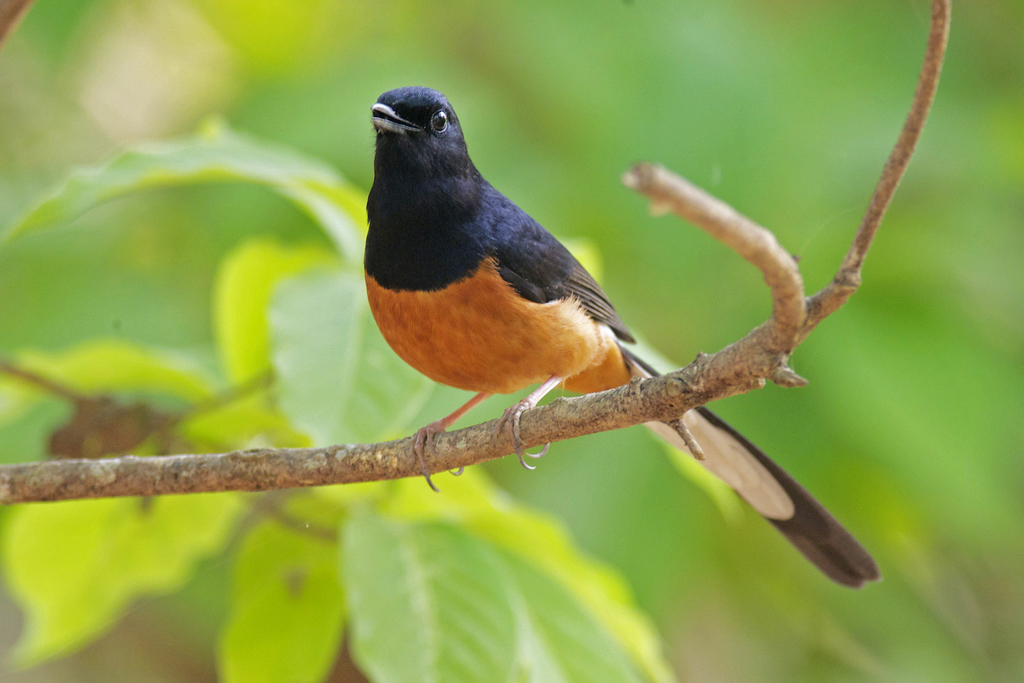
They typically weigh between 28 and 34 g (1.0 and 1.2 oz) and are around 23–28 cm (9–11 in) in length. Males are glossy black with a chestnut belly and white feathers on the rump and outer tail. Females are more greyish-brown, and are typically shorter than males. Both sexes have a black bill and pink feet. Juveniles have a greyish-brown colouration, similar to that of the females, with a blotchy or spotted chest.
Range & habitat
They are native across scrub and secondary forests in South and Southeast Asia, but have been introduced to Kaua'i, Hawaii, in early 1931 from Malaysia (by Alexander Isenberger), and to Oahu in 1940 (by the Hui Manu Society). Their popularity as a cage bird has led to many escaped birds establishing themselves. They have been introduced to Taiwan where they are considered an invasive species, eating native insect species and showing aggression towards native bird species. In Asia, their habitat is dense undergrowth especially in bamboo forests. In Hawaii, they are common in valley forests or on the ridges of the southern Koolaus, and tend to nest in undergrowth or low trees of lowland broadleaf forests.
Wikipedia: “Distribution and habitat”
What it does
They feed on insects in the wild but in captivity they may be fed on a diet of boiled, dried legumes with egg yolk and raw meat.
Wikipedia: “Feeding”
Listen
Looking for field recordings…
Where it lives
Recorded sightings
—
geo-referenced records in GBIF, from museums, herbaria and field observers.
Drag the globe to turn it. Dots are where records exist, not a range map; darker means more records.
In the stacks
Searching the stacks…
Every page naming Copsychus malabaricus in the Biodiversity Heritage Library →
This page is assembled live from iNaturalist, GBIF, Wikipedia, the Source Library and the Internet Archive. It is not yet part of the hand-edited codex. iNaturalist taxon 204490.