On eBird ↗
Eastern Paradise-Whydah
Live sightings near you, the range map, bar charts of when it is seen, and Macaulay Library photos and recordings.
Eastern Paradise-Whydah
Vidua paradisaea
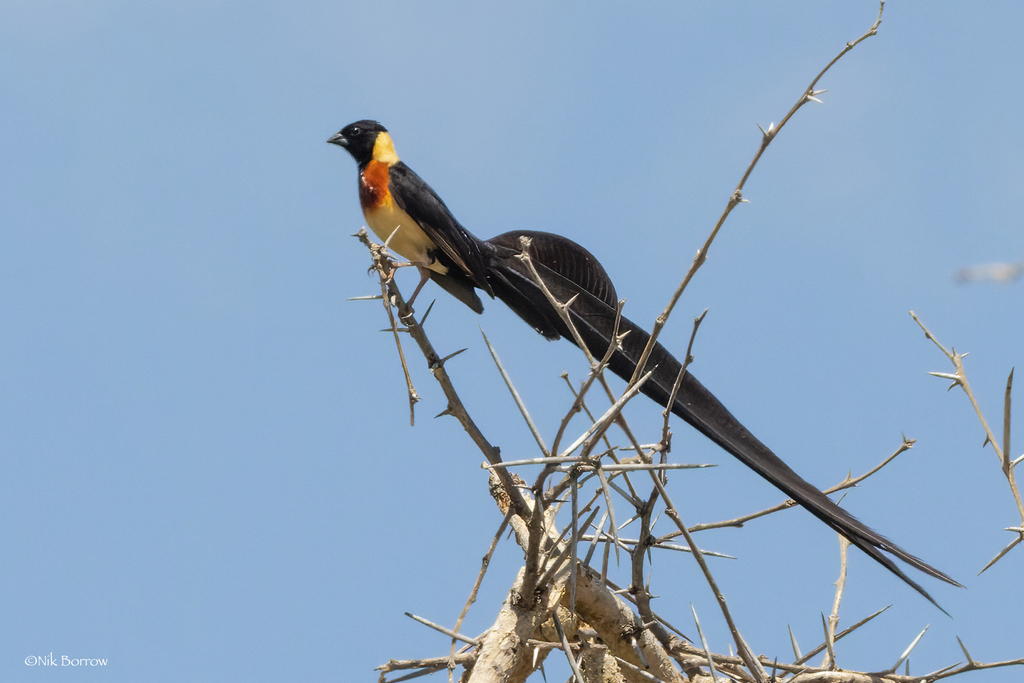
The long-tailed paradise whydah or eastern paradise whydah (Vidua paradisaea) is a bird in the family Viduidae of the order Passeriformes. It is a small passerine with a short, stubby bill, found across eastern and southern Africa from Ethiopia south to South Africa and west to Angola. It is mostly granivorous, and feed on seeds that have ripened and fallen on the ground. The ability to distinguish between males and females is quite difficult unless it is breeding season. During this time, the males moult into breeding plumage where they have a distinctive long tail. This can be up to three times longer than its own body or even more. Males are able to mimic songs where females can use that to discover their mate. However, there are some cases where females don't use songs to choose their mate but they use either male characteristics like plumage or they can have a shortage of options with song mimicry. Paradise whydahs are brood parasites. They do not destroy the host eggs that are originally there, but lay their own eggs alogside in the other bird's nest. Overall, these whydahs are considered least concern, based on the IUCN Red List of threatened species.
From the article Long-tailed paradise whydah on Wikipedia (CC BY-SA), quoted section by section
Description
Breeding male long-tailed paradise whydahs have black heads and back, a rusty coloured breast, a bright buffy-yellow nape, and white abdomen with broad, elongated black tail feathers that can grow up to 36 cm or more. When in non-breeding plumage, males are hard to distinguish from females, and in general, from other Viduidae species, as these differ from one another in size, in non-breeding plumage and colour, and in the songs used for mating.. Usually, they are about 13 cm in length and weigh about 21 grams. Females tend to have a grey bill and feathers that are greyish-brown with blackish streaks along with their under tail feather being more white. Males during the non-breeding season tend to have mostly browner plumage with black stripes on the crown, black parts along the face, and deeper brown colour for the chest and creamer colour for the abdomen.
Range & habitat
The long-tailed paradise whydahs are found in grassland, savanna and open woodland where they live in bushed grassland around cultivation. The majority of the time, these whydahs stay away from surface waters.
Wikipedia: “Distribution and habitat”
What it does
The long-tailed paradise whydah are known to be brood parasites where they would lay their eggs in nests of other songbirds. Furthermore, they usually roost together in flocks during both breeding and non-breeding seasons. Males develop the ability to mimic songs of their host. Studies showed that female whydahs respond more strongly to songs mimicked by males of their own species than they do to closely related species. Females use this mimicry to eliminate among potential mates and prefer those raised by the same host species. Hybrids can occur with other related paradise whydahs; researchers discovered that hybridisation can occur when female whydahs do not choose mates based on their song mimicry but instead on male traits such as plumage and flight displays if it is more important to them than song, or is restricted by the availability of males singing the appropriate host songs or if males is involved with unsolicited copulation with females of other parasitic species. Researchers discovered that these paradise whydahs mimic the songs of Melba Finch.
Additionally, these paradise whydahs are granivorous where they feed on small seed that ripen and fall on the ground. For foraging, they use something called "double scratch" where they use both of their feet almost simultaneously scratching the ground to find seeds in dust and hop backwards to pick up the seed. …
Wikipedia: “Behaviour and ecology”
Listen
Looking for field recordings…
Where it lives
Recorded sightings
—
geo-referenced records in GBIF, from museums, herbaria and field observers.
Drag the globe to turn it. Dots are where records exist, not a range map; darker means more records.
In the stacks
Searching the stacks…
Every page naming Vidua paradisaea in the Biodiversity Heritage Library →
This page is assembled live from iNaturalist, GBIF, Wikipedia, the Source Library and the Internet Archive. It is not yet part of the hand-edited codex. iNaturalist taxon 204449.