On eBird ↗
African Grass-Owl
Live sightings near you, the range map, bar charts of when it is seen, and Macaulay Library photos and recordings.
African Grass Owl
Tyto capensis
The African grass owl or simply grass owl (Tyto capensis) is a species of owl in the barn owl family, Tytonidae.
From the article African grass owl on Wikipedia (CC BY-SA), quoted section by section
Description
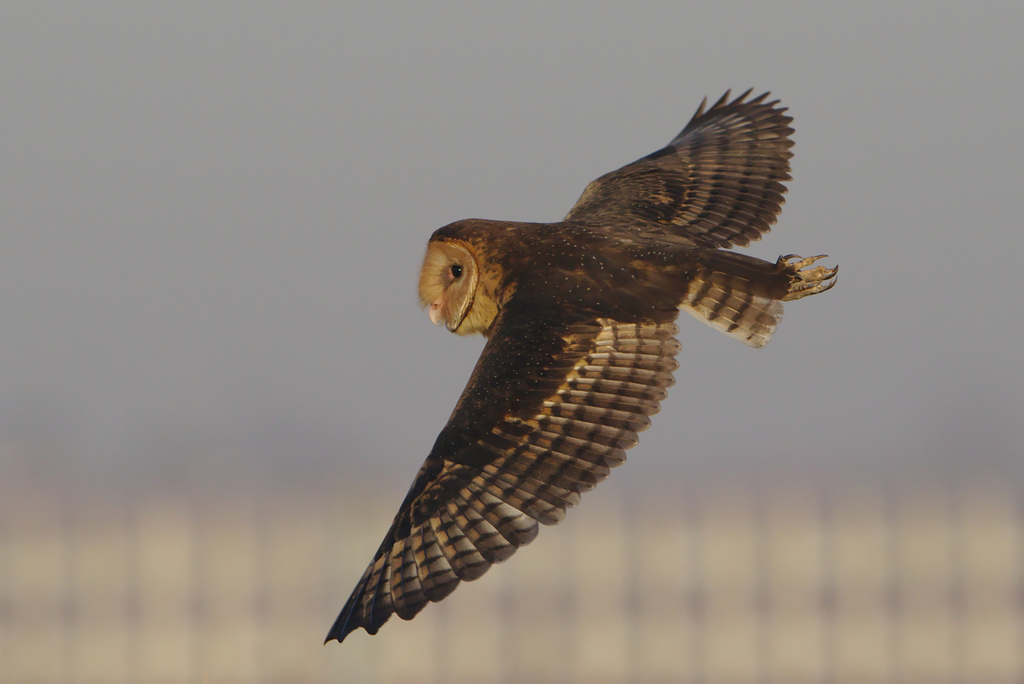
The African grass owl resembles the barn owl and has a heart shaped whitish-cream facial disc, with a narrow yellowish-buff rim which is densely spotted dark. The eyes are brownish-black, and the bill is whitish to pale pink. The entire upperparts from the crown to the lower back and wing-coverts are a uniform sooty blackish-brown, with scattered small white spots and greyish flecks. The primary feathers and secondary feathers are pale brownish-grey with dark bars and yellow bases. The short tail has uniform brown central feathers fading to paler, almost white, outer feathers which show about four dark bars. The underparts vary in colour from whitish to buff marked with dark spots. The legs have whitish feathers which extend to the lower third of the tarsi. The lower leg and feet are slightly bristled and coloured pale yellowish-grey. The body length is 38–42 cm (15–17 in), the wing length 283–345 mm (11.1–13.6 in) and they weigh between 355 and 520 g (12.5 and 18.3 oz). A high degree of sexual dimorphism is present, whereby the body mass and length is significantly larger in females than in males. This is a consequence of observable differences in hunting techniques and efficiency of brooding.
Voice. They have a screeching call which is similar to that of the barn owl, but it is less strident. …
Range & habitat
It is distributed in sub-Saharan Africa where there are two blocks of its main range, one in central southern Africa across southern Congo and northern Angola to the central coast of Mozambique and the other centred on South Africa from the Western Cape north to the southern extremities of Zimbabwe, Botswana and Mozambique. There are isolated populations in the Ethiopian Highlands, Kenya and Uganda and Cameroon.
Wikipedia: “Distribution”
Listen
Looking for field recordings…
Where it lives
Recorded sightings
—
geo-referenced records in GBIF, from museums, herbaria and field observers.
Drag the globe to turn it. Dots are where records exist, not a range map; darker means more records.
In the stacks
Searching the stacks…
Every page naming Tyto capensis in the Biodiversity Heritage Library →
This page is assembled live from iNaturalist, GBIF, Wikipedia, the Source Library and the Internet Archive. It is not yet part of the hand-edited codex. iNaturalist taxon 20438.