On eBird ↗
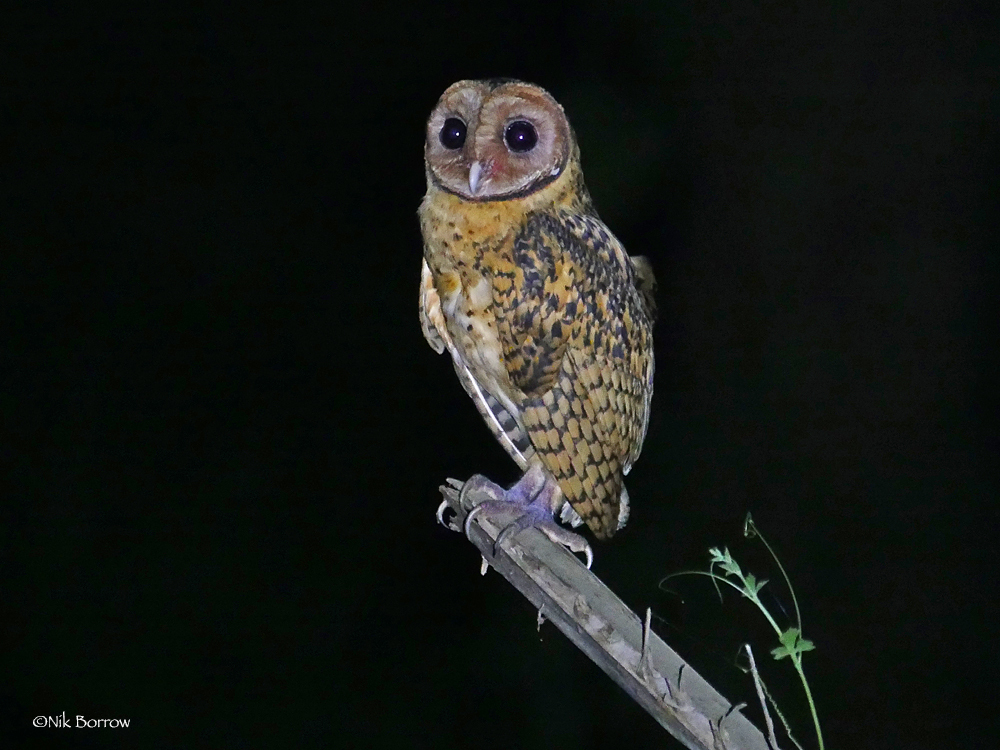
Golden Masked-Owl
Live sightings near you, the range map, bar charts of when it is seen, and Macaulay Library photos and recordings.
Golden Masked Owl
Tyto aurantia
The golden masked owl (Tyto aurantia) is a barn owl endemic to the island of New Britain, Papua New Guinea. It is also known as New Britain barn owl, New Britain masked owl, Bismarck owl and Bismarck masked owl.
As with other tropical barn owls, it is difficult to spot in the wild and therefore poorly studied. It is likely to be a lowland forest or coniferous species.
From the article Golden masked owl on Wikipedia (CC BY-SA), quoted section by section
Range & habitat
The golden masked owl's primary habitat, as previously stated is lowland or coniferous forests on the island of New Britain which is located off the coast of Papua New Guinea. Their unique habitat plays a key role in the survival of their species, and habitat loss has caused their conservation status to fall to vulnerable over time. While not explicitly endangered, being labeled as a vulnerable species is still within the broader category of being threatened. Their current habitat range is roughly 63,000 square kilometers; however, the status of forests and the larger ecoregion on New Britain and neighboring New Ireland have since been labeled as "critical/endangered" by the World Wide Fund for Nature (WWF). This projection means that the golden masked owl is currently in danger of further habitat loss. As a result, the population of golden masked owls, currently in the range of 2500 to 9999 individuals, is trending downward. Habitat loss in the case of the golden masked owls can be directly attributed to deforestation on New Britain island which is a product of large-scale infrastructure projects, agricultural expansion, and commercial logging.
Wikipedia: “Habitat loss”
What it does
Golden masked owl dwellings are commonly hollow trees. The size and style of dwelling best suits the golden masked owl's nesting behavior which involves laying an average of 2 to 3 eggs. With its most common predators being eagles, hawks, and larger owls, golden masked owl dwellings also serve as protection from these predators for both the eggs and the female owl while it incubates them over the course of roughly 32 days. The golden masked owl dwelling also serves to protect newly born owlets in the period of time between when they hatch and when they are able to live independently which is roughly 80 days.
Wikipedia: “Dwelling and nesting behaviour”
Listen
Looking for field recordings…
Where it lives
Recorded sightings
—
geo-referenced records in GBIF, from museums, herbaria and field observers.
Drag the globe to turn it. Dots are where records exist, not a range map; darker means more records.
In the stacks
Searching the stacks…
Every page naming Tyto aurantia in the Biodiversity Heritage Library →
This page is assembled live from iNaturalist, GBIF, Wikipedia, the Source Library and the Internet Archive. It is not yet part of the hand-edited codex. iNaturalist taxon 20435.