On eBird ↗
Maleo
Live sightings near you, the range map, bar charts of when it is seen, and Macaulay Library photos and recordings.
Maleo
Macrocephalon maleo
The maleo (Macrocephalon maleo) is a large megapode and the only member of the monotypic genus Macrocephalon. The maleo is endemic to Sulawesi and the nearby smaller island of Buton in Indonesia. It is found in the tropical lowland and hill forests, but nests in the open sandy areas, volcanic soils, or beaches that are heated by the sun or geothermal energy for incubation.
The megapode is named from a North Halmahera language (see Ternate: moleo, Tidore: muleu) transmitted via Ternate Malay maleu and later Ambon Malay maleo.
From the article Maleo on Wikipedia (CC BY-SA), quoted section by section
Description
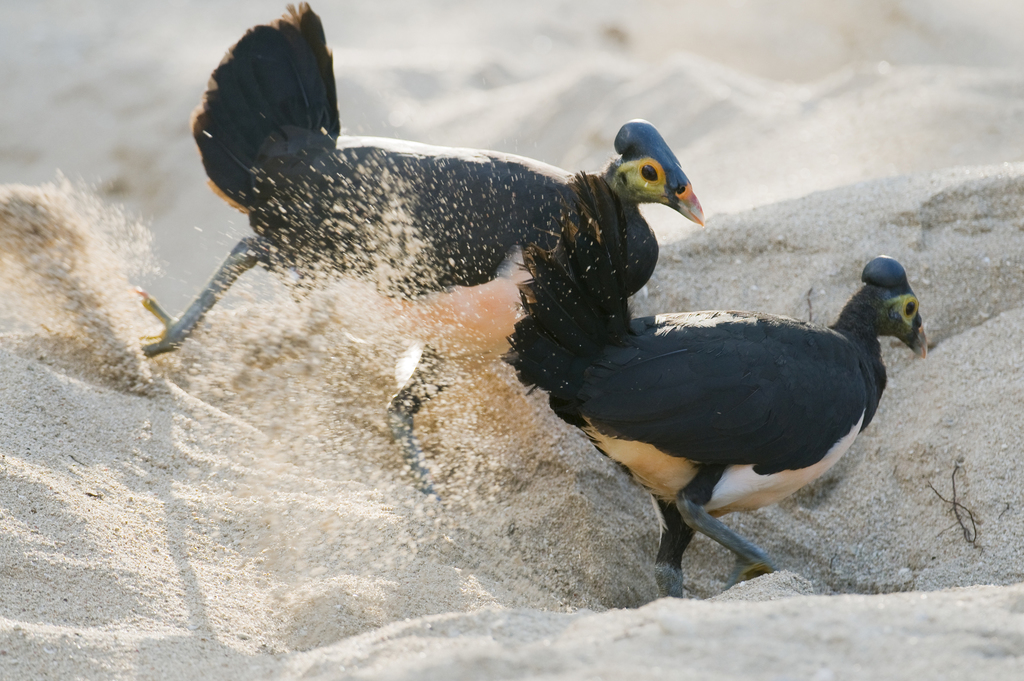
The maleo ranges from 55–60 cm (22–24 in) long with blackish plumage, bare yellow facial skin, reddish-brown iris, reddish-orange beak, and rosy salmon underparts. The crown is ornamented with a prominent, bony, dark casque - which is the origin of its genus name Macrocephalon (from the Greek makros meaning "large" and kephalon meaning "head"). The greyish blue feet have four long sharp claws, separated by a membranous web. The sexes are almost identical with a slightly smaller and duller female. Juvenile birds have largely brownish and paler heads with short blackish-brown crests and browner upper parts.
Range & habitat
This species is endemic to the Indonesian island of Sulawesi. It is usually not present on altitudes exceeding 1,000 meters and is usually found in lowland hills or rain forests. Ideal nesting locations include river banks, lake shores, and coastal areas of the island. Maleos are communal nesters. Maleos breed all year round, but peak breeding season varies depending upon the location on the island. When prepared to lay her eggs, the female maleo, accompanied by her mate, will leave the cover of the Sulawesian forest in search of historic coastal breeding grounds. Females can lay anywhere between 8–12 eggs over the course of a year. Once an optimal spot is chosen, the maleos dig a deep hole and lay the egg inside. After the egg is laid, the parents bury the egg securely in sand, sometimes covering the sand with other debris to better camouflage the hole. After the egg has been securely buried, the parents leave and never return, leaving the maleo chick to fend for itself. The hot sand of Sulawesi acts as an incubator for maleo eggs, which are warmed with geothermal heat or solar heat. A maleo chick is completely self-sufficient only hours after hatching. For this reason, maleo eggs are approximately five times the size of a domestic chicken's, as they contain nearly full-formed maleos inside. …
Wikipedia: “Breeding and habitat”
What it does
The maleo's egg is large, about five times as large as that of the domestic chicken's. The female lays and covers each egg in a deep hole in the sand and allows the incubation to take place through solar or volcanic heating. After the eggs hatch, the young birds work their way up through the sand and hide in the forest. The young birds are able to fly and are totally independent. They must find food and defend themselves from predators such as monitor lizards, reticulated pythons, wild pigs, and cats. The maleo is monogamous and members of a pair stay close to each other all the time. Its diet consists mainly of fruits, seeds, mollusks, ants, termites, beetles, and other small invertebrates.
Wikipedia: “Behaviour and ecology”
Listen
Looking for field recordings…
Where it lives
Recorded sightings
—
geo-referenced records in GBIF, from museums, herbaria and field observers.
Drag the globe to turn it. Dots are where records exist, not a range map; darker means more records.
In the old herbals & bestiaries

Treasury of Medical Matters of New Spain
Francisco Hernández · 1651 · p.770

Herbarium Portatile, Oder Behendes Kräuter- und Gewächs-Buch: Darinn nicht allein 1363. so wol Einheimische als Außländndische Kräuter mit Lateinisch und Deutscher Benennung abgebildet, sondern auch die meisten, so in der Medicin gebräuchlich, kürtzlich erkläret werden
Panckow, Thomas · 1656 · p.248
In the stacks
Searching the stacks…
Every page naming Macrocephalon maleo in the Biodiversity Heritage Library →
This page is assembled live from iNaturalist, GBIF, Wikipedia, the Source Library and the Internet Archive. It is not yet part of the hand-edited codex. iNaturalist taxon 2042.