On eBird ↗
Black-and-white Owl
Live sightings near you, the range map, bar charts of when it is seen, and Macaulay Library photos and recordings.
Black-and-white Owl
Strix nigrolineata
The black-and-white owl (Strix nigrolineata) is a species of owl in the family Strigidae.
From the article Black-and-white owl on Wikipedia (CC BY-SA), quoted section by section
Description
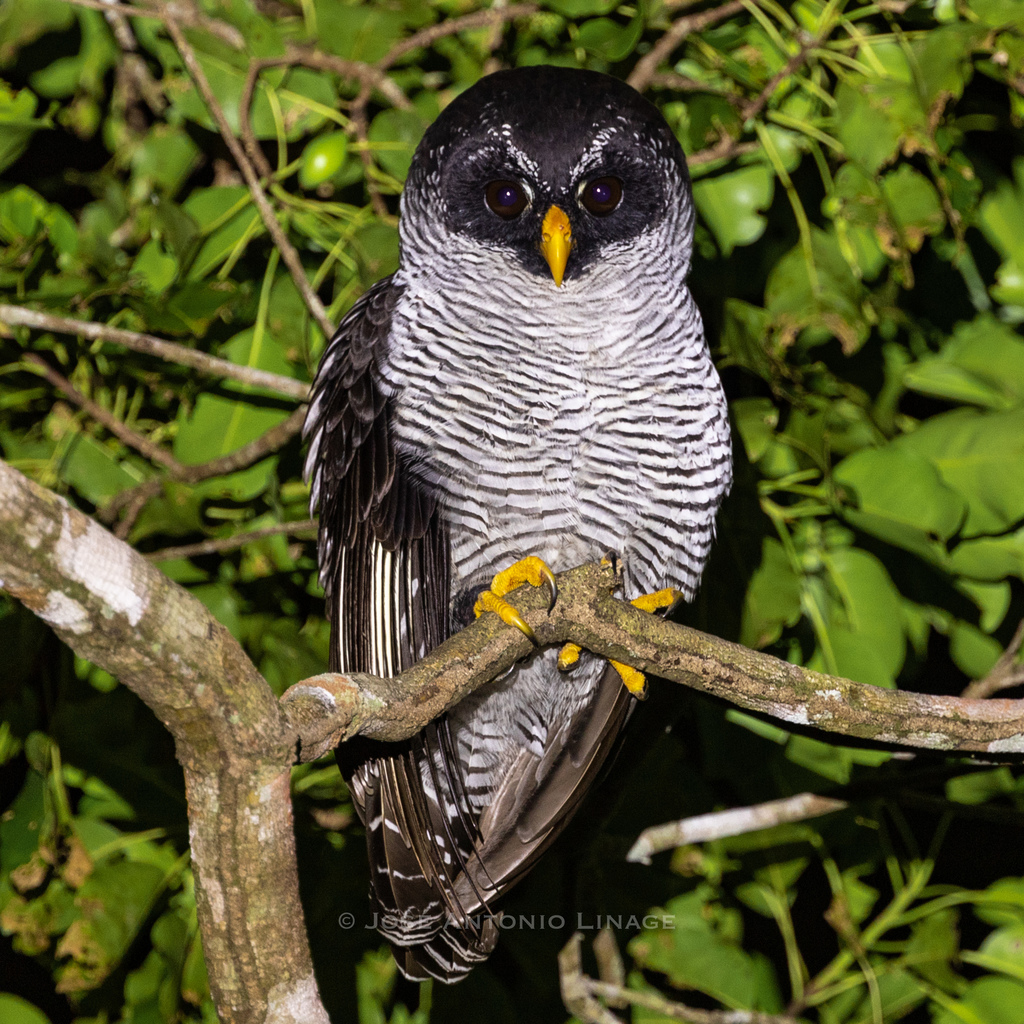
The black-and-white owl is a medium-sized owl with a round head and no ear tufts. It is between 35 and 40 cm in length and weigh between 400 and 535 grams. As for most owl species, females are usually bigger than males with an average weight of 487 g and 418 g respectively. It has a striped black-and-white breast, belly, and vent. With the exception of a black-and white striped collar, the upperparts from the crown to the tail are a sooty black. The facial disc is mostly sooty black, with white "eyebrows" that extend from the bill to the collar. The beak is a yellow-orange colour, and the eyes are a reddish brown. Chicks are downy and white. Juveniles have a whitish face, dark brown upper-parts and a white-barred black underside.
Range & habitat
The black-and-white owl is mostly found in gallery forests and rainforest, but is also found in wet deciduous and mangrove forests, usually at an altitude between sea level and 2400 meters. Small ponds are also often visited by this species when hunting. It usually nests in the foliage of large, tall trees such as mahogany. This owl is not afraid of living near human habitations.
Wikipedia: “Habitat”
What it does
This neotropical bird is a nocturnal hunter and since most of its prey can fly, it forages mostly at the canopy level of its habitat. It will first examine its surroundings by perching on an elevated branch. Then it will make short, silent flights to catch its food. Primarily insectivorous, the black-and-white owl prefers scarab beetles (Scarabaedidae) such as dung beetles and sometimes prey upon orthopterans and cicadas (Cicadidae). Bats such as the Jamaican fruit bat (Artibeus jamaicensis) and other small rodents also make up a large part of its diet. Furthermore, it can occasionally feed on smaller birds like thrushes and tanagers as well as amphibians. It is also one of the only tropical owl species reported to capture barn swallows since those are easy to catch when roosting on nearby electric lines.
Wikipedia: “Foraging and diet”
Listen
Looking for field recordings…
Where it lives
Recorded sightings
—
geo-referenced records in GBIF, from museums, herbaria and field observers.
Drag the globe to turn it. Dots are where records exist, not a range map; darker means more records.
In the stacks
Searching the stacks…
Every page naming Strix nigrolineata in the Biodiversity Heritage Library →
This page is assembled live from iNaturalist, GBIF, Wikipedia, the Source Library and the Internet Archive. It is not yet part of the hand-edited codex. iNaturalist taxon 20392.