On eBird ↗
Boreal Owl
Live sightings near you, the range map, bar charts of when it is seen, and Macaulay Library photos and recordings.
Boreal Owl
Aegolius funereus
The boreal owl or Tengmalm's owl (Aegolius funereus) is a small owl in the "true owl" family Strigidae. It is known as the boreal owl or, more rarely, Richardson's owl after Sir John Richardson, in North America, and as Tengmalm's owl in Europe and Asia, after the Swedish naturalist Peter Gustaf Tengmalm.
Due to its nocturnal habits and preferred inaccessible taiga forest habitat, it is rarely seen by humans; when met with, it is often extremely confiding, showing little or no fear of people, only flying off if approached to within 3–5 metres.
From the article Boreal owl on Wikipedia (CC BY-SA), quoted section by section
Description
The boreal owl is small with a large head and long wings. Both sexes are similar in appearance, though females are larger. Males typically measure 21–25 cm (8–10 in) in length, with a wingspan of 55–58 cm (22–23 in), while females are larger, 25–28 cm (10–11 in), with a wingspan of 59–62 cm (23–24 in). Females, weighing 132–215 g (4.7–7.6 oz), are heavier than males, which weigh 93–139 g (3.3–4.9 oz).
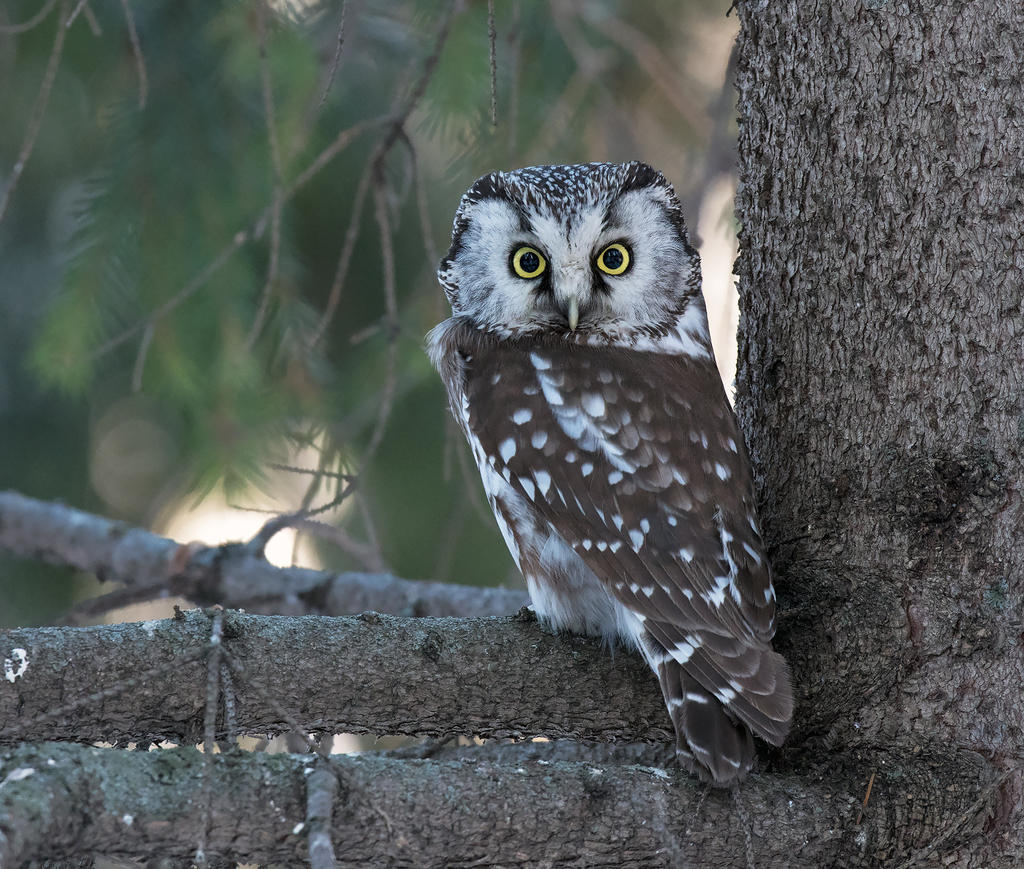
Adult identification. The plumage is brown above, with conspicuous pearly-white spots on the back and wings (giving it its Danish name of perleugle, "pearl owl"), and whitish underparts with rust-coloured streaks. Its large head has yellow eyes and an olive-brown crown with small white droplets and larger central spots. The dull white facial disc is framed with a dark border and white "eyebrows" often described as giving the owl a "surprised" expression. The underparts are cream-white with russet-brown streaks, while the tail has olive-brown feathers with narrow bars. Flight feathers are dark olive-brown with contrasting white spots. The primaries typically have up to five rows of white spots, while the tail has three distinct rows of spots. Unlike other owl species, these spots remain separated even when the tail is folded closely together. The beak is light yellow, rather than dark like its relative the northern saw-whet owl. …
Range & habitat
The boreal owl breeds in dense boreal, subalpine forest as well as mixed woodland. The preferred habitats are old-growth forests as they provide shelter from avian predators and an abundance of prey. Breeding habitats include boreal forests of black spruce, white spruce, birch, and aspen across northern North America and the Palearctic, and in mountain ranges such as the Alps and the Rockies. Nests can be found in aspen and mixed forests, while individuals roost in conifers of about 6 metres high. This species can travel long distances but are known to breed within 500 metres of their natal sites. Males have a higher site fidelity than females and occupy stable year-long home ranges. However, northern populations may migrate south in response to snow depth and poor prey availability, but eventually return to their breeding grounds.
Wikipedia: “Distribution and habitat”
What it does
Calls and related functions can be challenging to interpret because of their nocturnal and hard to locate lifestyle. Starting at one week old, young owls produce a harsh "peep" or "chirp" that softens after fledging. Comprehensive studies in North America have found 8 different types of calls that play an important role in communication, mating, and territorial behaviour:
The Primary Song – loud trill sung by males to attract females and establish territory The Prolonged Song – softer courtship melody sung by males from beginning of courtship to incubation to strengthen bonds The Delivery Call – soft call by male to signal the transfer of prey to a female or young The Screech – a load contact call made while flying or from a perch The Peeping Call – soft calls by females throughout breeding to respond to males' calls The Weak Call – single note repeated rapidly from females in nest after hatching The Chuuk Call – harsh response call by females on male's territory The Hiss Call – defensive call by females when the nest is disturbed Bill clapping is used as a protective sound by both adults and juveniles, and is frequently associated with vocal hiss. Young develop bill clapping at least one week before fledging. Adults reply with a bill clap when humans handle them or enter the nest cavity. Calls are similar in sound to the "winnowing" of the North American Wilson's snipe.
Wikipedia: “Vocal behaviour”
At the table
This small owl eats mainly voles and other mammals (such as mice, chipmunks, other squirrels, gophers, moles, shrews, and bats), but also birds as well as small amphibians, insects (such as beetles), and other invertebrates. In North America, they have been observed preying on southern red-backed voles, western heather voles, jumping mice, northern pocket gophers, and northern flying squirrels. Birds preyed upon include dark-eyed juncos, American robins, and redpolls. It is largely nocturnal, though in the northernmost parts of its range, it has to hunt during daylight because of the very short nights in summer. This species is an Ambush predator, meaning it does not pursue animals until they are within 10 metres of its hunting perch. Their extreme asymmetrical skulls leads to pinpoint sound in both horizontal and vertical directions, and allows them to capture prey under snow and dense vegetation.
Wikipedia: “Food and feeding behaviour”
In human culture
Remains of the boreal owl dating back to the Pleistocene era were found in a cave in southern New Mexico. Bones were found in a pueblo in north-central New Mexico that has been inhabited from around 1250 CE to the present.
Wikipedia: “Fossil history”
Listen
Looking for field recordings…
Where it lives
Recorded sightings
—
geo-referenced records in GBIF, from museums, herbaria and field observers.
Drag the globe to turn it. Dots are where records exist, not a range map; darker means more records.
In the stacks
Searching the stacks…
Every page naming Aegolius funereus in the Biodiversity Heritage Library →
This page is assembled live from iNaturalist, GBIF, Wikipedia, the Source Library and the Internet Archive. It is not yet part of the hand-edited codex. iNaturalist taxon 20359.