On eBird ↗
Marsh Owl
Live sightings near you, the range map, bar charts of when it is seen, and Macaulay Library photos and recordings.
Marsh Owl
Asio capensis
The marsh owl (Asio capensis) is a species of owl which is a mainly resident breeder in Africa and Madagascar.
From the article Marsh owl on Wikipedia (CC BY-SA), quoted section by section
Description
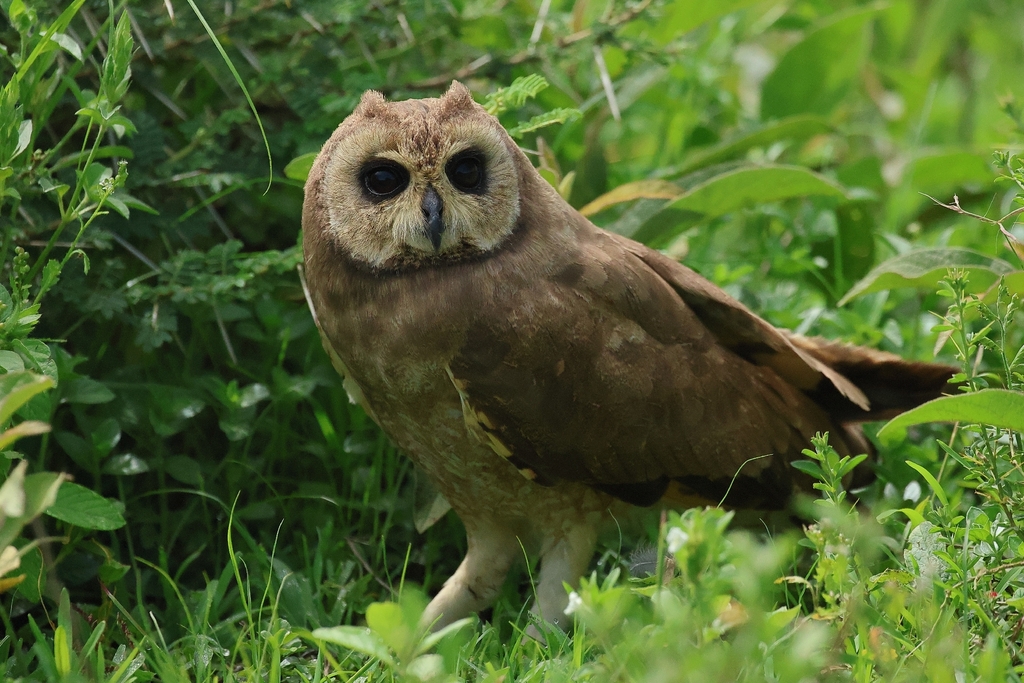
Medium-sized, dark brown with a pumpkin-shaped head with small 'ear' tufts. The facial disc is pale buff, with a distinct dark brown rim with buff speckles. There is a dark brown area around the eyes, which are also dark brown. Its ear-tufts are earth-brown and quite small, often not visible, and set near the centre of the forehead. The tail is dark brown, barred pale buff with a whitish tip. Tarsi are feathered pale tawny-buff and toes are covered with pale buffish plumes, leaving the dark brown tips bare. Claws are blackish. Males are generally paler than females, and there is some individual variation in tone. Length is 31–38 cm, wing length is 284–380mm, tail length is 132–186mm, and weight is 225–485g.
Range & habitat
The marsh owl's habitat preference is open grassland, marshlands and short scrub, typically near marshy grounds, vleis or dams. Marsh owls prefer to nest on the ground and they have also been observed leaving certain areas during drought-stricken times. Their preferred habitat tends to be vulnerable to destruction due to agriculture or overgrazing.
Wikipedia: “Habitat”
What it does
Marsh owls are typically found singly or in pairs. They are usually nocturnal; however, they are sometimes active during early morning and late afternoon. The marsh owl typically feeds on small rodents, insects and other small vertebrates. Prey items include mice, voles, rats, shrews, young hares, bats, birds up to the size of small ducks and doves, frogs, lizards, scorpions, beetles and grasshoppers.
Wikipedia: “Behavior and diet”
Listen
Looking for field recordings…
Where it lives
Recorded sightings
—
geo-referenced records in GBIF, from museums, herbaria and field observers.
Drag the globe to turn it. Dots are where records exist, not a range map; darker means more records.
In the stacks
Searching the stacks…
Every page naming Asio capensis in the Biodiversity Heritage Library →
This page is assembled live from iNaturalist, GBIF, Wikipedia, the Source Library and the Internet Archive. It is not yet part of the hand-edited codex. iNaturalist taxon 20327.