On eBird ↗
Long-eared Owl
Live sightings near you, the range map, bar charts of when it is seen, and Macaulay Library photos and recordings.
Long-eared Owl
Asio otus
The long-eared owl (Asio otus), also known as the northern long-eared owl or informally as the lesser horned owl or cat owl, is a medium-sized typical owl with an extensive range. The genus name, Asio, is Latin for "horned owl", and the specific epithet, otus, is derived from Greek and refers to a small eared owl. It breeds in Europe and the Palearctic, as well as in North America.
This owl prefers semi-open habitats, particularly woodland edge, as they to roost and nest within dense stands of wood but prefer to hunt over open ground. The long-eared owl primarily hunts small rodents, especially voles, but during population cycles of their regular prey, or in arid, insular, or urbanized habitats, it takes diverse prey including birds and insects. The long-eared owl utilizes nests built by other animals, in particular by corvids. Breeding success in this species is correlated with prey populations and predation risks. Unlike many owls, long-eared owls are not strongly territorial or sedentary. They are partially migratory or nomadic. Another characteristic of this species is its partiality for regular roosts shared by a number of long-eared owls at once. The long-eared owl is one of the most widely distributed and most numerous owl species in the world, and due to its very broad range and numbers it is considered a least concern species by the IUCN. Nonetheless, strong declines have been detected for this owl in several parts of its range.
From the article Long-eared owl on Wikipedia (CC BY-SA), quoted section by section
Description
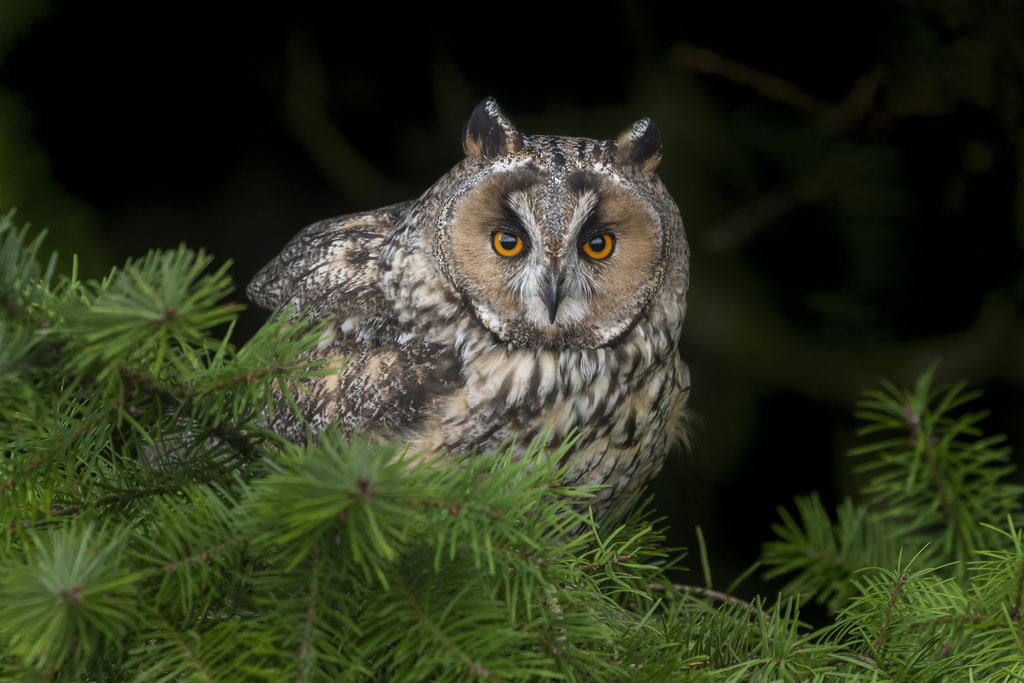
This species is a slim and long winged owl with erectile ear tufts, which are positioned closer to the center of the head than in many other types of owl. Ear tufts, present in about half of living owls, are conjectured to be a means of intraspecies communication of intent and mood. In general coloration, the long-eared owl is a hue of ochraceous-tawny with a grayish or brownish wash variably manifesting. The base color is overlaid with variable blackish vertical streaks (and occasionally spots), which are more apparent about the wings and back. The scapulars are marked whitish, which provide further contrast when seen against the base color and blackish markings. The wing's dark carpal patches can also display broad panels of buff or almost orange on the wings across the base of primaries, which represent an emphasized version of a pattern shared with other owls that tend to be vole-hunting specialists, like short-eared owls (Asio flammeus) and great gray owl (Strix nebulosa). On the underside, the body tends to be a somewhat paler ochraceous-tawny compared to the upperside. Long-eared owls tend to have dusky streaks on the upper breast, below which they may be heavily marked with herring bone pattern (which is created by dusky shaft-streaks and crossbars on these feathers). …
Range & habitat
The long-eared owl has an extremely large range. In Eurasia, they are distributed from the Iberian Peninsula and Britain and Ireland. From western France east through the remainder of Europe they are found nearly everywhere. In Scandinavia they are found only as a breeding species in about the southern two-thirds of Norway, Sweden and Finland while they persist year round in the southern tips of Norway and Sweden, respectively, as well as in all of Denmark. In coastal Norway they are found at their worldwide northern limit as breeding bird, with long-eared owls nesting as far north as in the Subarctic zone of Troms. In latitudinal range, they are found as far south the Azores, the Canary Islands while their limited breeding range in north Africa is from Morocco to Tunisia, as well as seemingly in northernmost Algeria. Out of Europe, they are found spottily as breeders in Turkey, northernmost Syria, Israel and Lebanon. They are broadly distributed within Russia, breeding in the southern two-thirds of the country (north as far as Chernyshevsky and Yakutsk) and occurring year around in about the southern third of it (north to the cities of Perm, Tyumen and Tomsk) and east to Siberia, ranging far as Sakhalin. Their range is continuous from Russia into most of Kazakhstan, Georgia, Kyrgyzstan, about half of Uzbekistan and infrequently into northern Afghanistan and Turkmenistan. …
Wikipedia: “Distribution and habitat”
What it does
Long-eared owls are nocturnal. Usually activity for the species commences at dusk. After nightfall, long-eared owls in Idaho were least active from 8-10 pm and from 5-6 am, while the hours around 10 pm -12 am and 3-5 am were often the peak times of activity. When living relatively close to the Arctic, long-eared owls may be forced to forage during daylight, as no full nightfall may occur during summer. When flying by day, long-eared owls are often mobbed by diurnal birds such as corvids and other birds of prey. Often long-eared owls will discharge a fairly large amount of pellets and drop them below regular day roosts. Unlike most other owls, the species has no territorial hunting ground. In Switzerland, 14 long-eared owls examined using radiotelemetry were found to have an average home range of 980 ha (3.8 sq mi). In the study, they required fields along borders of woodlands, avoiding completely treeless areas more so than they were prevalent in the environment. In the České Budějovice area of Czech Republic, 9 radiotagged owls were studied. Nearly equal numbers were found in suburban and urban areas, and urban ones used developed areas for more than 50% of their nocturnal activity while suburban ones used developed areas for less than half of their activities. …
Wikipedia: “Behaviour”
Listen
Looking for field recordings…
Where it lives
Recorded sightings
—
geo-referenced records in GBIF, from museums, herbaria and field observers.
Drag the globe to turn it. Dots are where records exist, not a range map; darker means more records.
In the old herbals & bestiaries

In the stacks
Searching the stacks…
Every page naming Asio otus in the Biodiversity Heritage Library →
This page is assembled live from iNaturalist, GBIF, Wikipedia, the Source Library and the Internet Archive. It is not yet part of the hand-edited codex. iNaturalist taxon 20307.