On eBird ↗
Comoro Scops-Owl
Live sightings near you, the range map, bar charts of when it is seen, and Macaulay Library photos and recordings.
Comoro Scops-Owl
Otus pauliani
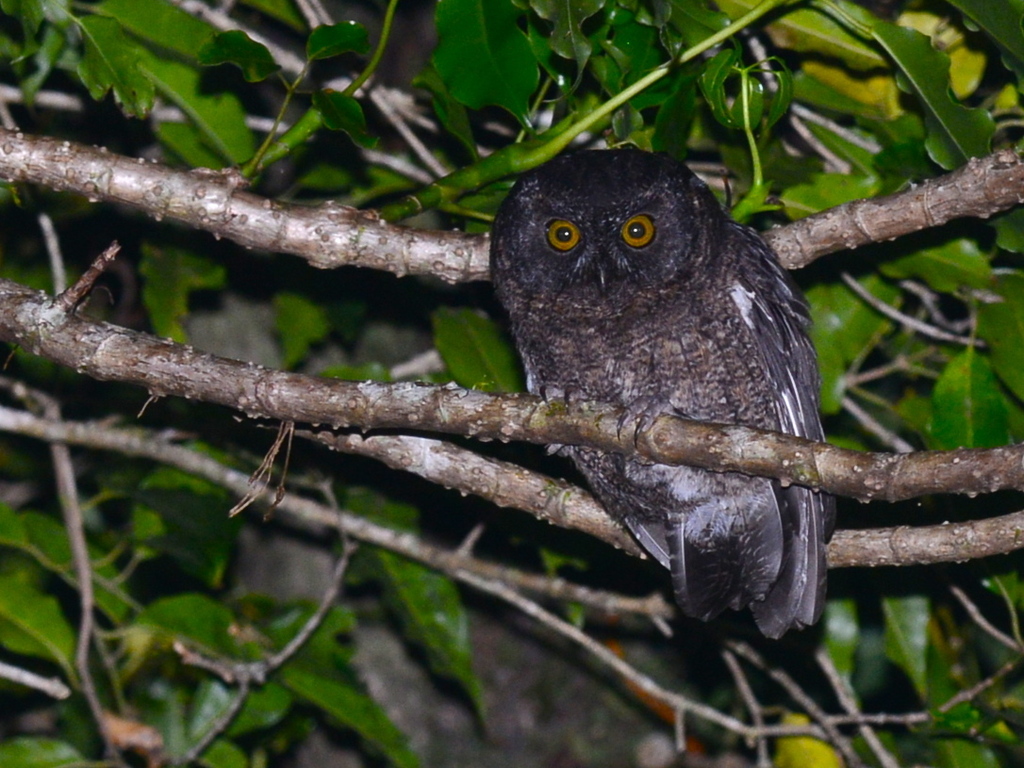
The Karthala scops owl (Otus pauliani), also known as the Grand Comore scops owl or Comoro scops owl, is a small scops owl endemic to the island of Grande Comore in the Comoro Islands.
From the article Karthala scops owl on Wikipedia (CC BY-SA), quoted section by section
Description
The Karthala scops owl lacks ear-tufts and comes in two colour forms, a light morph and a dark morph. The light morph is dark greyish-brown on the upperparts with fine barring and pale spots along the scapulars. The underparts are reddish-buff with a dense pattern of fine barring on the flight feathers and tail. The dark morph is overall dark chocolate brown but no specimen of a dark morph individual has been taken. It measures approximately 20 cm (7.9 in) in length and the wingspan is 45 cm (18 in).
Voice. Its call is a whistled "toot", which is given repeatedly with one second intervals.
Range & habitat
Endemic to the island of Grande Comore, the Karthala scops owl is found only on Mount Karthala, an active volcano. Here it inhabits the montane forest, some secondary growth and the tree-heath above the forest.
Wikipedia: “Distribution and habitat”
What it does
Nocturnal and very territorial, the Karthala scops owl will approach an imitation of its call, otherwise almost unknown. It has relatively weak talons so probably feeds on insects and other invertebrates. It is thought to nest in tree cavities.
Wikipedia: “Behaviour”
Listen
Looking for field recordings…
Where it lives
Recorded sightings
—
geo-referenced records in GBIF, from museums, herbaria and field observers.
Drag the globe to turn it. Dots are where records exist, not a range map; darker means more records.
In the stacks
Searching the stacks…
Every page naming Otus pauliani in the Biodiversity Heritage Library →
This page is assembled live from iNaturalist, GBIF, Wikipedia, the Source Library and the Internet Archive. It is not yet part of the hand-edited codex. iNaturalist taxon 20291.