On eBird ↗
Sokoke Scops-Owl
Live sightings near you, the range map, bar charts of when it is seen, and Macaulay Library photos and recordings.
Sokoke Scops-Owl
Otus ireneae
The Sokoke scops owl (Otus ireneae), also Morden's scops owl or Morden's owlet, is a highly localized species of scops owl found in lowland forests of Kenya and Tanzania. The greatest population of this species of owl is in the Cynometra-Manilkara forest, which is less than one-third of the Sokoke Forest. It is also found in the Afzelia-Cynometra forest.
The Sokoke scops owl can grow to 6+1⁄2 in (17 cm), and can weigh up to 2 oz (57 g), and is the smallest of the scops owls. It is insectivorous and coloring ranges from grey to rufous.
From the article Sokoke scops owl on Wikipedia (CC BY-SA), quoted section by section
Description
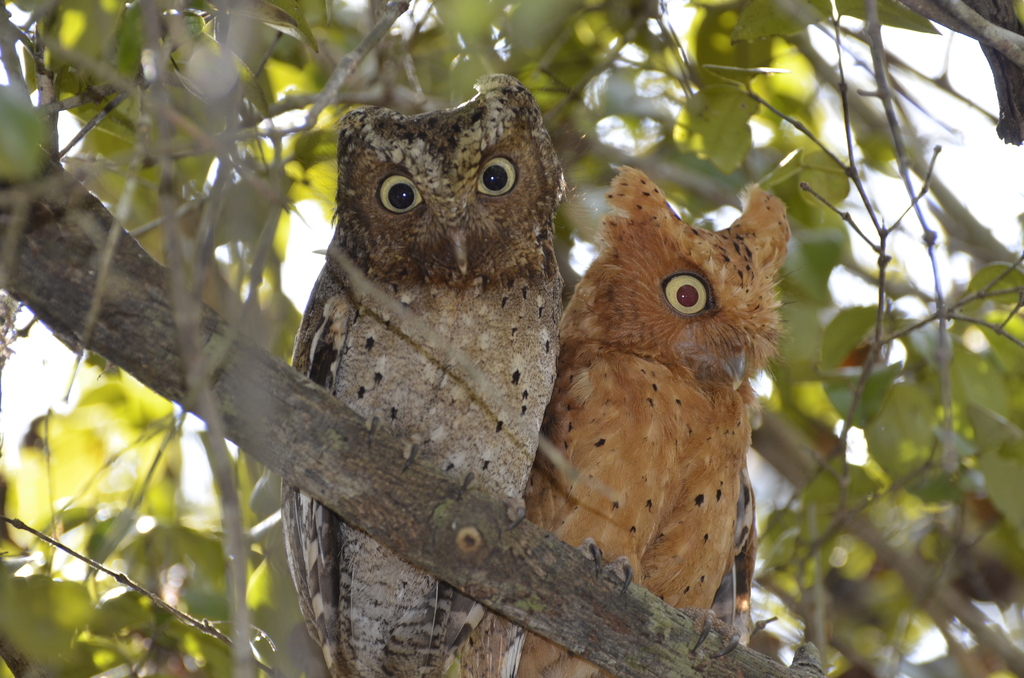
Sokoke scops owl is a fairly plain scops owl with small spotted markings on the underside. They are found in a number of color morphs ranging from grey through brown to an orange-rufous. Their call consists of a repetitive "too-too-too-too-too" reminiscent of the calls of tinkerbirds. Males have a higher-pitched, louder and clearer call compared to females, which have a softer, muffled, low-pitched call. They are territorial and pairs may duet in response to intruding conspecifics. The calling intensity of spontaneously calling owls varies with the time of night and phase of the moon.
Range & habitat
Sokoke scops owl have a highly restricted range in coastal Kenya and north-eastern Tanzania. It was first discovered in 1965 in the Arabuko-Sokoke Forest Reserve in coastal Kenya. Two other isolated populations have been subsequently discovered in the Dakatcha woodlands in Kenya and in the Manga and Kwamgumi forest reserves in the lowlands of the East Usambara mountains, Tanzania. Its global range is not thought to exceed 500 km2. Other isolated populations of this species may still persist in unsurveyed patches of suitable habitat.
Wikipedia: “Distribution”
What it does
Like other Otus owls, they are strictly nocturnal, making their biology difficult to study. They are most active immediately after dark and before dawn and travel further from their roost sites to forage when there is less illumination from the Moon. They roost in the dense understory of Cynometra trees during the day. The mean home-range of a pair is 11 ha and there is very little overlap with neighboring pairs.
Wikipedia: “Behaviour”
Listen
Looking for field recordings…
Where it lives
Recorded sightings
—
geo-referenced records in GBIF, from museums, herbaria and field observers.
Drag the globe to turn it. Dots are where records exist, not a range map; darker means more records.
In the stacks
Searching the stacks…
Every page naming Otus ireneae in the Biodiversity Heritage Library →
This page is assembled live from iNaturalist, GBIF, Wikipedia, the Source Library and the Internet Archive. It is not yet part of the hand-edited codex. iNaturalist taxon 20278.