On eBird ↗
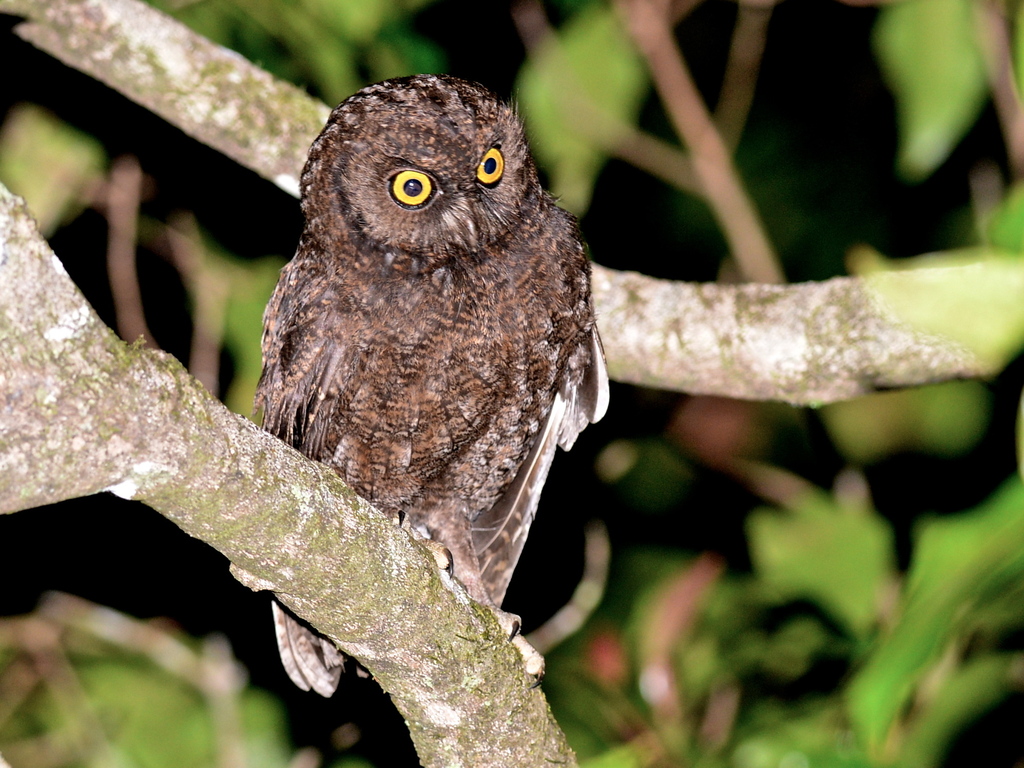
Anjouan Scops-Owl
Live sightings near you, the range map, bar charts of when it is seen, and Macaulay Library photos and recordings.
Anjouan Scops-Owl
Otus capnodes
The Anjouan scops owl (Otus capnodes) is an owl endemic to the island of Anjouan in the Comoro Islands.
From the article Anjouan scops owl on Wikipedia (CC BY-SA), quoted section by section
Description
The Anjouan scops owl occurs in chocolate and rufous colour phases and has very small ear-tufts compared to other scops owls. The former has fine buff bars on the head and neck, a dark brown face with fine streaks and brown underparts with very fine brown streaks and vermiculations. The latter has abdomen markings that contrasts more with the plumage. Body length is 15 cm (5.9 in) and the wingspan is 45 cm (18 in).
Voice. The call of the Anjouan scops owl is a distinctive drawn-out whistle, which is repeated often with short interludes. It has been likened to the "pee-oo" call of the grey plover. The local name is "badanga".
Range & habitat
The Anjouan scops owl is found only on the island of Anjouan, where it occurs in the remaining fragments of native upland forest, degraded forest and plantations. It appears to be dependent on large trees situated on steep slopes with cavities for nesting and roosting.
Wikipedia: “Distribution and habitat”
What it does
Little is known, but it probably nests and roosts in tree cavities and feeds mainly on insects.
Wikipedia: “Behaviour”
Listen
Looking for field recordings…
Where it lives
Recorded sightings
—
geo-referenced records in GBIF, from museums, herbaria and field observers.
Drag the globe to turn it. Dots are where records exist, not a range map; darker means more records.
In the stacks
Searching the stacks…
Every page naming Otus capnodes in the Biodiversity Heritage Library →
This page is assembled live from iNaturalist, GBIF, Wikipedia, the Source Library and the Internet Archive. It is not yet part of the hand-edited codex. iNaturalist taxon 20253.