On eBird ↗
Pemba Scops-Owl
Live sightings near you, the range map, bar charts of when it is seen, and Macaulay Library photos and recordings.
Pemba Scops-Owl
Otus pembaensis
The Pemba scops owl (Otus pembaensis) is a species of owl in the family Strigidae. It is endemic to Pemba Island which is part of and off the coast of Tanzania.
From the article Pemba scops owl on Wikipedia (CC BY-SA), quoted section by section
Description
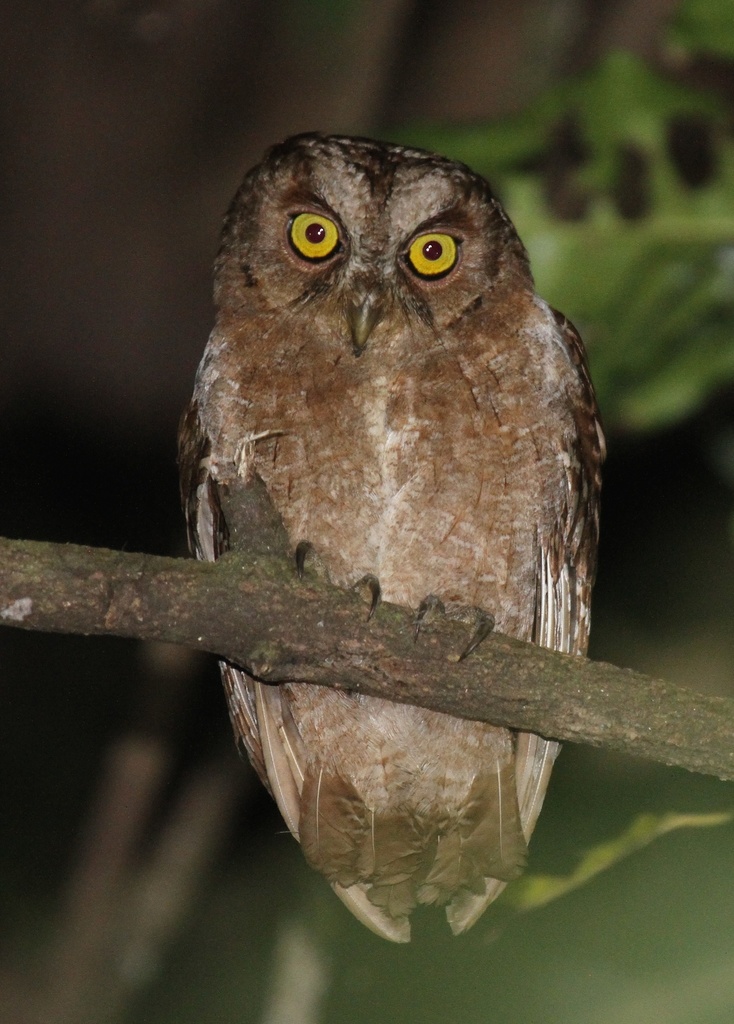
The Pemba scops owl is a medium-sized scops-owl with short ear-tufts. There are two colour morphs, a brown morph which is mainly pale rufous-brown with light streaking on the head and faint barring on paler underparts and a rufous morph which is a bright, rich rufous, that is paler on the underwing coverts. Both morphs show a pale scapular band, whitish in the brown morph and pale rufous in the rufous morph. The bill is black while the cere is greenish-yellow and the eyes and legs are yellow. It is 15 cm (5.9 in) tall with a 45 cm (18 in) wingspan.
Voice. The call is a single "hoo" note which is made at irregular intervals or in a vast rapid series of 4–6 notes given at intervals of half a second. The pair duets with the male calls being shorter, and lower in pitch.
Range & habitat
The Pemba scops owl is endemic to Pemba, the northern island of the Zanzibar archipelago, part of Tanzania, off the coast of east Africa. On Pemba this owl is found in all wooded habitats from native forest to overgrown plantations of cloves and mango. However, it is most common in native forest.
Wikipedia: “Distribution and habitat”
What it does
The biology of the Pemba scops owl is little known. It is nocturnal and roosts among foliage or in dense undergrowth during the day. It starts calling soon after sunset and then hunts. Its diet is mainly insects which may be caught in flight, gleaned from leaves or caught on the ground after a short glide from a perch. The breeding behaviour is almost unknown, although it possibly breeds from August to October and nests in natural holes in trees.
Wikipedia: “Behaviour”
Listen
Looking for field recordings…
Where it lives
Recorded sightings
—
geo-referenced records in GBIF, from museums, herbaria and field observers.
Drag the globe to turn it. Dots are where records exist, not a range map; darker means more records.
In the stacks
Searching the stacks…
Every page naming Otus pembaensis in the Biodiversity Heritage Library →
This page is assembled live from iNaturalist, GBIF, Wikipedia, the Source Library and the Internet Archive. It is not yet part of the hand-edited codex. iNaturalist taxon 20211.