- Animals
- ›Arthropods
- ›Hexapods
- ›Insects
- ›Winged and Once-winged Insects
- ›Ants, Bees, Wasps, and Sawflies
- ›Narrow-waisted Wasps, Ants, and Bees
- ›Ants, Bees, and Stinging Wasps
- ›Formicoidea
- ›Ants
- ›Odorous Ants
- ›Leptomyrmecini
- ›Iridomyrmex
- ›Iridomyrmex purpureus
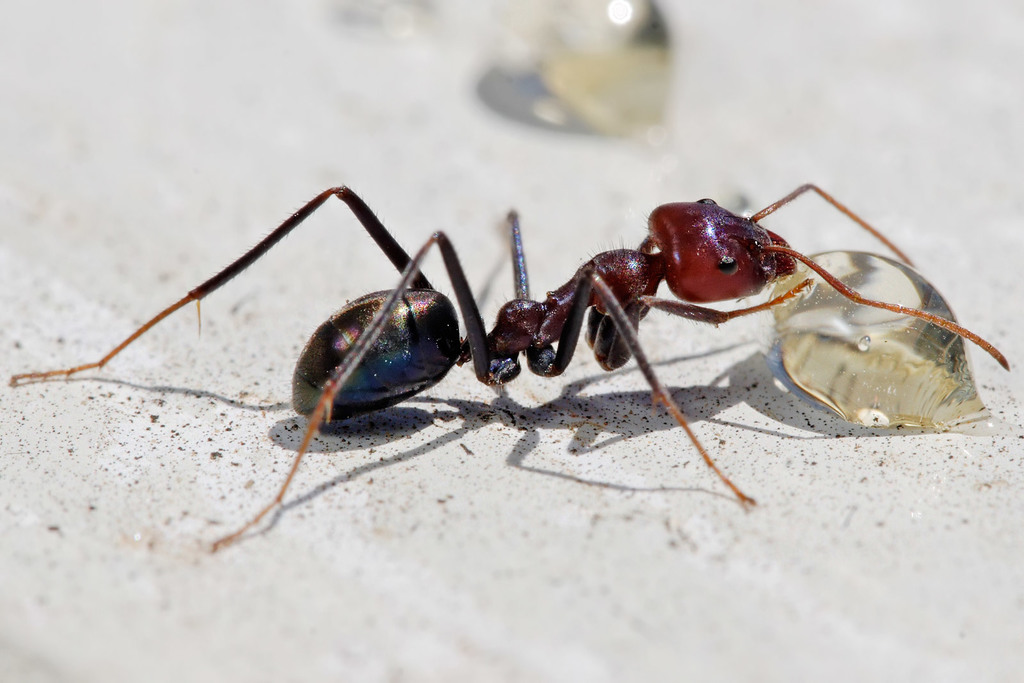
Southern Meat Ant
Iridomyrmex purpureus
The meat ant (Iridomyrmex purpureus), also known as the gravel ant or southern meat ant, is a species of ant endemic to Australia. A member of the genus Iridomyrmex in the subfamily Dolichoderinae, it was described by British entomologist Frederick Smith in 1858. The meat ant is associated with many common names due to its appearance, nest-building behaviour and abundance, of which its specific name, purpureus, refers to its coloured appearance. It is among the best-known species of ant found throughout Australia; it occurs in almost all states and territories except for Tasmania. Its enormous distribution, aggression and ecological importance have made this ant a dominant species.
The meat ant is monomorphic (occurs in a particular form), although there is evidence that certain populations can be polymorphic. It is characterised by its dark-bluish body and red head. It is a medium to large species, measuring 6–12 mm (0.24–0.47 in). The workers and males are approximately the same sizes at 6–7 mm (0.24–0.28 in) and 8 mm (0.31 in), respectively. The queens are the largest and appear mostly black, measuring 12.7 mm (0.50 in). The iridescence in workers ranges from green or blue to plain green and purple, varying in different body parts and castes. Meat ants inhabit open and warm areas in large, oval-shaped mounds that are accompanied by many entrance holes. The nest area is always cleared of vegetation and covered with materials including gravel, pebbles and dead vegetation.
From the article Meat ant on Wikipedia (CC BY-SA), quoted section by section
Description
In general, meat ants are medium to large in size, measuring 6–12 mm (0.24–0.47 in), and can be easily recognised by their dark-bluish body and red head. Generally, their heads and pronotums share similar colours and are lighter than the mesothorax (the middle of the three segments in the thorax) and the propodeum (the first abdominal segment), which are reddish brown. However, the head may sometimes be lighter, and the pronotum and mesothorax may share similar colours. The mesosomal setae (as in hair found on the mesosoma) are dark and sometimes translucent. The iridescence between the compound eyes and the lateral portion of the head ranges from slightly purple to strong and dark purple. The colour of the legs and coxae (the basal segment of the insect leg, which attaches to the body) are darker than the mesothorax, and the petiole (narrow waist) is reddish brown and also darker than the mesothorax. The lateral portion of the second gastral tergite (a dorsal segment other than the head) is shiny, and the iridescence varies among workers, from green or blue to plain green and purple. The soft hairs on the head are frequent around the occipital margin, and around the mandibular insertion, three to eight pale setae are usually seen. The soft hairs are also common around the first gastral tergite. Examined specimens show no known ocelli. Erect setae on the pronotum are abundant. …
Range & habitat
The meat ant is one of the best-known species of ant endemic to Australia; it has an enormous geographical range, covering at least one-third of the continent. Its range spans 4,000 kilometres (2,500 mi) from east to west, and 3,000 kilometres (1,900 mi) from north to south. This extensive range has allowed the meat ant to form large nesting grounds in areas where no development has occurred, and large amounts of gravel and open space have led to an abundant supply of materials (i.e. pebbles and dead pieces of vegetation) used to construct nests. The ant is particularly dominant and frequently seen across the coastal and inland regions of southeastern Australia. Based on examined material, meat ants are widespread throughout New South Wales, the Australian Capital Territory and Victoria. In Queensland, they are frequently encountered in the eastern regions, whereas their abundance is limited around the north and central parts. The ants are common in the southwestern regions of Western Australia, though not in the north. However, the Division of Entomology of the CSIRO states that the ant's presence in the state has not been verified. Most specimens collected in South Australia are from the south-east, but some populations are known in the north-west and northeast regions of the state. …
Wikipedia: “Distribution and habitat”
What it does
Like other Iridomyrmex species, the meat ant is an omnivore, retrieving food sources from various insects it tends, including caterpillars and various sorts of butterflies, particularly the larvae of the Waterhouse's hairstreak (Jalmenus lithochroa). Meat ants usually feed on honeydew from sap-sucking insects, flower nectar, sugar and other sweet substances. In captive colonies, workers prefer to consume small pieces of grapes rather than honey solutions and other sweet foods. These ants prey on various insects and animals, collecting both live and dead invertebrates and acquire meat from dead vertebrates. Insects the meat ants prey on include giant lacewings, which they swarm up trees to kill, the butterfly genoveva azure Ogyris genoveva, Indian mealmoths, almond moths, the Western Australian jarrah leafminer and the larvae of the wasp Trichogramma. Large and developed larvae of the cabbage butterfly (Pieris rapae) are attacked more effectively by meat ant workers than those of other Iridomyrmex species. On sandy beaches, this species is observed preying on the polychaete annelid worm, Armandia intermedia, causing high mortality rates on them (rates of 30 percent). These ants will feed on a number of dead or alive animals, including metamorphic crucifix toads, snakes, lizards, and birds. On some occasions, swarms of workers have been found on dead foxes. …
Wikipedia: “Diet”
In human culture
The specific epithet of the meat ant, purpureus, derives from Latin, in which it means "purple", "purple-coloured" or "dark-red", referencing the coloured appearance of the ant. In classical Latin, purpureus primarily translated to "dyed purple", while the word purpura, used by Smith for the meat ant (Formica purpura), translates to "purpled-dyed cloth". The generic name, Iridomyrmex, translates to "rainbow ants" from Ancient Greek, another reference which points to its appearance. This, in particular, is due to its blue-green iridescence colour. It is a compound of two Ancient Greek words – iris, meaning "rainbow", and myrmex, that means "ant". The ant is commonly known as the meat ant because of its habit of stripping the meat off dead vertebrates. Alternative names include the gravel ant, Greenslade's meat ant, meat-eater ant, mound ant, or southern meat ant. The name "southern meat ant" is due to its extreme abundance in the southern regions of Australia.
Wikipedia: “Etymology and common names”
Listen
Looking for field recordings…
Where it lives
Recorded sightings
—
geo-referenced records in GBIF, from museums, herbaria and field observers.
Drag the globe to turn it. Dots are where records exist, not a range map; darker means more records.
In the stacks
Searching the stacks…
Every page naming Iridomyrmex purpureus in the Biodiversity Heritage Library →
This page is assembled live from iNaturalist, GBIF, Wikipedia, the Source Library and the Internet Archive. It is not yet part of the hand-edited codex. iNaturalist taxon 202000.