- Animals
- ›Arthropods
- ›Hexapods
- ›Insects
- ›Winged and Once-winged Insects
- ›Ants, Bees, Wasps, and Sawflies
- ›Narrow-waisted Wasps, Ants, and Bees
- ›Ants, Bees, and Stinging Wasps
- ›Formicoidea
- ›Ants
- ›Ectaheteromorph Ants
- ›Ectatommini
- ›Rhytidoponera
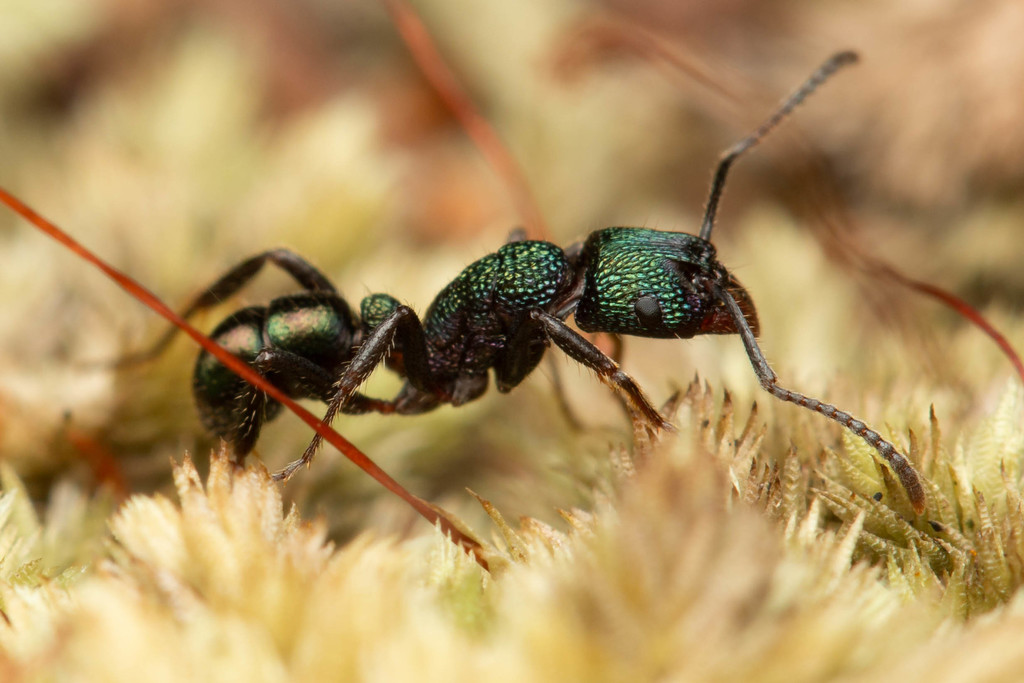
Green-head Ant
Rhytidoponera metallica
The green-head ant (Rhytidoponera metallica) is a species of ant that is endemic to Australia. It was described by British entomologist Frederick Smith in 1858 as a member of the genus Rhytidoponera in the subfamily Ectatomminae. These ants measure between 5 and 7 mm (0.20 and 0.28 in). The queens and workers look similar, differing only in size, with the males being the smallest. They are well known for their distinctive metallic appearance, which varies from green to purple or even reddish-violet. Among the most widespread of all insects in Australia, green-head ants are found in almost every Australian state, but are absent in Tasmania. They have also been introduced in New Zealand, where several populations have been established.
This species lives in many habitats, including deserts, forests, woodland and urban areas. They nest underground below logs, stones, twigs, and shrubs, or in decayed wooden stumps, and are sometimes found living in termite mounds. They are among the first insects to be found in burnt-off areas after the embers have stopped smouldering. Rain presents no threat to colonies as long as it is a light shower in continuous sunshine. The green-head ant is diurnal, active throughout the day, preying on arthropods and small insects or collecting sweet substances such as honeydew from sap-sucking insects. They play an important role in seed dispersal, scattering and consuming seeds from a variety of species. Predators include the short-beaked echidna (Tachyglossus aculeatus) and a number of bird species.
From the article Green-head ant on Wikipedia (CC BY-SA), quoted section by section
Description
In general, green-head ants are monomorphic (occurs in a single form), measuring 5 to 7 mm (0.20 to 0.28 in) in length and varying in colour, ranging from green-blue to green-purple. Their exoskeletons are hard and heavily armoured with a single-segmented waist. The queens measure 7.4 mm (0.29 in) with the head, thorax, and abdomen exhibiting various metallic colours. The head is usually green behind the eyes and ferruginous (rust in colour) at the front with a less obvious purple tint between the colours. The antennae are ferruginous and the eyes are ovate (shape resembling an egg). The head is emarginate (having a notched tip or edge) from its posterior view and also rugose, along with the thorax and node (a segment between the mesosoma and gaster); these body parts are covered with large confluent punctures. The basal segment of the abdomen has transversely curved striae (grooves which run across the body). The colour of the thorax is usually greenish, the wings are subhyaline (they have a glassy appearance), and the nervures (the veins of the wings) are testaceous (brick-red colour). The legs and apex are ferruginous, and the abdomen is purple. The workers and queens closely resemble each other, making the two castes hard to distinguish, but the workers differ in having a compressed and elongated thorax, and an abdomen that is predominately green-tinted. …
Range & habitat
The green-head ant is among the most widespread of all insects endemic to Australia. The ant is found throughout Victoria, New South Wales, the Australian Capital Territory and South Australia. It can be found in most areas of Western Australia but is less common in the north, and is present in the lower regions of the Northern Territory and east of Queensland. They are not present in Tasmania. The green-head ant is an introduced species to New Zealand and was first seen in 1959. Populations of the ant were probably introduced into the country on cargoes of timber; a number of other Rhytidoponera species were most likely introduced the same way. Populations have been established in Napier, as the ants were collected in the town between 2001 and 2003. Nests were previously found in the suburb of Penrose in Auckland and Mount Maunganui, but no specimens have been collected there since the 1960s. The habitat of the green-head ant varies, ranging from desert, heath, open forests, urban areas and woodland. These ants mainly live in moderate wooded or open areas, but they are abundant in lawns and gardens in cities. Nests have been found in dry and wet sclerophyll woodland, mallee, savannah woodland, on roadsides, and in native vegetation. Green-head ants are mostly found at altitudes of between 5 and 1,000 m (16 and 3,281 ft) above sea level. …
Wikipedia: “Distribution and habitat”
What it does
Colonies show variation as to favoured nest location, with some, for example, avoiding nesting under small rocks and preferring larger ones, which apparently promote colony growth. The promotion of colony growth is associated with territory size, border disputes, the increase of alates (fertile females and males), colony survival, and stable worker production. Colony growth under smaller rocks is slow and restricted. A colony that increases in size requires a larger space to accommodate such growth and the extra brood and workers. Despite this, green-head ants do not discriminate among rocks according to their thickness or temperature. Instead, they choose a rock based on its ground cover dimensions. The distance of a rock is also important; colonies move no more than 3 metres (9.8 ft) to a rock they prefer. This suggests that the cost of moving to a suitable nesting site outweighs the benefits of moving to a larger rock. A large expenditure of energy is required for a move: scouts must first find a suitable site, brood must be transported safely, and the colony is exposed to an increased risk of predation. Nest abandonment by the green-head ant varies, but peaks during summer. Like other temperate species, activity in colonies is greatly reduced during the colder months, which may be the reason there is a high proportion of nest abandonment during summer. …
Wikipedia: “Behaviour and ecology”
Listen
Looking for field recordings…
Where it lives
Recorded sightings
—
geo-referenced records in GBIF, from museums, herbaria and field observers.
Drag the globe to turn it. Dots are where records exist, not a range map; darker means more records.
In the stacks
Searching the stacks…
Every page naming Rhytidoponera metallica in the Biodiversity Heritage Library →
This page is assembled live from iNaturalist, GBIF, Wikipedia, the Source Library and the Internet Archive. It is not yet part of the hand-edited codex. iNaturalist taxon 201975.