On eBird ↗
Barking Owl
Live sightings near you, the range map, bar charts of when it is seen, and Macaulay Library photos and recordings.
Barking Owl
Ninox connivens
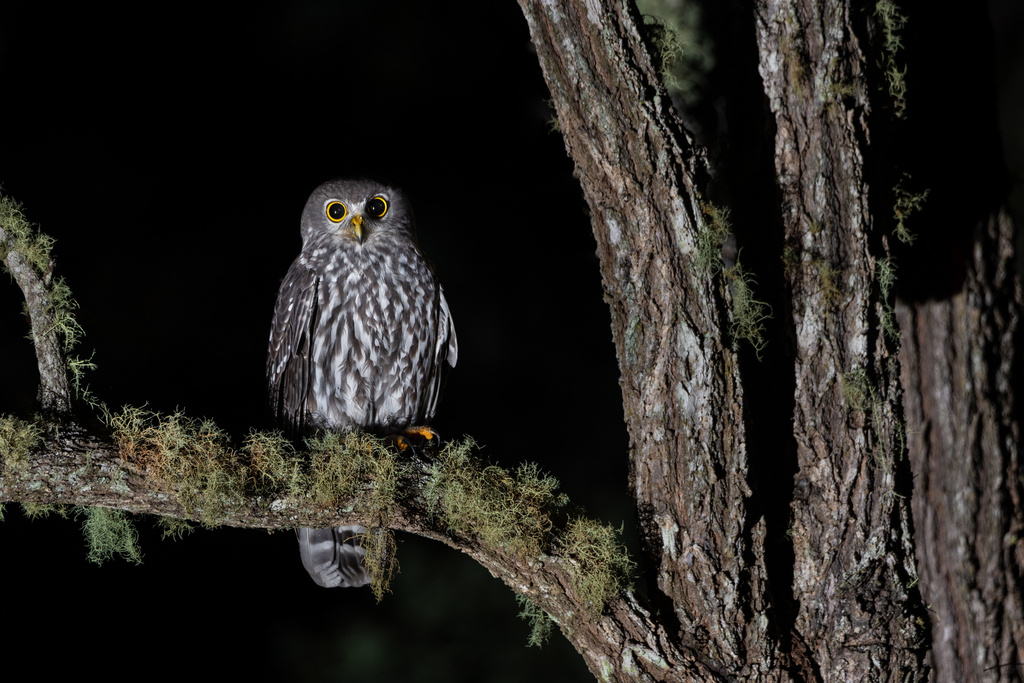
The barking owl (Ninox connivens), also known as the winking owl, is a nocturnal bird species native to mainland Australia and parts of Papua New Guinea and the Moluccas. They are a medium-sized brown owl and have a characteristic voice with calls ranging from a barking dog noise to a shrill human-like howl of great intensity.
From the article Barking owl on Wikipedia (CC BY-SA), quoted section by section
Description
The barking owl is coloured brown with white spots on its wings and a vertically streaked chest. They have large eyes that have a yellow iris, a discrete facial mask and yellow skin on the feet. Their underparts are brownish-grey and coarsely spotted white with their tail and flight feathers being strongly banded brown and white. They are a robust, medium-sized owl 39–44 cm (15–17 in) long and their wingspan is between 85 and 120 cm (33 and 47 in). They weigh between 380 and 960 g (13 and 34 oz)[p20] Size varies only slightly between the male and female birds with the male barking owl being 8-10 % heavier. In a banding study conducted in the Pilliga forests of northern New South Wales, males averaged 824 g (29.1 oz) with females averaging 745 g (26.3 oz)[p20]. In Australia, the smallest barking owls are found on Cape York Peninsula and the largest in southern Australia.
Range & habitat
The barking owl lives in mainland Australia along the eastern and northern coast of the continent and the southwest areas surrounding Perth, Western Australia. Inland they occupy areas near lakes and waterways or other wooded environments. They also live in drier parts of New Guinea and the Moluccas (Halmahera, Morotai, Bacan and Obi). Once widespread, barking owls are now less common in southern mainland Australia. They choose to live in forests or woodland areas that have large trees for nesting and foliage cover for roosting. They often reside near river, swamp or creek beds as these features often have large trees with hollows required for nesting and the productivity to support sufficient prey. The only detailed studies of barking owl home-ranges have been conducted in southern Australia where the species is declining. In northern Victoria, barking owl pairs were found to average a home-range of 1,424 ha (3,520 acres) with little overlap between pairs. Foraging was concentrated within forested areas of each home range. These results are mirrored in the Pilliga forests of northern NSW although there the home ranges were larger, often up to 2,500 ha (6,200 acres).
Wikipedia: “Distribution and habitat”
What it does
The barking owl has one of the broadest diets of any Australian owl. Barking owls hunt in timbered and open habitats but usually rely on trees as hunting perches. Their diet includes prey taken from the ground, the trees, the surface of waterbodies, and directly from the air. In some locations mammals make up the majority of prey biomass with prey sizes from mice, rats, and small carnivorous marsupials up to rabbits, young hares, and brushtail possums around a kilogram or more in weight. Sugar gliders are a frequent prey item. Bats of all sizes are also commonly taken. It also occasionally takes house cats. In some areas, bird prey items make a sizeable contribution to the diet. Birds up to the size of Australian magpies, sulphur-crested cockatoos (~800 grams), and ducks are taken, but many smaller roosting birds, such as passerines, are more commonly taken. One frequent prey item is the tawny frogmouth, a nocturnal bird of Australian forests and woodlands. Insect prey items can dominate the prey item count. Beetles and moths are commonly taken on the wing. A range of other insects are also consumed. Occasionally frogs, reptiles, fish or crustaceans are eaten. In summary, if an animal can be detected by a barking owl and it is of its size or smaller, it can be considered as potential prey.[pp8–11, 35-77]
Wikipedia: “Diet”
In human culture
The owl takes its name from its characteristic barking voice. For a short period before 2016, the Red List of Threatened Species referred to this species as the "barking boobook". However, this is not used as a common name in Australia or other English speaking areas in this species' range and has now been corrected to barking owl. The Yanyuwa name for the owl is mulurrku.
Wikipedia: “Etymology”
Listen
Looking for field recordings…
Where it lives
Recorded sightings
—
geo-referenced records in GBIF, from museums, herbaria and field observers.
Drag the globe to turn it. Dots are where records exist, not a range map; darker means more records.
In the stacks
Searching the stacks…
Every page naming Ninox connivens in the Biodiversity Heritage Library →
This page is assembled live from iNaturalist, GBIF, Wikipedia, the Source Library and the Internet Archive. It is not yet part of the hand-edited codex. iNaturalist taxon 20166.