- Animals
- ›Arthropods
- ›Hexapods
- ›Insects
- ›Winged and Once-winged Insects
- ›Butterflies and Moths
- ›Butterflies
- ›Skippers
- ›Spread-wing Skippers
- ›Checkered-Skippers, White-Skippers, and Allies
- ›Pyrgus
- ›Pyrgus malvae
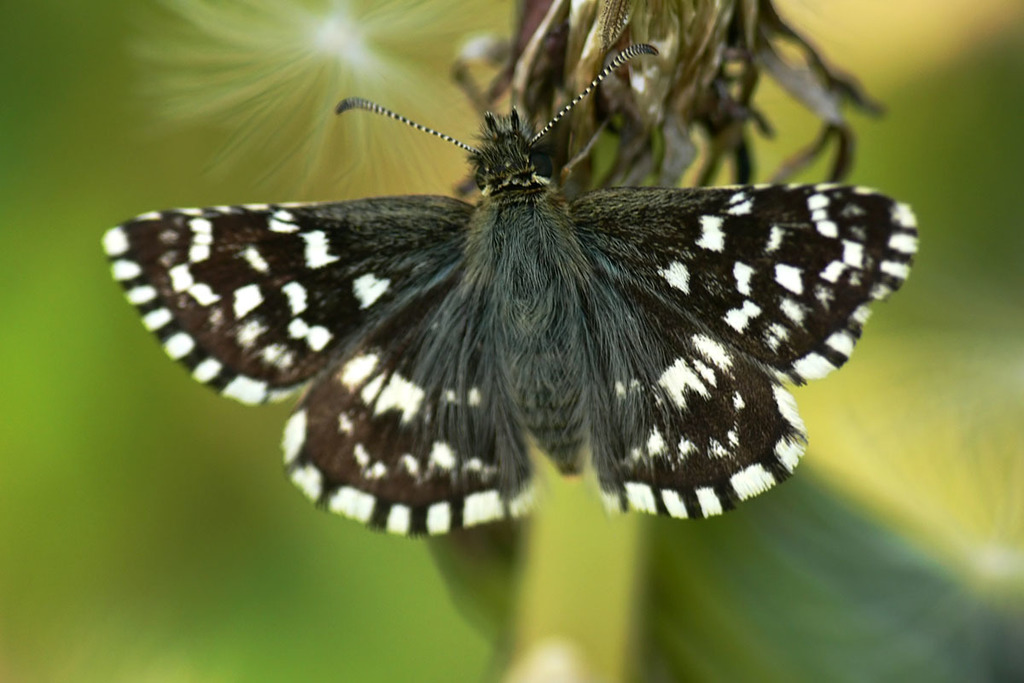
Grizzled Skipper
Pyrgus malvae
Pyrgus malvae, the grizzled skipper, is a butterfly species from the family Hesperiidae. It is a small skipper (butterfly) with a chequered pattern on its wings that appears to be black and white. This butterfly can be found throughout Europe and is common in central and southern regions of England. The butterfly prefers three major types of habitat: woodland, grassland, and industrial. Referenced as a superspecies, Pyrgus malvae includes three semispecies: malvae, malvoides, and melotis. Eggs are laid on plants that will provide warmth and proper nutrition for development. As larvae, their movement is usually restricted to a single plant, on which they will build tents, unless they move onto a second host plant. Larvae then spin cocoons, usually on the last host plant they have occupied, where they remain until spring. Upon emerging as adult butterflies, grizzled skippers are quite active during the day and tend to favour blue or violet-coloured plants for food. They also possess multiple methods of communication; for example, vibrations are used to communicate with ants, and chemical secretions play a role in mating. Exhibiting territorial behaviour, males apply perching and patrolling strategies to mate with a desired female.
From the article Pyrgus malvae on Wikipedia (CC BY-SA), quoted section by section
Description
With its characteristic chequered black-and-white pattern, the grizzled skipper is quite distinctive. It is small, with an average forewing diameter of 12 millimeters, and closely resembles moths in appearance. Males and females can be differentiated by the shape of their wings: males have slightly more angular wings, while females have a more rounded wing shape. Larvae are coloured green and light brown with darker brown stripes. Seitz describes malvae "The terminal row of white dots developed, at least on the hindwing. Underside of hindwing reddish, with distinct white dots, those of the subterminal band being rounded. Veins bordered with yellowish white or white. In ab. taras Bergstr.(86a) the white spots of the forewing are united to form bands; occurs singly among ordinary specimens. Europe, Asia from the Mediterranean Sea to the Amur; Mongolia. — Larva yellowish grey, minutely dotted with greenish, the dots bearing short thin hairs, dorsal line darker, spiracles yellowish; in June and October on Potentilla, Dipsacus, Strawberry, Raspberry, and other plants. The butterflies are on the wing in April and May and again from the end of July onwards, on sunny slopes, roads among fields and clearings in woods, being common everywhere in Central Europe.
Range & habitat
Pygrus malvae can be found throughout Western Europe in northern Scandinavia, parts of Greece, and some of the Mediterranean Islands. Its populations in many European countries appear to be quite stable. It is also present in Korea, as well as throughout the Mediterranean up to Middle Finland, and rarely in parts of Germany.
Wikipedia: “Geographic range”
What it does
The wings of Pygrus malvae are only mildly adhesive, rough, and highly hydrophobic. These qualities prevent their wings from sticking to external surfaces, support their resistance to water damage, and allow the butterfly to self-clean its wings without risking desiccation. Additionally, these properties enable the grizzled skipper to avoid excess weight bearing, consequently promoting secure and efficient flight patterns.
Wikipedia: “Wing structure effect on flight behaviour”
At the table
Studies support a concentrated preference for specifically coloured flowers by grizzled skippers. They are most attracted to blue and violet while showing little or no attraction to white, yellow, or red. Butterflies have ultraviolet and blue receptors that may be responsible for Hesperiidae butterflies favoring blue. This evidence indicates that when butterflies from this species forage for food, they are particularly attentive to short-wavelength light that is reflected off flowers. In fact, this particular preference aligns with a prominent attentiveness that members of Hesperiidae have for blue. This preference may be a result of phylogenetic adaptations, foraging signals, and learning abilities. Specifically, the prevalence of blue flowers in lowlands could further intensify this preference, especially for grizzled skippers that tend to be found in lowland grasslands.
Wikipedia: “Adult food preference”
Listen
Looking for field recordings…
Where it lives
Recorded sightings
—
geo-referenced records in GBIF, from museums, herbaria and field observers.
Drag the globe to turn it. Dots are where records exist, not a range map; darker means more records.
In the stacks
Searching the stacks…
Every page naming Pyrgus malvae in the Biodiversity Heritage Library →
This page is assembled live from iNaturalist, GBIF, Wikipedia, the Source Library and the Internet Archive. It is not yet part of the hand-edited codex. iNaturalist taxon 201519.