On eBird ↗
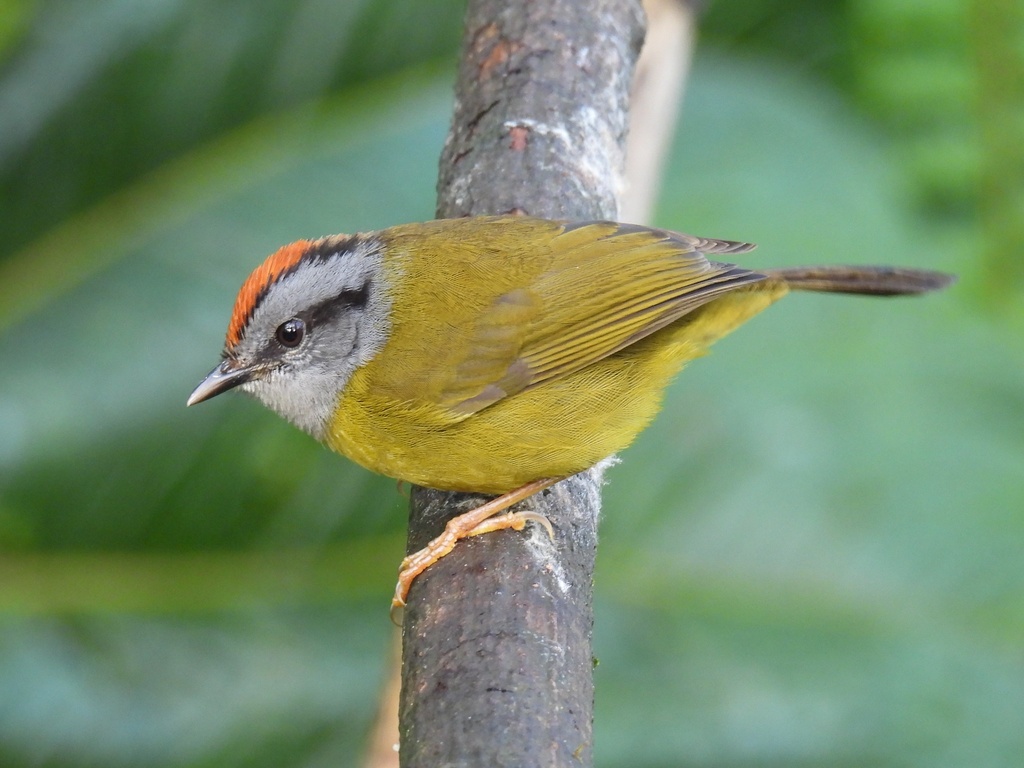
Russet-crowned Warbler
Live sightings near you, the range map, bar charts of when it is seen, and Macaulay Library photos and recordings.
Russet-crowned Warbler
Myiothlypis coronata
The russet-crowned warbler (Myiothlypis coronata) is a species of bird in the Parulidae family. It is found in Bolivia, Colombia, Ecuador, Peru, and Venezuela. Its natural habitats are subtropical or tropical moist montane forests and heavily degraded former forest.
From the article Russet-crowned warbler on Wikipedia (CC BY-SA), quoted section by section
Description
The russet-crowned warbler is about 14 cm (5.5 in) long and weighs 13.5 to 19.5 g (0.48 to 0.69 oz). The sexes have the same plumage. Adults of the nominate subspecies M. c. coronata have a mostly gray head with an orange-rufous crown stripe with black borders, a long thin black stripe through the eye, and a grayish white throat. Their upperparts, wings, and tail are olive-green with a slight bronze tinge on the upperparts. Their underparts are yellow. Juveniles have an olive-brown head, upperparts, and breast. Their median and greater wing coverts have cinnamon tips that show as two faint wing bars. Their belly is pale buffy yellow and their flanks and undertail coverts olive-buff. The other subspecies of the russet-crowned warbler differ from the nominate and each other thus:
M. c. regulus: slightly more orange crown stripe than nominate with similar upperparts M. c. elata: slightly more orange crown stripe, no bronze tinge on upperparts, and gray throat merges into olive-yellow breast M. c. orientalis greenish-gray olive upperparts and pale grayish white throat and breast becoming pale yellowish on the belly and below M. c. castaneiceps: grayish olive upperparts and grayish white underparts M. c. chapmani: pale bronze-olive upperparts and grayish white underparts M. c. inaequalis: slightly smaller than nominate with deeper olive-green upperparts with no bronze tinge M. c. …
Range & habitat
The subspecies of the russet-crowned warbler are found thus:
M. c. regulus: Venezuelan Andes from Trujillo south through Mérida and Táchira into Colombia, where present in all three Andean ranges south to Cauca and Huila departments M. c. elata: from southwestern Colombia's Nariño Department south on the western Andean slope to Guayas Province in Ecuador M. c. orientalis: eastern Andean slope through most of Ecuador M. c. castaneiceps: from Azuay, El Oro, and Loja provinces in southwestern Ecuador south into northwestern Peru's Tumbes and Piura departments M. c. chapmani: eastern Andean slope in northwestern Peru's Department of Cajamarca M. c. inaequalis: eastern Andean slope in northern Peru's Amazonas and San Martín departments M. c. coronata: eastern Andean slope from central Peru's Department of Pasco south into western Bolivia's La Paz Department M. c. notia: eastern Andean slope in central Bolivia's Cochabamba Department The russet-crowned warbler inhabits the edges and interior of humid woodlands, montane forest, and cloudforest, and also mature secondary forest with a dense understory. In elevation it ranges between 1,800 and 2,800 m (5,900 and 9,200 ft) in Venezuela, between 1,400 and 3,200 m (4,600 and 10,500 ft) in Colombia, and mostly between 1,500 and 3,000 m (4,900 and 9,800 ft) in Ecuador. …
Wikipedia: “Distribution and habitat”
What it does
The russet-crowned warbler's diet has not been studied though it is believed to feed primarily on invertebrates. It forages by gleaning from vegetation, mostly between about 1 and 6 m (3 and 20 ft) above the ground. Pairs and family groups often join mixed-species feeding flocks.
Wikipedia: “Feeding”
Listen
Looking for field recordings…
Where it lives
Recorded sightings
—
geo-referenced records in GBIF, from museums, herbaria and field observers.
Drag the globe to turn it. Dots are where records exist, not a range map; darker means more records.
In the stacks
Searching the stacks…
Every page naming Myiothlypis coronata in the Biodiversity Heritage Library →
This page is assembled live from iNaturalist, GBIF, Wikipedia, the Source Library and the Internet Archive. It is not yet part of the hand-edited codex. iNaturalist taxon 201229.