On eBird ↗
White-lored Warbler
Live sightings near you, the range map, bar charts of when it is seen, and Macaulay Library photos and recordings.
White-lored Warbler
Myiothlypis conspicillata
The white-lored warbler (Myiothlypis conspicillata) is a Near Threatened species of bird in the family Parulidae, the New World warblers. It is endemic to the Sierra Nevada de Santa Marta in Colombia.
From the article White-lored warbler on Wikipedia (CC BY-SA), quoted section by section
Description
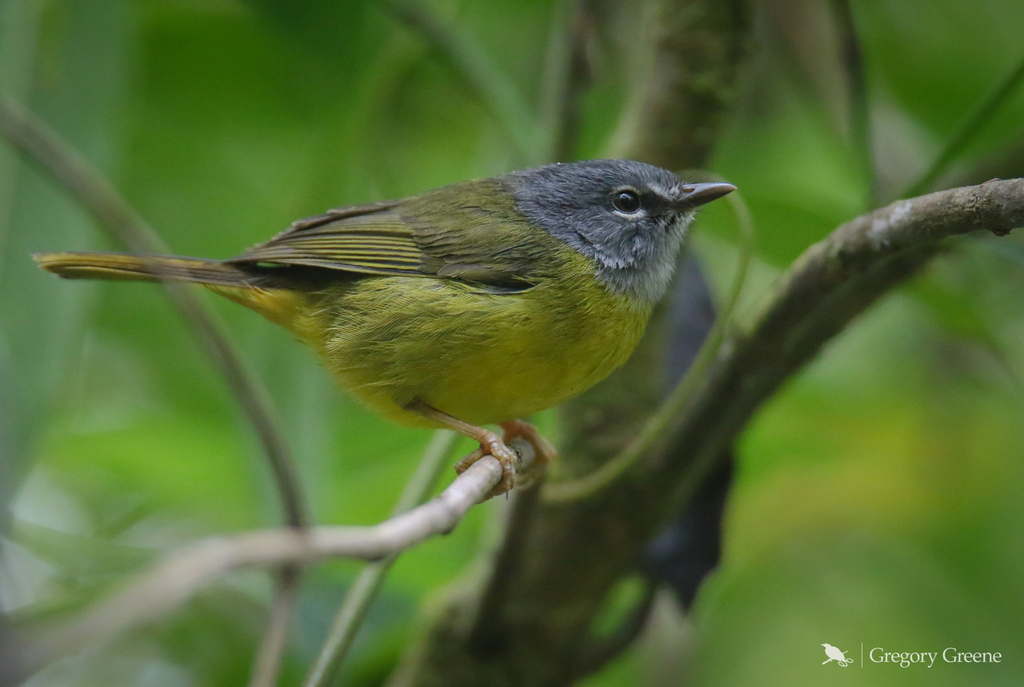
The white-lored warbler is about 14 cm (5.5 in) long and weighs about 14 g (0.49 oz). The sexes have the same plumage. Adults have a mostly gray head with a bright yellow to orange crown stripe with thin blackish borders, blackish lores, a white streak from the lores to join a wide white broken eye-ring ("spectacles"), and a pale gray throat. Their upperparts, wings, and tail are olive green. Their underparts are mostly yellow with a yellow-olive wash on the flanks. They have a brown iris, a dark gray bill, and pale orange legs and feet.
Range & habitat
The white-lored warbler is found only in the isolated Sierra Nevada de Santa Marta in northern Colombia. It primarily inhabits the edges and interior of humid premontane and montane forest and is also found in secondary forest and shade coffee plantations. While it ranges in elevation between 450 and 2,100 m (1,500 and 6,900 ft), it is most abundant between 1,000 and 1,500 m (3,300 and 4,900 ft).
Wikipedia: “Distribution and habitat”
What it does
The white-lored warbler's diet has not been studied but is believed to be mostly or entirely invertebrates. Pairs and family groups usually forage in the forest understory below about 2 m (7 ft). The species often joins mixed-species feeding flocks during the time they pass through its territory; with the flocks it may forage as high as the canopy.
Wikipedia: “Feeding”
Listen
Looking for field recordings…
Where it lives
Recorded sightings
—
geo-referenced records in GBIF, from museums, herbaria and field observers.
Drag the globe to turn it. Dots are where records exist, not a range map; darker means more records.
In the stacks
Searching the stacks…
Every page naming Myiothlypis conspicillata in the Biodiversity Heritage Library →
This page is assembled live from iNaturalist, GBIF, Wikipedia, the Source Library and the Internet Archive. It is not yet part of the hand-edited codex. iNaturalist taxon 201228.