On eBird ↗
Varzea Thrush
Live sightings near you, the range map, bar charts of when it is seen, and Macaulay Library photos and recordings.
Várzea Thrush
Turdus sanchezorum
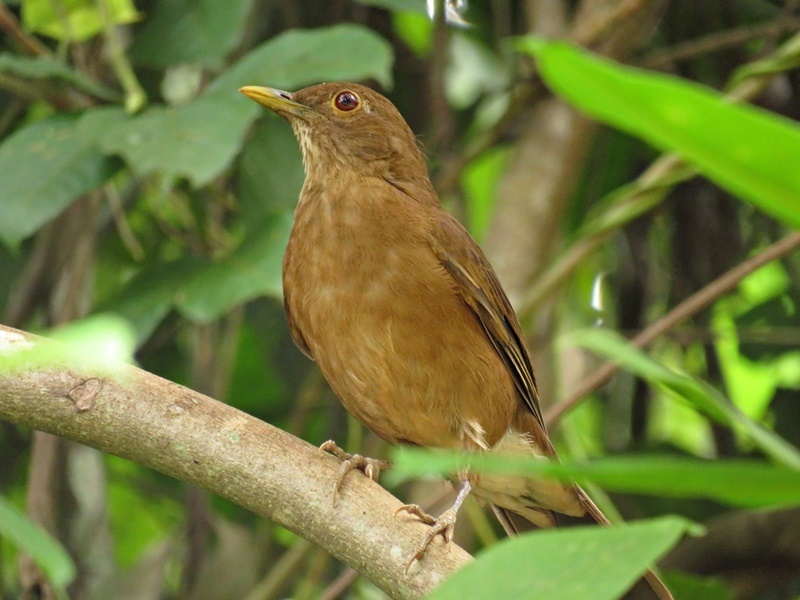
The Várzea thrush, (Turdus sanchezorum), is a resident breeding bird in the western Amazon. It is a cryptic species identified through molecular analysis of museum specimens. It was formerly considered conspecific with the Hauxwell's thrush.
From the article Várzea thrush on Wikipedia (CC BY-SA), quoted section by section
Description
The varzea thrush is about 22 to 24 cm (8.7 to 9.4 in) long and weighs about 58 g (2.0 oz). The sexes have the same plumage. Adults have a rich sepia-brown head with a dull orange eye-ring. Their upperparts are the same rich sepia-brown. Their flight feathers are dark brown with warm sepia edges on their outer webs. Their tail is grayish brown with warm sepia feather edges. Their chin and throat are warm buffy white with dusky brown streaks. Their upper breast and flanks are caramel-brown, their lower breast slightly lighter, their belly and vent whitish, and their undertail coverts whitish with brown streaks. Their underwing coverts are bright orange-rufous. They have a brown iris, a dull yellow bill with a blackish base, and olive-gray legs and feet.
Range & habitat
The varzea thrush is found along river corridors in the central and upper Amazon Basin in Brazil, Colombia, and Peru. Its range includes the Mayo, Napo, Ucayali, Urubamba, Purus, Madeira, Preto, and upper Amazon (Solimões) rivers, and the lower Amazon to somewhat beyond the mouth of the Madeira. The species is primarily a bird of várzea forest. Howerver, along the Mayo River in Peru's Department of San Martín it inhabits forest and savanna on white sand soils, though these are near várzea areas. This river differs from the others: It is a blackwater river rather than a whitewater river like the others. Overall it ranges in elevation from about 80 to 1,100 m (300 to 3,600 ft) but in San Martín is found only above 800 m (2,600 ft). As a possible addition to the species' well-known range, two recordings believed to be of the species were made in eastern Ecuador in 2022.
Wikipedia: “Distribution and habitat”
What it does
The varzea thrush is probably omnivorous though the only food items documented are fruits. It apparently forages singly and in small groups, and generally in the forest's lower levels and on the ground.
Wikipedia: “Feeding”
Listen
Looking for field recordings…
Where it lives
Recorded sightings
—
geo-referenced records in GBIF, from museums, herbaria and field observers.
Drag the globe to turn it. Dots are where records exist, not a range map; darker means more records.
In the stacks
Searching the stacks…
Every page naming Turdus sanchezorum in the Biodiversity Heritage Library →
This page is assembled live from iNaturalist, GBIF, Wikipedia, the Source Library and the Internet Archive. It is not yet part of the hand-edited codex. iNaturalist taxon 201217.