On eBird ↗
Orange Ground-Thrush
Live sightings near you, the range map, bar charts of when it is seen, and Macaulay Library photos and recordings.
Orange Ground-Thrush
Geokichla gurneyi
The orange ground thrush (Geokichla gurneyi) is a species of bird in the family Turdidae. It is found in eastern and southern Africa.
From the article Orange ground thrush on Wikipedia (CC BY-SA), quoted section by section
Description
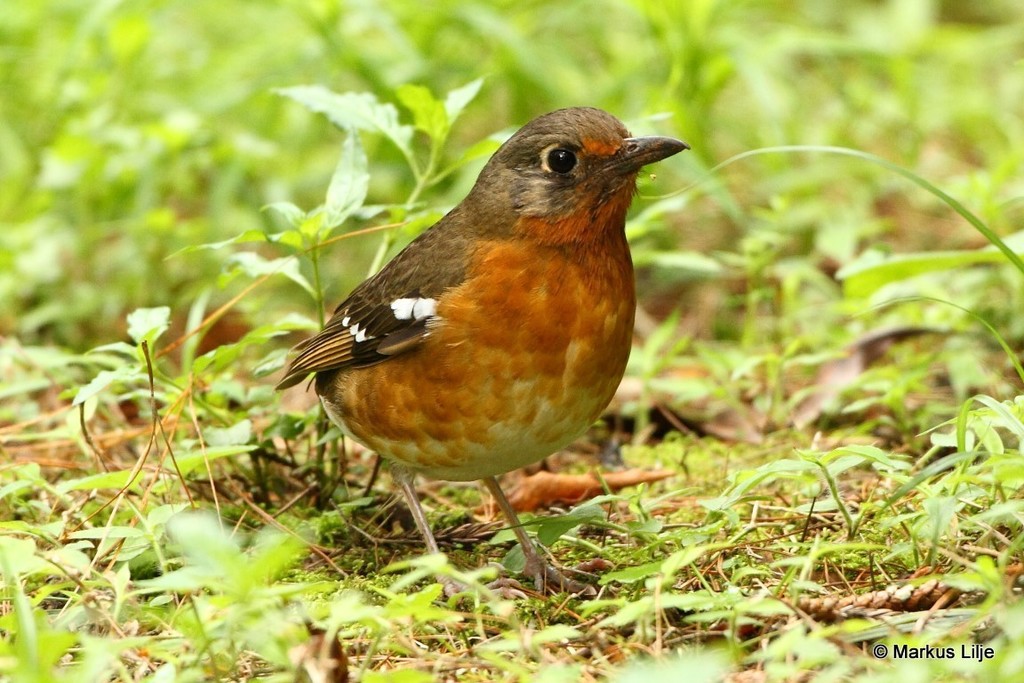
Its length is 21–23 cm (8.3–9.1 in). The male weighs 44.5–64.5 g (1.57–2.28 oz), and the female weighs 48.5–76 g (1.71–2.68 oz). The upperparts are olive-brown; some parts have a grey tinge. The flight feathers are blackish-brown. There are two bars on the wing. The throat, breast and flanks are orange. The vent is white. There is an incomplete white eye-ring. The beak is dark. The legs are pink. The female is similar to the male but is less bright. The immature has mottled underparts.
Range & habitat
Its habitat is montane forests, namely the afromontane of southeastern Africa. The size of its range is estimated at 5,370,000 km2 (2,070,000 sq mi). It is found at elevations of 500–2,500 m (1,600–8,200 ft).
Wikipedia: “Distribution and habitat”
What it does
The orange ground thrush is crepuscular. It is sedentary, but makes altitudinal movements in some regions. Its call is tsip and cureek. Its song is a series of several mellow and melodious notes. It feeds on the ground. Its diet is earthworms, insects, molluscs and fruits. The breeding season is January to May in Kenya, August to December in Tanzania, October to January in Malawi, and September to December in Mozambique, South Africa and Zimbabwe. In breeding pairs, the female has been observed to consistently weigh more than the male. The nest is a deep cup built of moss, twigs, leaves, roots and ferns. There are 2 to 3 turquoise-blue eggs. The eggs are incubated for 15 days. The fledging period is 18 to 20 days.
Wikipedia: “Behaviour”
Listen
Looking for field recordings…
Where it lives
Recorded sightings
—
geo-referenced records in GBIF, from museums, herbaria and field observers.
Drag the globe to turn it. Dots are where records exist, not a range map; darker means more records.
In the stacks
Searching the stacks…
Every page naming Geokichla gurneyi in the Biodiversity Heritage Library →
This page is assembled live from iNaturalist, GBIF, Wikipedia, the Source Library and the Internet Archive. It is not yet part of the hand-edited codex. iNaturalist taxon 201203.