On eBird ↗
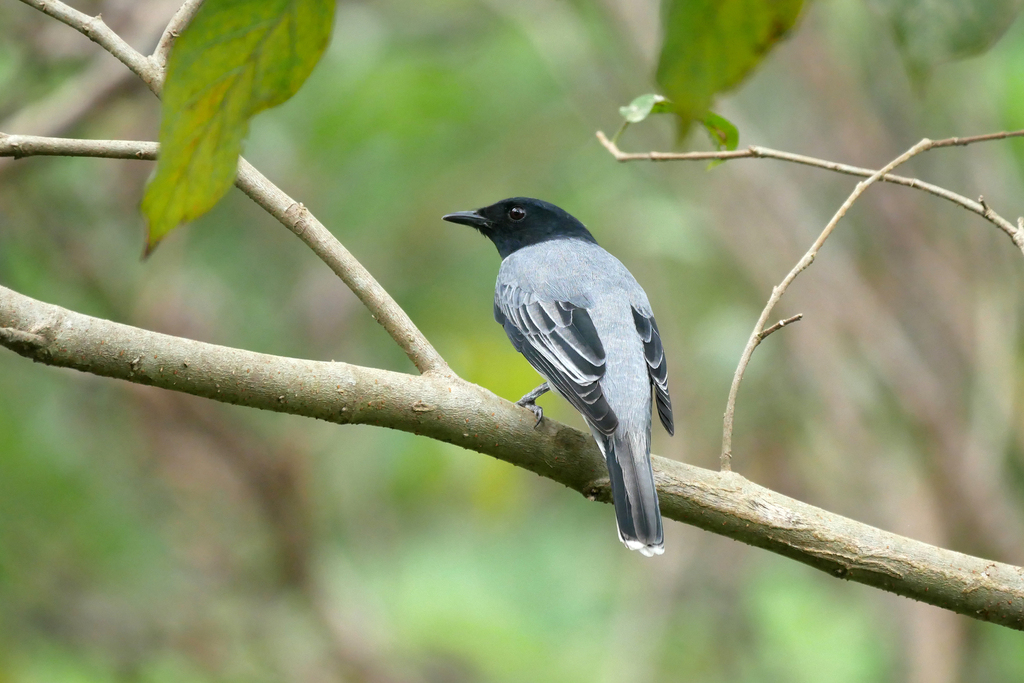
Black-headed Cuckooshrike
Live sightings near you, the range map, bar charts of when it is seen, and Macaulay Library photos and recordings.
Black-headed Cuckooshrike
Lalage melanoptera
The black-and-white triller (Lalage melanoleuca) is a species of bird in the family Campephagidae. It is endemic to the Philippines.
From the article Black-headed cuckooshrike on Wikipedia (CC BY-SA), quoted section by section
Description
The Black-headed Cuckooshrike is a 18-20 cm slender bird found in the Indian subcontinent with distinct sexual dimorphism. Males feature a dark slaty-grey hood, neck, and upper breast, contrasting with a pale grey back and white belly. They have blackish wings with grey edges and white-tipped tail feathers. The females are duller, with brownish-grey upperparts, a whitish supercilium (eyebrow), and heavily barred underparts with a dark grey bill.
Range & habitat
This is a resident and partially bird migratory that is found across the Indian subcontinent, including India, Bangladesh, Sri Lanka, Nepal, and Bhutan, extending to Myanmar. It inhabits open, dry-deciduous, or semi-evergreen forests, secondary growth, bamboo patches, and, frequently, urban gardens, orchards, and agricultural plantations up to 2,100 meters, typically preferring lower altitudes. Primarily distributed across India (from the Himalayan foothills in the north to the peninsula, including Rajasthan, Gujarat, Maharashtra, and Kerala), with breeding populations in Nepal and Sri Lanka. While mostly resident, it is a summer breeding visitor in the Himalayan foothills and North India, often moving to southern regions or lower altitudes during the winter. They prefer open wooded habitats over thick, dense forests. Common in scrub-jungle, wooded suburban areas, and mixed deciduous woodlands.
Wikipedia: “Distribution and habitat”
What it does
They are arboreal, foraging in the canopy of tall trees. They move methodically from tree to tree, searching foliage for prey, often joining mixed-species foraging flocks. They have an undulating, "dipping" flight pattern. and like other cuckooshrikes, they have a characteristic habit of rearranging or shuffling their wings upon landing. Often quiet, their song is a series of clear, mellow, whistled notes ("twit-wit-wit-wee-twéé-twéé-twy-twy-twy"). They also produce a rapid, high-pitched call. They are primarily insectivorous, favoring caterpillars (Lepidoptera), beetles, ants, and cicadas. They supplement their diet with fruits, including Lantana berries and figs.
Wikipedia: “Behaviour and diet”
Listen
Looking for field recordings…
Where it lives
Recorded sightings
—
geo-referenced records in GBIF, from museums, herbaria and field observers.
Drag the globe to turn it. Dots are where records exist, not a range map; darker means more records.
In the stacks
Searching the stacks…
Every page naming Lalage melanoptera in the Biodiversity Heritage Library →
This page is assembled live from iNaturalist, GBIF, Wikipedia, the Source Library and the Internet Archive. It is not yet part of the hand-edited codex. iNaturalist taxon 201113.