On eBird ↗
Nullarbor Quail-thrush
Live sightings near you, the range map, bar charts of when it is seen, and Macaulay Library photos and recordings.
Nullarbor Quailthrush
Cinclosoma alisteri
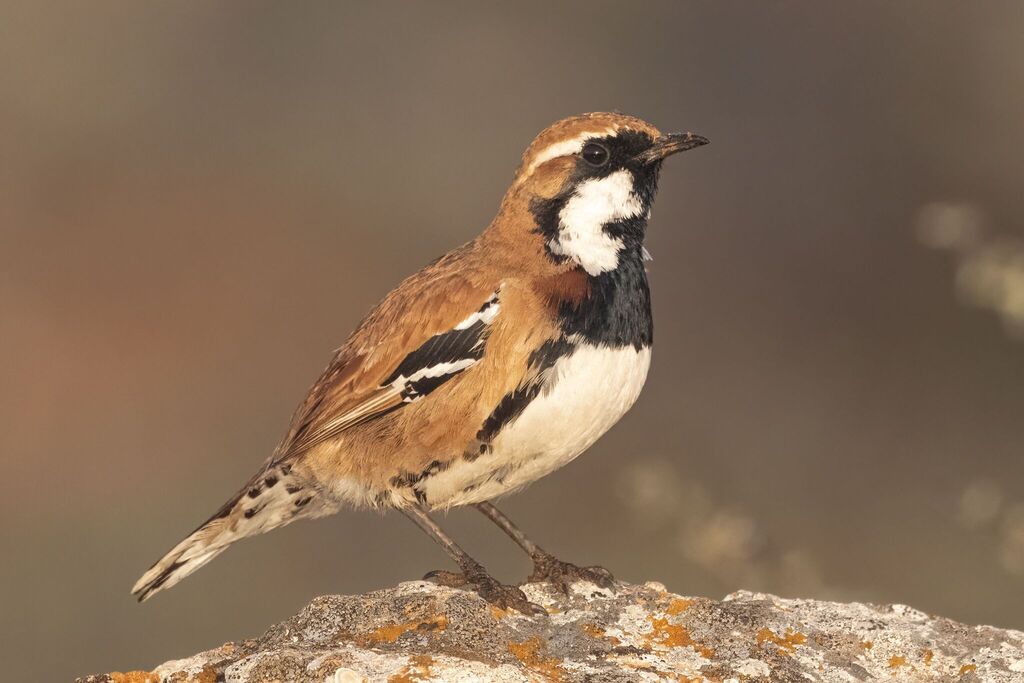
The Nullarbor quail-thrush (Cinclosoma alisteri) is a species of bird in the family Cinclosomatidae. It is the only Australian bird endemic to the Nullarbor Plain in southern Australia.
From the article Nullarbor quail-thrush on Wikipedia (CC BY-SA), quoted section by section
Description
The size of the male is slightly larger than the female, the range is 185 to 210 millimetres. The tail colour is black at the outer feathers, tipped with white, the upper parts of the plumage is otherwise a rufous colour. Black coloration appears at the lores, throat, breast, and beneath white spots at the shoulder.
Range & habitat
The range is restricted to the Nullarbor Plain, an area in southern Australia that extends across the Western and South Australian border. The habitat favoured by this species is described as limestone gibber plains, containing little overlying vegetation, and shrub-dominated plant communities on the steppe. Two other species of the genus are populations that also resulted from the increasing aridity of the Australian continent: the chestnut quail-thrush Cinclosoma castanotum has a wider distribution that overlaps with this species; and the cinnamon quail-thrush Cinclosoma cinnamomeum which is only found to the north of the Nullarbor.
Wikipedia: “Distribution and habitat”
What it does
A ground-feeding bird that is usually only evident while foraging, Cinclosoma alisteri actively moves over a range, although in a haphazard manner, turning stones in search of seeds and small invertebrates. This quail-thrush is able to see anything approaching for a considerable distance on the plains, and will quickly seek refuge beneath a shrub or in the burrows created by the introduced rabbit. During the breeding season a pair will defend a territory, but at other times they are found in groups of around individuals. Breeding may occur at any opportune time of the year, but always during a period from August to September. The site selected for breeding may be a slight depression scraped into the earth by the female, but is often against a bush, rock, or patch of grass and lined with strips of plant material. The clutch size is usually two eggs, measuring 28 by 20 mm, which are a creamy white colour with brownish or greyish spots.
Wikipedia: “Behaviour”
Listen
Looking for field recordings…
Where it lives
Recorded sightings
—
geo-referenced records in GBIF, from museums, herbaria and field observers.
Drag the globe to turn it. Dots are where records exist, not a range map; darker means more records.
In the stacks
Searching the stacks…
Every page naming Cinclosoma alisteri in the Biodiversity Heritage Library →
This page is assembled live from iNaturalist, GBIF, Wikipedia, the Source Library and the Internet Archive. It is not yet part of the hand-edited codex. iNaturalist taxon 201103.