- Animals
- ›Chordates
- ›Vertebrates
- ›Birds
- ›Woodpeckers and Allies
- ›Woodpeckers
- ›Typical woodpeckers
- ›Campephilini
- ›Chrysocolaptes
On eBird ↗
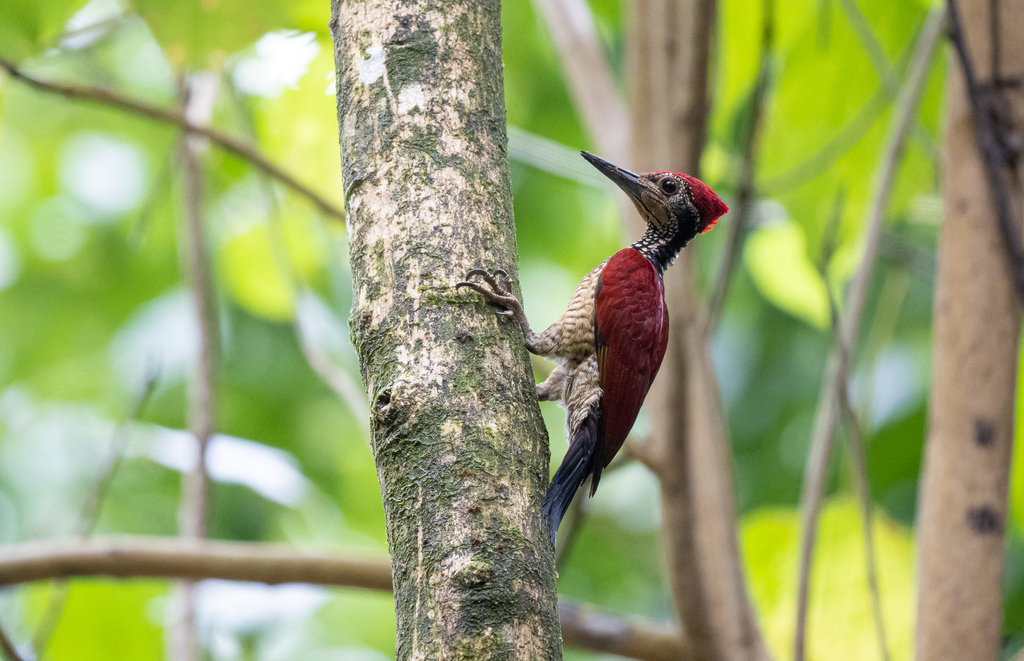
Luzon Flameback
Live sightings near you, the range map, bar charts of when it is seen, and Macaulay Library photos and recordings.
Luzon Flameback
Chrysocolaptes haematribon
The Luzon flameback (Chrysocolaptes haematribon) is a species of bird in the family Picidae. It is found on the northern islands of Luzon, Polillo, Catanduanes and Marinduque, Philippines. It is sometimes considered a subspecies of the greater flameback.
From the article Luzon flameback on Wikipedia (CC BY-SA), quoted section by section
Description
Large sized woodpecker with a red back hence the name and a yellowish belly. Males and females are sexually dimorphic. Males have a red crest while the females have a more drab black crest with white spots.
Range & habitat
Its natural habitats are tropical moist lowland forests and less often on tropical moist montane forests up to 1,500 masl. It is threatened by habitat loss, and the illegal wildlife trade. It is possibly extinct on Marinduque IUCN has assessed this bird as a Least-concern species as it remains locally common in suitable habitat. This species is believed to be declining due to habitat loss. It is found in multiple protected areas such as Mount Banahaw, Mount Makiling, Mount Isarog, Bataan National Park and Northern Sierra Madre Natural Park but like all areas in the Philippines, protection is lax and deforestation and hunting continues despite this protection on paper.
Wikipedia: “Habitat and conservation status”
What it does
Not much is known about this species specific diet but based on other flameback species it is presumed to feed on large caterpillars, wood-boring larvaes, pupaes and ants. It is often seen foraging on larger trees and snags pecking and hammering the wood to find insects. Often seen in pairs or small family groups and even with White-bellied woodpecker and Northern sooty woodpecker. Nests in tree cavities. Breeding is believed to occur from January to May. The very similar and well studied Greater flameback lays 2 to 5 eggs which incubate in 2 weeks and fledge within a month.
Wikipedia: “Ecology and behavior”
Listen
Looking for field recordings…
Where it lives
Recorded sightings
—
geo-referenced records in GBIF, from museums, herbaria and field observers.
Drag the globe to turn it. Dots are where records exist, not a range map; darker means more records.
In the stacks
Searching the stacks…
Every page naming Chrysocolaptes haematribon in the Biodiversity Heritage Library →
This page is assembled live from iNaturalist, GBIF, Wikipedia, the Source Library and the Internet Archive. It is not yet part of the hand-edited codex. iNaturalist taxon 201083.