On eBird ↗
Sira Barbet
Live sightings near you, the range map, bar charts of when it is seen, and Macaulay Library photos and recordings.
Sira Barbet
Capito fitzpatricki
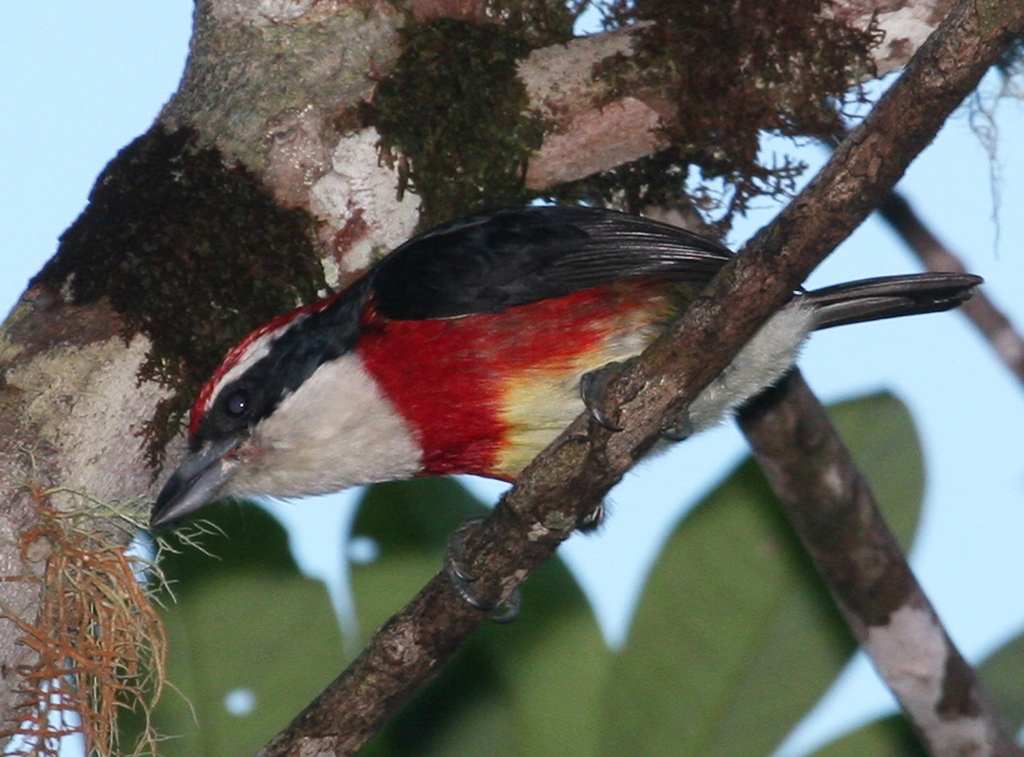
The Sirá barbet (Capito fitzpatricki) is a bird in the family Capitonidae, the New World barbets. It is endemic to the Cerros del Sira of east-central Peru.
From the article Sira barbet on Wikipedia (CC BY-SA), quoted section by section
Description
The Sira barbet is approximately 19.5 to 20 cm (7.7 to 7.9 in) long and weighs 70 to 79 g (2.5 to 2.8 oz). The adult male's crown and nape are crimson. It has a band of white, fairly wide at the shoulders tapering to the tail; the rest of the upperparts are black. It has a broad white supercilium and a black "mask". The rest of its face, throat, neck, and upper chest are white. A broad crimson band crosses the chest and extends along the flanks where it meets a variable amount of black or gray. The rest of the underparts are white. The female's plumage has minor differences from the male's. The Sira barbet is distinguished from the scarlet-banded barbet by differences in morphology and plumage, particularly the color on the bird's flanks, lower back and thighs, and it has a wider, darker scarlet breast band. DNA sequencing was also used to confirm the Sira barbet's status as a distinct species.
Range & habitat
The Sira barbet is found only on the eastern slope of the southern Cerros del Sira, Ucayali Department, Peru. Eight specimens were collected from the upper Río Shinipo 10°31′48″S 74°07′12″W and Río Tzipani valleys 10°41′24″S 74°05′56″W, and a further two at Quebrada Quirapokiari 10°25′12″S 74°09′00″W in July 2011. Its range is sympatric and syntopic with that of the gilded barbet, and coincides with the boundary and sections of the Sira Communal Reserve. It primarily inhabits the highest stratum of tall (up to 30 m (98 ft)) montane forest with arboreal epiphytes and moss above a sparsely vegetated understory. It is also found in shorter forest with a thicker understory. In elevation it ranges as high as 1,700 m (5,600 ft) but is mostly found between 950 and 1,250 m (3,120 and 4,100 ft).
Wikipedia: “Distribution and habitat”
What it does
The Sira barbet forages in the forest canopy and subcanopy. It was observed in pairs, small groups of the same species, and in mixed-species foraging flocks. It feeds primarily on fruits and takes small numbers of insects as well.
Wikipedia: “Feeding”
Listen
Looking for field recordings…
Where it lives
Recorded sightings
—
geo-referenced records in GBIF, from museums, herbaria and field observers.
Drag the globe to turn it. Dots are where records exist, not a range map; darker means more records.
In the stacks
Searching the stacks…
Every page naming Capito fitzpatricki in the Biodiversity Heritage Library →
This page is assembled live from iNaturalist, GBIF, Wikipedia, the Source Library and the Internet Archive. It is not yet part of the hand-edited codex. iNaturalist taxon 201079.