On eBird ↗
Cuban Nightjar
Live sightings near you, the range map, bar charts of when it is seen, and Macaulay Library photos and recordings.
Cuban Nightjar
Antrostomus cubanensis
The Cuban nightjar (Antrostomus cubanensis), is a species of nightjar in the family Caprimulgidae. It is commonly found in Cuba, Cayo Coco and the Isle of Pines. Its natural habitats are subtropical or tropical moist lowland forests and subtropical or tropical moist montane forests.
From the article Cuban nightjar on Wikipedia (CC BY-SA), quoted section by section
Description
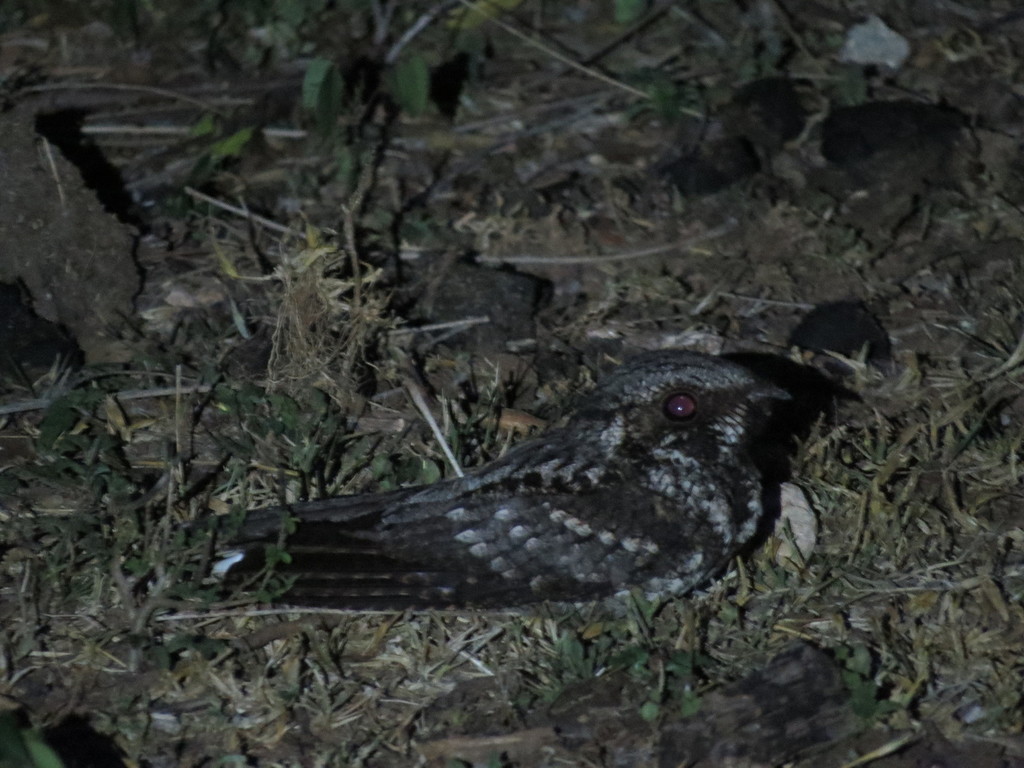
The Cuban nightjar's subspecies A. c. cubanensis is 25 to 29.5 cm (9.8 to 12 in) long. Males weigh approximately 76 g (2.7 oz) and females 70 g (2.5 oz). Their upperparts are dark brown speckled with grayish buff, pale buff, and grayish brown. The tail is brown and the three outer pairs of feathers are tipped with white (male) or buff (female). The innermost pair has grayish brown chevrons. The wings are brown with spots, bars, and mottling of lighter shades. The face is tawny with dark brown speckles, the chin and throat dark brown with cinnamon speckles, the breast dark brown with large spots and smaller speckles of buffy white, and the belly and flanks dark brown with gray speckles. A. c. insulaepinorum is smaller, much darker, and has a shorter tail.
Range & habitat
The nominate subspecies of Cuban nightjar is found on the main island of Cuba and most of the small adjoining islands of the archipelago. A. c. insulaepinorum is found only on Isla de la Juventud ("Isle of Youth", formerly the Isle of Pines). They inhabit landscapes described by different authors as "dense scrub", "open woodland and the edges of swamps", and "rather dense forest".
Wikipedia: “Distribution and habitat”
What it does
The Cuban nightjar is crepuscular and nocturnal. Its prey is insects that it captures in flight, though whether that is during continuous flight or by sallies from a perch or the ground is not known.
Wikipedia: “Feeding”
Listen
Looking for field recordings…
Where it lives
Recorded sightings
—
geo-referenced records in GBIF, from museums, herbaria and field observers.
Drag the globe to turn it. Dots are where records exist, not a range map; darker means more records.
In the stacks
Searching the stacks…
Every page naming Antrostomus cubanensis in the Biodiversity Heritage Library →
This page is assembled live from iNaturalist, GBIF, Wikipedia, the Source Library and the Internet Archive. It is not yet part of the hand-edited codex. iNaturalist taxon 201067.