On eBird ↗
Seychelles Blue-Pigeon
Live sightings near you, the range map, bar charts of when it is seen, and Macaulay Library photos and recordings.
Seychelles Blue-Pigeon
Alectroenas pulcherrimus
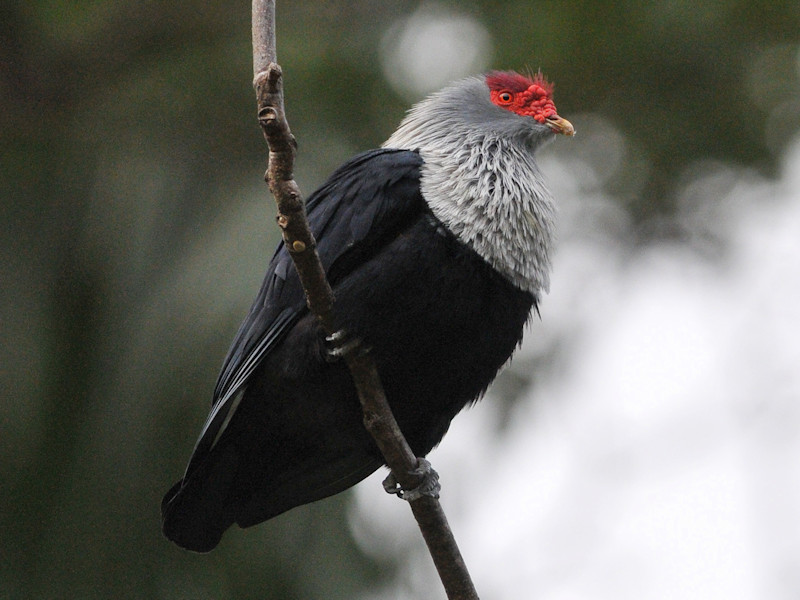
The Seychelles blue pigeon (Alectroenas pulcherrimus), also known as the Seychelles blue fruit dove, is a medium-sized pigeon which inhabits woodland areas of the granitic Seychelles archipelago.
From the article Seychelles blue pigeon on Wikipedia (CC BY-SA), quoted section by section
Description
The Seychelles blue pigeon is about 10 inches (25.4 cm) in length. Its head and breast are silver-grey, and these feathers can be raised when the bird is excited, giving it a ruffled look. Its wings, under-body and tail are dark blue. It has a distinctive bright crimson patch of orbital skin extending from forehead to crown. Its bill is dull yellow and it has dark grey legs. The juvenile is very different, with a dark grey head and bib, dark greenish brown upperparts with pale yellow fringes, dark crown feathers with obvious green edges and a dark pink wattle around the eye.
Range & habitat
The Seychelles blue pigeon is found on all the larger granitic islands of the Seychelles, plus Denis Island and Bird Island on the edge of the Seychelles Bank. Numbers have greatly increased since the cessation of human exploitation for food, a practice that died out around the late 1970s. Since then birds have recolonised Curieuse (early 1980s), Denis (late 1980s), Aride Island (1990) and Bird (2009).
Wikipedia: “Distribution and habitat”
What it does
It can be found either singly, in pairs or in small groups. In courtship birds fly high above the tree canopy, before plummeting downward at a steep angle, wings held rigidly forward and downward. This procedure may be repeated before landing in a tree. The male bows and coos to the female, raising plume feathers on the neck and head or struts up and down a branch plumes extended, turning his head 180°, then back again.
Breeding. Breeding may take place at any time of the year, but is concentrated in October to April. The nest, built entirely by the female, is an untidy platform of twigs in a tree or shrub. Usually one white egg is laid, occasionally two. Incubation takes about 28 days, fledging about 21 days.
Wikipedia: “Behaviour”
Listen
Looking for field recordings…
Where it lives
Recorded sightings
—
geo-referenced records in GBIF, from museums, herbaria and field observers.
Drag the globe to turn it. Dots are where records exist, not a range map; darker means more records.
In the stacks
Searching the stacks…
Every page naming Alectroenas pulcherrimus in the Biodiversity Heritage Library →
This page is assembled live from iNaturalist, GBIF, Wikipedia, the Source Library and the Internet Archive. It is not yet part of the hand-edited codex. iNaturalist taxon 201056.