On eBird ↗
Mauritius Blue-Pigeon
Live sightings near you, the range map, bar charts of when it is seen, and Macaulay Library photos and recordings.
Mauritius Blue-Pigeon
Alectroenas nitidissimus
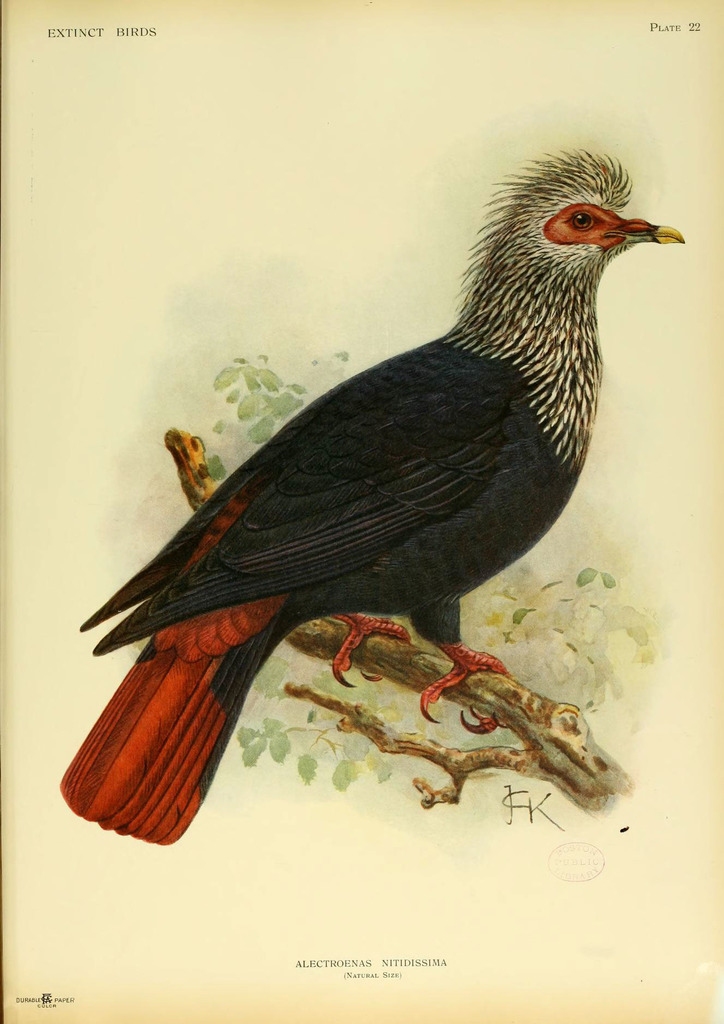
The Mauritius blue pigeon (Alectroenas nitidissimus) is an extinct species of blue pigeon formerly endemic to the Mascarene island of Mauritius in the Indian Ocean east of Madagascar. It has two extinct relatives from the Mascarenes and three extant ones from other islands. It is the type species of the genus of blue pigeons, Alectroenas. It had white hackles around the head, neck and breast and blue plumage on the body, and it was red on the tail and the bare parts of the head. These colours were thought similar to those of the Dutch flag, a resemblance reflected in its French common name, Pigeon Hollandais. The juveniles may have been partially green. It was 30 cm (12 in) long and larger and more robust than any other blue pigeon species. It fed on fruits, nuts, and molluscs, and was once widespread in the forests of Mauritius.
The bird was first mentioned in the 17th century and was described several times thereafter, but very few accounts describe the behaviour of living specimens. The oldest record of the species is two sketches from a 1601–1603 ship's journal. Several stuffed specimens reached Europe in the 18th and 19th centuries, while only three stuffed specimens exist today. A live bird kept in the Netherlands around 1790 was long thought to have been a Mauritius blue pigeon, but examination of illustrations depicting it have shown it was most likely a Seychelles blue pigeon. The species is thought to have become extinct in the 1830s due to deforestation and predation.
From the article Mauritius blue pigeon on Wikipedia (CC BY-SA), quoted section by section
Description
The feathers on the head, neck and breast of the Mauritius blue pigeon were silvery white, long, stiffened and pointed, especially around the neck. A patch of bright red, naked skin surrounded the eyes, and extended across the cheeks to the beak, which was greenish with a dark tip. The plumage of the body was indigo, and the back, scapular feathers and wings were metallic blue. The bases of the outer rectrices were partially blackish blue. The tail feathers and tail coverts were maroon. The bill was greenish with a darker tip, and the legs were dark slate-grey. The iris was reddish orange and had an inner yellow ring. The bird was 30 cm (12 in) in length, the wings were 208 mm (8.2 in), the tail was 132 mm (5.2 in), the culmen was 25 mm (1 in), and the tarsals were 28 mm (1.10 in). It was the largest and most robust member of its genus, and the hackles were longer and covered a larger area than in other blue pigeons. A Mauritian woman recalling observations of Mauritius blue pigeons around 1815 mentioned green as one of its colours. Juvenile Seychelles and Comoro blue pigeons have green feathers, so this may also have been the case for juvenile Mauritian pigeons. Some depictions and descriptions have shown the legs of Mauritius blue pigeons as red, like those of the Madagascar blue pigeon. …
What it does
Few descriptions of the behaviour of Mauritius blue pigeons are known; unpublished notes by Desjardins are now lost. The bird probably lived in pairs or small groups in humid, mountainous evergreen forests, like their extant relatives. Subfossil remains have been found in mid-west, mid-east and south-east Mauritius, indicating that the bird was once widespread. By 1812, the French naturalist Jacques Gérard Milbert stated that solitary individuals were found in river valleys. They probably became rarer during French rule in Mauritius (1715–1810), as lowland areas of the island were almost completely deforested during this time. Many other endemic species of Mauritius became extinct after the arrival of humans, so the ecosystem of the island is severely damaged and hard to conserve. Before humans arrived, forests covered Mauritius entirely, but very little remains today because of deforestation. The surviving endemic fauna is still seriously threatened. The Mauritius blue pigeon lived alongside other recently extinct Mauritian birds such as the dodo, the red rail, the Mascarene grey parakeet, the broad-billed parrot, the Mauritius scops owl, the Mascarene coot, the Mauritian shelduck, the Mauritian duck and the Mauritius night heron. …
Wikipedia: “Behaviour and ecology”
Listen
Looking for field recordings…
Where it lives
Recorded sightings
—
geo-referenced records in GBIF, from museums, herbaria and field observers.
Drag the globe to turn it. Dots are where records exist, not a range map; darker means more records.
In the stacks
Searching the stacks…
Every page naming Alectroenas nitidissimus in the Biodiversity Heritage Library →
This page is assembled live from iNaturalist, GBIF, Wikipedia, the Source Library and the Internet Archive. It is not yet part of the hand-edited codex. iNaturalist taxon 201055.