On eBird ↗
Philippine Collared-Dove
Live sightings near you, the range map, bar charts of when it is seen, and Macaulay Library photos and recordings.
Philippine Collared-Dove
Streptopelia dusumieri
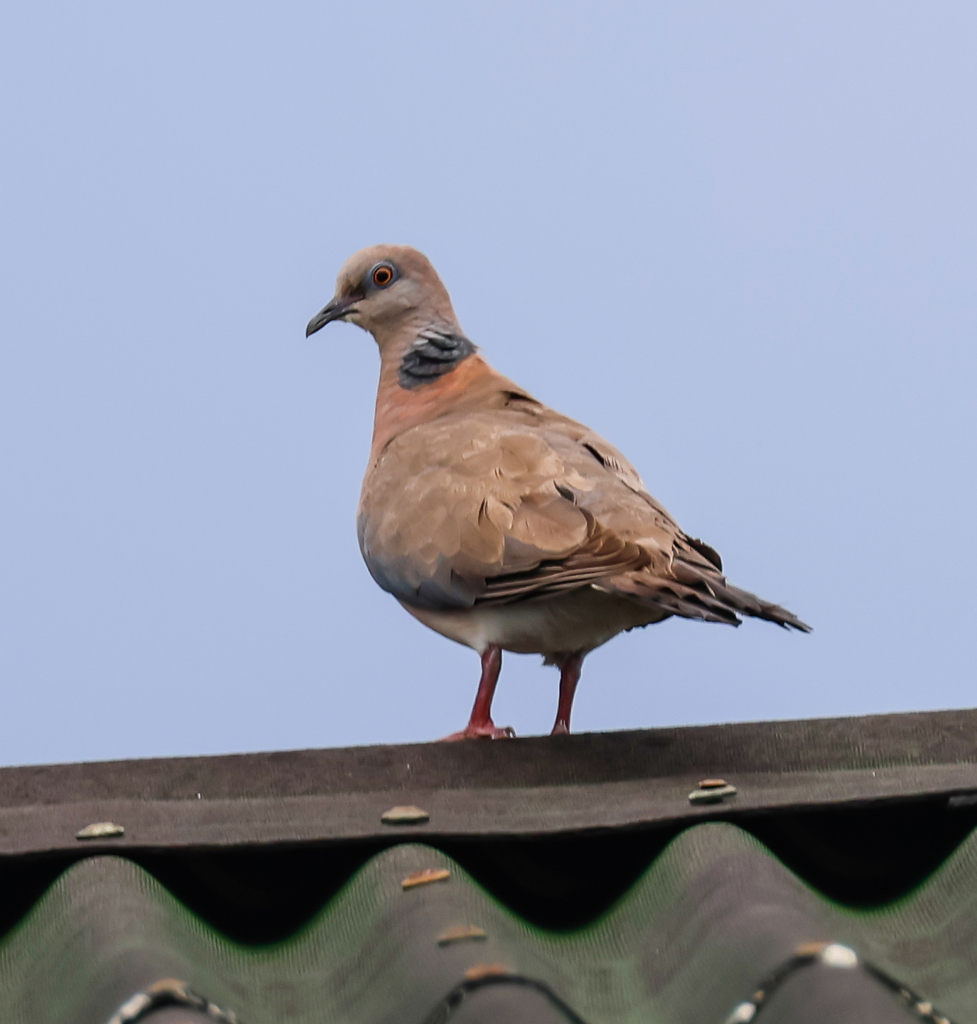
The Philippine collared dove (Streptopelia dusumieri) is a species of bird in the family Columbidae. It was formerly considered a subspecies of the island collared dove (S. bitorquata).
The species occurs in the Philippines where it is called locally as bato-bato de collar. It has also been introduced into Guam and the Northern Mariana Islands, although the population on Guam has been severely reduced by introduced brown tree snakes.
From the article Philippine collared dove on Wikipedia (CC BY-SA), quoted section by section
Description
This species is described as a large brownish dove found in the open forest and even urban areas. It is primarily light brown with a pinkish wash on the breast and enck. It has a collar with a scaly black stripe and a grayish white head. Its call is described as melancholic coo repeated at regular intervals. Was considered conspecific with the Sunda collared dove as part of the Island collared dove species complex. Differs in a stronger contrast black and white tail but a weaker contrast in the undertail, a paler collar with a green sheen and scales and no white band, rusty pink plummage, shorter bill and a different song. This species is monotypic and has no subspecies.
Wikipedia: “Description and taxonomy”
Range & habitat
An open country species inhabiting grassland and agricultural land with trees and scrub, while introduced populations are found in urban areas. Breeding has been recorded in March and May in the Philippines. IUCN has assessed this bird as vulnerable with its population continuing to decline despite its tolerance for open habitat and proximity to urban areas. Its main threat is heavy interspecific competition from spotted doves and red collared doves. In Guam where the birds are still fairly common, nest success rate is just 2 to 5% in urban areas and 0 to 3% in forest habitat. Conservation actions proposed to clarify nature and extent of threat from spotted doves and red collared doves are identification of remaining strongholds, monitoring of population trends, and assessment of desirability and feasibility of the control of competing species.
Wikipedia: “Habitat and conservation status”
What it does
This species' diet has yet to be studied comprehensively but it is presumed to be the same as the Sunda collared dove which feeds mostly on seeds and feeds from the ground. It is typically observed singly or in pairs. Breeding season is March to May. Nests 1 to 7 meters from the ground in branches in low trees at clearings, fishponds and mangroves. Nest is described as a typical flimsy dove nest consisting on messily arranged twigs. Clutch size is 2 to 3 eggs.
Wikipedia: “Ecology and behavior”
Listen
Looking for field recordings…
Where it lives
Recorded sightings
—
geo-referenced records in GBIF, from museums, herbaria and field observers.
Drag the globe to turn it. Dots are where records exist, not a range map; darker means more records.
In the stacks
Searching the stacks…
Every page naming Streptopelia dusumieri in the Biodiversity Heritage Library →
This page is assembled live from iNaturalist, GBIF, Wikipedia, the Source Library and the Internet Archive. It is not yet part of the hand-edited codex. iNaturalist taxon 201047.