- Animals
- ›Chordates
- ›Vertebrates
- ›Birds
- ›Hawks, Eagles, Kites, and Allies
- ›Hawks, Eagles, and Kites
- ›Buteonine Hawks, Kites, and allies
- ›Pseudastur
On eBird ↗
Gray-backed Hawk
Live sightings near you, the range map, bar charts of when it is seen, and Macaulay Library photos and recordings.
Gray-backed Hawk
Pseudastur occidentalis
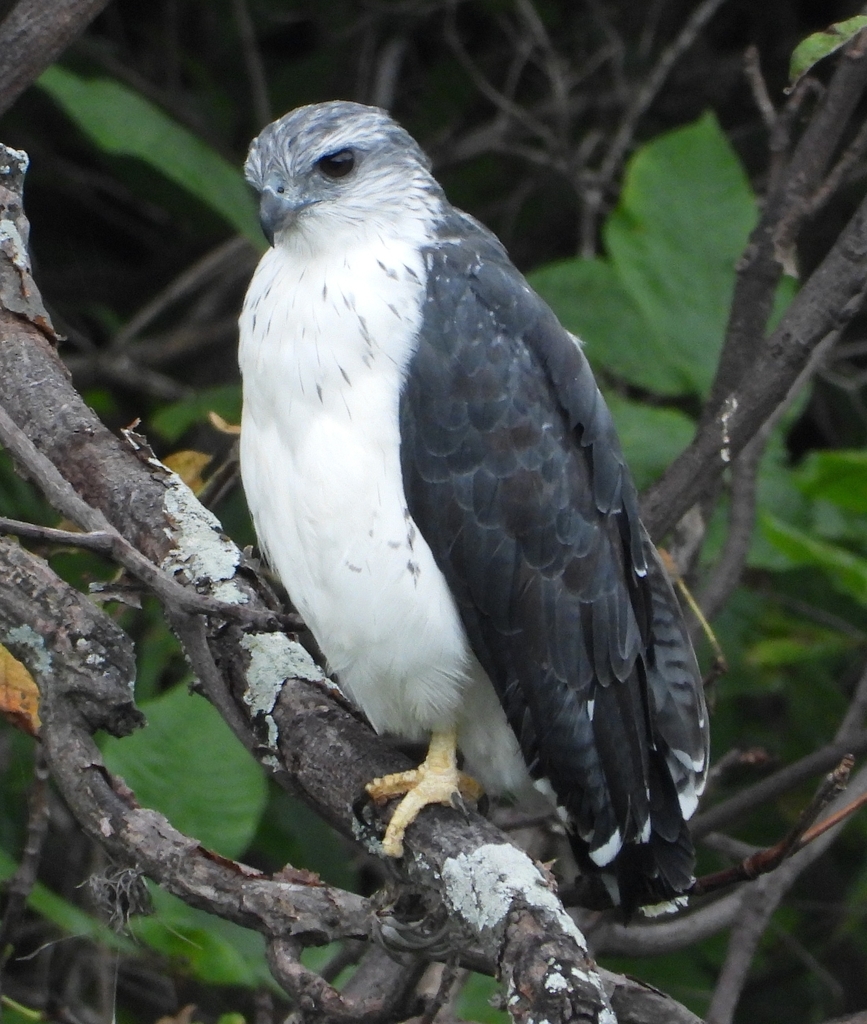
The grey-backed hawk (Pseudastur occidentalis) is a species of bird of prey in the family Accipitridae. It is found in Ecuador and far northern Peru. Its natural habitats are subtropical or tropical dry forest and subtropical or tropical moist lowland forest. It is threatened by habitat loss.
From the article Grey-backed hawk on Wikipedia (CC BY-SA), quoted section by section
Description
The grey-backed hawk is 45 to 52 cm (18 to 20 in) long with a 104 to 116 cm (41 to 46 in) wingspan. One female weighed 660 g (23 oz). Females are about 10% larger than males and both sexes have the same plumage. Adults have a gray and white streaked head, nape, and mantle. They have blackish gray upperparts and a mostly white tail with a wide black band near the end. Their eye is dark brown, their cere gray, and their legs and feet pale yellow. Immatures have brownish gray upperparts, a dusky-striped nape, and gray spots on the breast.
Range & habitat
The grey-backed hawk is found locally in western Ecuador between southern Esmeraldas and Loja provinces and slightly into Peru's Department of Tumbes. It inhabits subtropical and tropical semi-deciduous and evergreen forest, cloudforest, and secondary forest. It prefers moist areas and is often found in steep ravines. In elevation it mostly ranges between 100 and 1,400 m (330 and 4,600 ft) but occurs as high as 2,900 m (9,500 ft).
Wikipedia: “Distribution and habitat”
What it does
The grey-backed hawk's hunting method and diet are not well defined. It has been recorded hunting over streams and croplands and sometimes up to four will hunt together. Its diet includes reptiles, amphibians, crabs, rodents, birds, and large insects.
Wikipedia: “Feeding”
Listen
Looking for field recordings…
Where it lives
Recorded sightings
—
geo-referenced records in GBIF, from museums, herbaria and field observers.
Drag the globe to turn it. Dots are where records exist, not a range map; darker means more records.
In the stacks
Searching the stacks…
Every page naming Pseudastur occidentalis in the Biodiversity Heritage Library →
This page is assembled live from iNaturalist, GBIF, Wikipedia, the Source Library and the Internet Archive. It is not yet part of the hand-edited codex. iNaturalist taxon 201046.